
We read your photo as:
Simplify (y2+y-6)/(y2-4) + (y+3)/(2y2+y-1)
ScanSolve AI Answer
Step-by-step solution
13 stepsHere are the solutions to Question 56.
Question 56:
- Part (i): Simplify
Factorize the numerators and denominators of both fractions.
For the first fraction:
Numerator:
Denominator: (difference of squares)For the second fraction:
Numerator: (already in simplest form)
Denominator:Rewrite the expression with the factored terms.
Simplify the first fraction by canceling the common factor .
Find a common denominator to add the fractions.
The common denominator is .
Combine the numerators over the common denominator.
Factor out the common term from the numerator.
Expand and simplify the expression inside the square brackets in the numerator.
Substitute this back into the expression.
The final answer is .
- Part (ii): What must be added to to make it a perfect square?
Recall the formula for a perfect square trinomial.
A perfect square trinomial is of the form .
Compare the given expression with the first two terms of the perfect square form.
We have . Comparing this to , we can equate the coefficients of :
Solve for .
Determine the term that completes the square.
The value that must be added to to make it a perfect square is 9.
This results in , which is .
The final answer is .
Still stuck on this one?
Ask a follow-up, and the answer starts from this question.
More Mathematics Questions
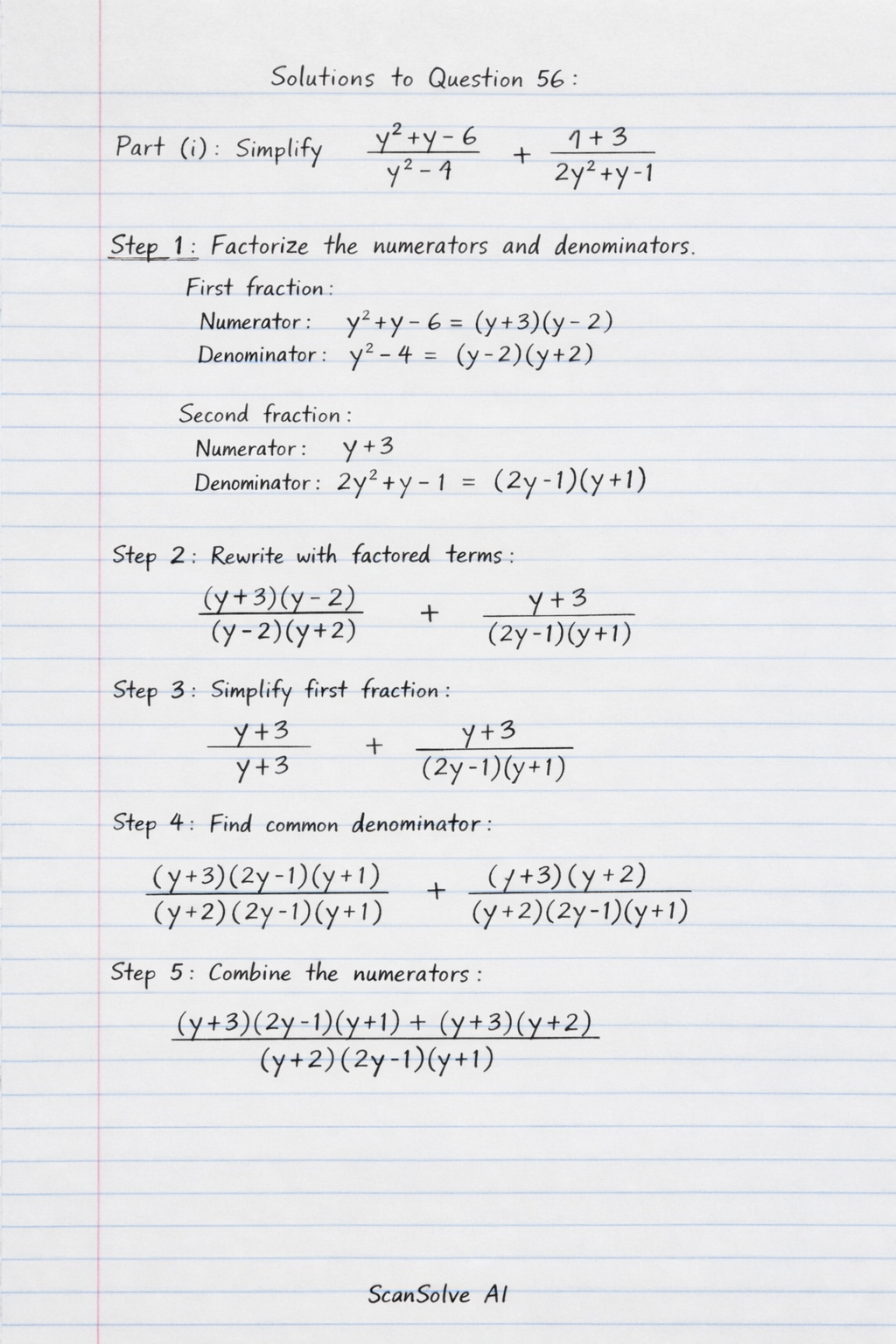
Handwritten Step-by-Step Solution
Get this as a handwritten image on WhatsApp — like a tutor wrote it for you.
Try on WhatsApp