Find the slope of the given line.
The equation of the given line is $3y = 5 - 2x$.
To find its slope, rewrite it in the slope-intercept form $y = mx + c$:
$$ 3y = -2x + 5 $$
$$ y = -\frac{2}{3}x + \frac{5}{3} $$
The slope of this line, let's call it $…
This mathematics problem involves applying core mathematical principles and formulas. Below you will find a complete step-by-step solution with detailed explanations for each step, helping you understand not just the answer but the method behind it.
ScanSolve AI Answer
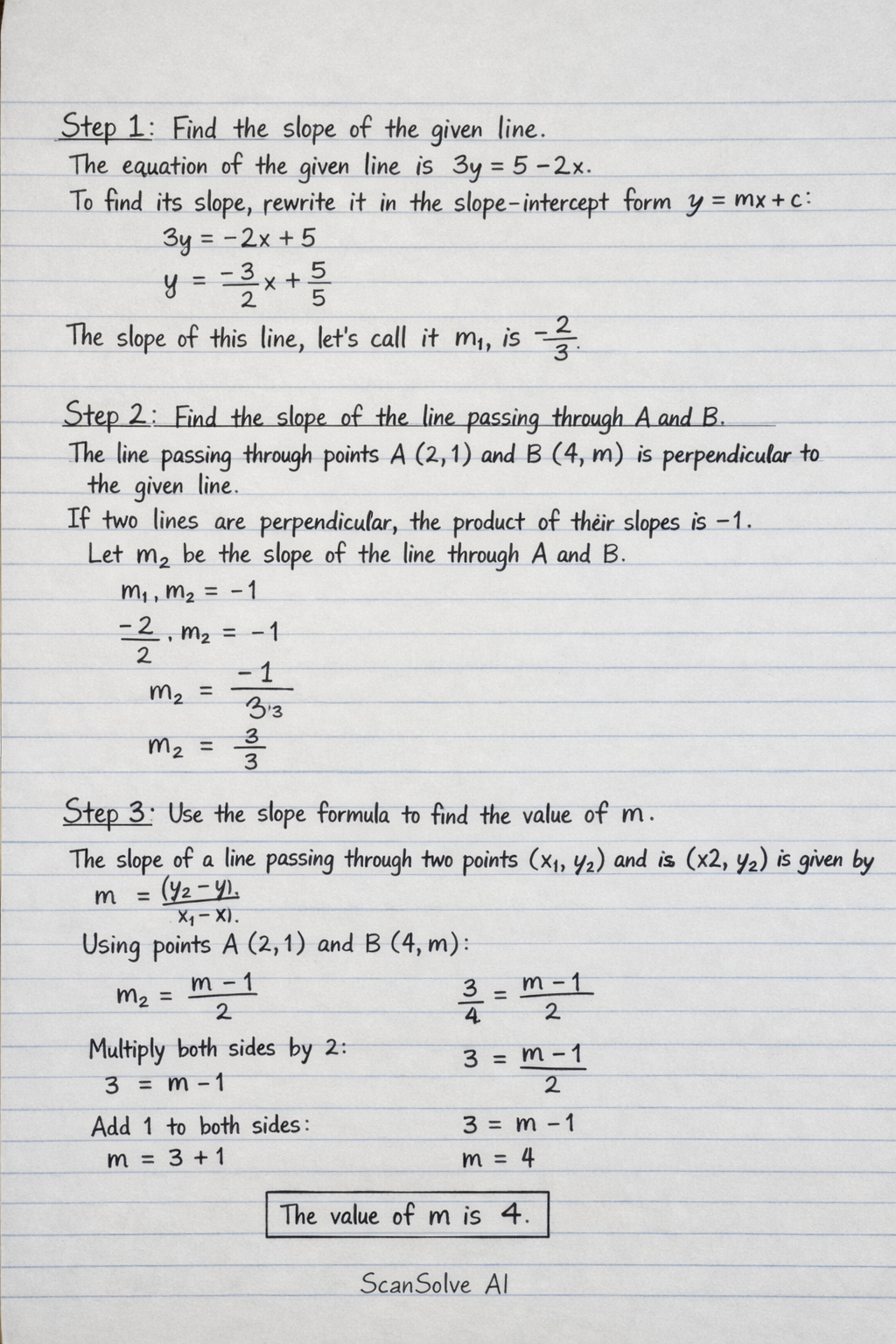
Step 1: Find the slope of the given line.
The equation of the given line is $3y = 5 - 2x$.
To find its slope, rewrite it in the slope-intercept form $y = mx + c$:
$$ 3y = -2x + 5 $$
$$ y = -\frac{2}{3}x + \frac{5}{3} $$
The slope of this line, let's call it $m_1$, is $-\frac{2}{3}$.
Step 2: Find the slope of the line passing through A and B.
The line passing through points A $(2, 1)$ and B $(4, m)$ is perpendicular to the given line.
If two lines are perpendicular, the product of their slopes is $-1$.
Let $m_2$ be the slope of the line through A and B.
$$ m_1 \times m_2 = -1 $$
$$ -\frac{2}{3} \times m_2 = -1 $$
$$ m_2 = \frac{-1}{-\frac{2}{3}} $$
$$ m_2 = \frac{3}{2} $$
Step 3: Use the slope formula to find the value of $m$.
The slope of a line passing through two points $(x_1, y_1)$ and $(x_2, y_2)$ is given by $m = \frac{y_2 - y_1}{x_2 - x_1}$.
Using points A $(2, 1)$ and B $(4, m)$:
$$ m_2 = \frac{m - 1}{4 - 2} $$
$$ \frac{3}{2} = \frac{m - 1}{2} $$
Multiply both sides by 2:
$$ 3 = m - 1 $$
Add 1 to both sides:
$$ m = 3 + 1 $$
$$ m = 4 $$
The value of $m$ is $\boxed{4}$.
Step 1: Divide the equation by the coefficient of $x^2$.
The given quadratic equation is $2x^2 - 5x + 3 = 0$.
Divide all terms by 2:
$$ x^2 - \frac{5}{2}x + \frac{3}{2} = 0 $$
Step 2: Move the constant term to the right side.
$$ x^2 - \frac{5}{2}x = -\frac{3}{2} $$
Step 3: Complete the square on the left side.
To complete the square for $x^2 + bx$, add $(\frac{b}{2})^2$ to both sides. Here, $b = -\frac{5}{2}$.
$$ \left(\frac{b}{2}\right)^2 = \left(\frac{-\frac{5}{2}}{2}\right)^2 = \left(-\frac{5}{4}\right)^2 = \frac{25}{16} $$
Add $\frac{25}{16}$ to both sides of the equation:
$$ x^2 - \frac{5}{2}x + \frac{25}{16} = -\frac{3}{2} + \frac{25}{16} $$
Step 4: Factor the left side and simplify the right side.
The left side is a perfect square: $(x - \frac{5}{4})^2$.
For the right side, find a common denominator:
$$ -\frac{3}{2} + \frac{25}{16} = -\frac{3 \times 8}{2 \times 8} + \frac{25}{16} = -\frac{24}{16} + \frac{25}{16} = \frac{1}{16} $$
So the equation becomes:
$$ \left(x - \frac{5}{4}\right)^2 = \frac{1}{16} $$
Step 5: Take the square root of both sides.
$$ x - \frac{5}{4} = \pm\sqrt{\frac{1}{16}} $$
$$ x - \frac{5}{4} = \pm\frac{1}{4} $$
Step 6: Solve for $x$.
$$ x = \frac{5}{4} \pm \frac{1}{4} $$
Two possible solutions:
$$ x_1 = \frac{5}{4} + \frac{1}{4} = \frac{6}{4} = \frac{3}{2} $$
$$ x_2 = \frac{5}{4} - \frac{1}{4} = \frac{4}{4} = 1 $$
The solutions are $\boxed{x = \frac{3}{2} \text{ or } x = 1}$.
Step 1: Apply logarithm properties to simplify the equation.
The given equation is $\text{Log } (x-1) = \text{log } 12 - \text{log } (x-2)$.
Use the logarithm property $\text{log } a - \text{log } b = \text{log } \left(\frac{a}{b}\right)$ on the right side:
$$ \text{Log } (x-1) = \text{log } \left(\frac{12}{x-2}\right) $$
Step 2: Equate the arguments of the logarithms.
Since the logarithms on both sides have the same base (implied base 10), their arguments must be equal:
$$ x-1 = \frac{12}{x-2} $$
Step 3: Solve the resulting algebraic equation.
Multiply both sides by $(x-2)$ to eliminate the denominator:
$$ (x-1)(x-2) = 12 $$
Expand the left side:
$$ x^2 - 2x - x + 2 = 12 $$
$$ x^2 - 3x + 2 = 12 $$
Subtract 12 from both sides to set the quadratic equation to zero:
$$ x^2 - 3x - 10 = 0 $$
Factor the quadratic equation:
We need two numbers that multiply to -10 and add to -3. These numbers are -5 and 2.
$$ (x-5)(x+2) = 0 $$
This gives two possible solutions for $x$:
$$ x-5 = 0 \implies x = 5 $$
$$ x+2 = 0 \implies x = -2 $$
Step 4: Check for valid solutions.
For a logarithm $\text{log } A$ to be defined, the argument $A$ must be positive ($A > 0$).
Check $x=5$:
$x-1 = 5-1 = 4 > 0$ (Valid)
$x-2 = 5-2 = 3 > 0$ (Valid)
So, $x=5$ is a valid solution.
Check $x=-2$:
$x-1 = -2-1 = -3$ (Not valid, as argument must be positive)
$x-2 = -2-2 = -4$ (Not valid)
So, $x=-2$ is not a valid solution.
The only valid solution is $\boxed{x=5}$.
3 done, 2 left today. You're making progress.
Find the slope of the given line.
|Mathematics
Find the slope of the given line.
ScanSolve AI Answer
Step 1: Find the slope of the given line.
The equation of the given line is 3y=5−2x.
To find its slope, rewrite it in the slope-intercept form y=mx+c:
3y=−2x+5y=−32x+35
The slope of this line, let's call it m1, is −32.
Step 2: Find the slope of the line passing through A and B.
The line passing through points A (2,1) and B (4,m) is perpendicular to the given line.
If two lines are perpendicular, the product of their slopes is −1.
Let m2 be the slope of the line through A and B.
m1×m2=−1−32×m2=−1m2=−32−1m2=23
Step 3: Use the slope formula to find the value of m.
The slope of a line passing through two points (x1,y1) and (x2,y2) is given by m=x2−x1y2−y1.
Using points A (2,1) and B (4,m):
m2=4−2m−123=2m−1
Multiply both sides by 2:
3=m−1
Add 1 to both sides:
m=3+1m=4
The value of m is 4.
Step 1: Divide the equation by the coefficient of x2.
The given quadratic equation is 2x2−5x+3=0.
Divide all terms by 2:
x2−25x+23=0
Step 2: Move the constant term to the right side.
x2−25x=−23
Step 3: Complete the square on the left side.
To complete the square for x2+bx, add (2b)2 to both sides. Here, b=−25.
(2b)2=(2−25)2=(−45)2=1625
Add 1625 to both sides of the equation:
x2−25x+1625=−23+1625
Step 4: Factor the left side and simplify the right side.
The left side is a perfect square: (x−45)2.
For the right side, find a common denominator:
−23+1625=−2×83×8+1625=−1624+1625=161
So the equation becomes:
(x−45)2=161
Step 5: Take the square root of both sides.
x−45=±161x−45=±41
Step 6: Solve for x.
x=45±41
Two possible solutions:
x1=45+41=46=23x2=45−41=44=1
The solutions are x=23orx=1.
Step 1: Apply logarithm properties to simplify the equation.
The given equation is Log (x−1)=log12−log(x−2).
Use the logarithm property log a−logb=log(ba) on the right side:
Log(x−1)=log(x−212)
Step 2: Equate the arguments of the logarithms.
Since the logarithms on both sides have the same base (implied base 10), their arguments must be equal:
x−1=x−212
Step 3: Solve the resulting algebraic equation.
Multiply both sides by (x−2) to eliminate the denominator:
(x−1)(x−2)=12
Expand the left side:
x2−2x−x+2=12x2−3x+2=12
Subtract 12 from both sides to set the quadratic equation to zero:
x2−3x−10=0
Factor the quadratic equation:
We need two numbers that multiply to -10 and add to -3. These numbers are -5 and 2.
(x−5)(x+2)=0
This gives two possible solutions for x:
x−5=0⟹x=5x+2=0⟹x=−2
Step 4: Check for valid solutions.
For a logarithm log A to be defined, the argument A must be positive (A>0).
Check x=5:
x−1=5−1=4>0 (Valid)
x−2=5−2=3>0 (Valid)
So, x=5 is a valid solution.
Check x=−2:
x−1=−2−1=−3 (Not valid, as argument must be positive)
x−2=−2−2=−4 (Not valid)
So, x=−2 is not a valid solution.
The only valid solution is x=5.
3 done, 2 left today. You're making progress.
Need help with your own homework?
Get instant step-by-step solutions to any question. Free to start.