
How to square both sides with pythagoras theroem
ScanSolve AI Answer
Answer
The Pythagorean theorem states that in a right-angled triangle, the square of the length of the hypotenuse (the side opposite the right angle) is equal to the sum of the squares of the lengths of the other two sides.
Step-by-step solution
3 stepsState the Pythagorean Theorem.
The theorem is expressed as:
where and are the lengths of the two shorter sides (legs), and is the length of the hypotenuse. Notice that the terms are already squared in the theorem itself.
Understand when to "square both sides".
You would typically "square both sides" of an equation when you need to eliminate a square root to solve for an unknown variable. This often happens when you've rearranged the Pythagorean theorem to solve for one of the sides, and you end up with a square root.
Example of squaring both sides.
Suppose you have a right triangle where the legs are 3 and 4, and you want to find the hypotenuse .
Using the Pythagorean theorem:To find , you take the square root of both sides:
Now, consider if you were given and , and you needed to find .
To find , you take the square root of both sides:
In these cases, you are taking the square root of both sides to solve for a variable that is squared. The operation of "squaring both sides" would be used if you had an equation like and you wanted to find , so you would square both sides to get . This is less common directly with the Pythagorean theorem itself, as it's already in squared form.
Still stuck on this one?
Ask a follow-up, and the answer starts from this question.
More Mathematics Questions
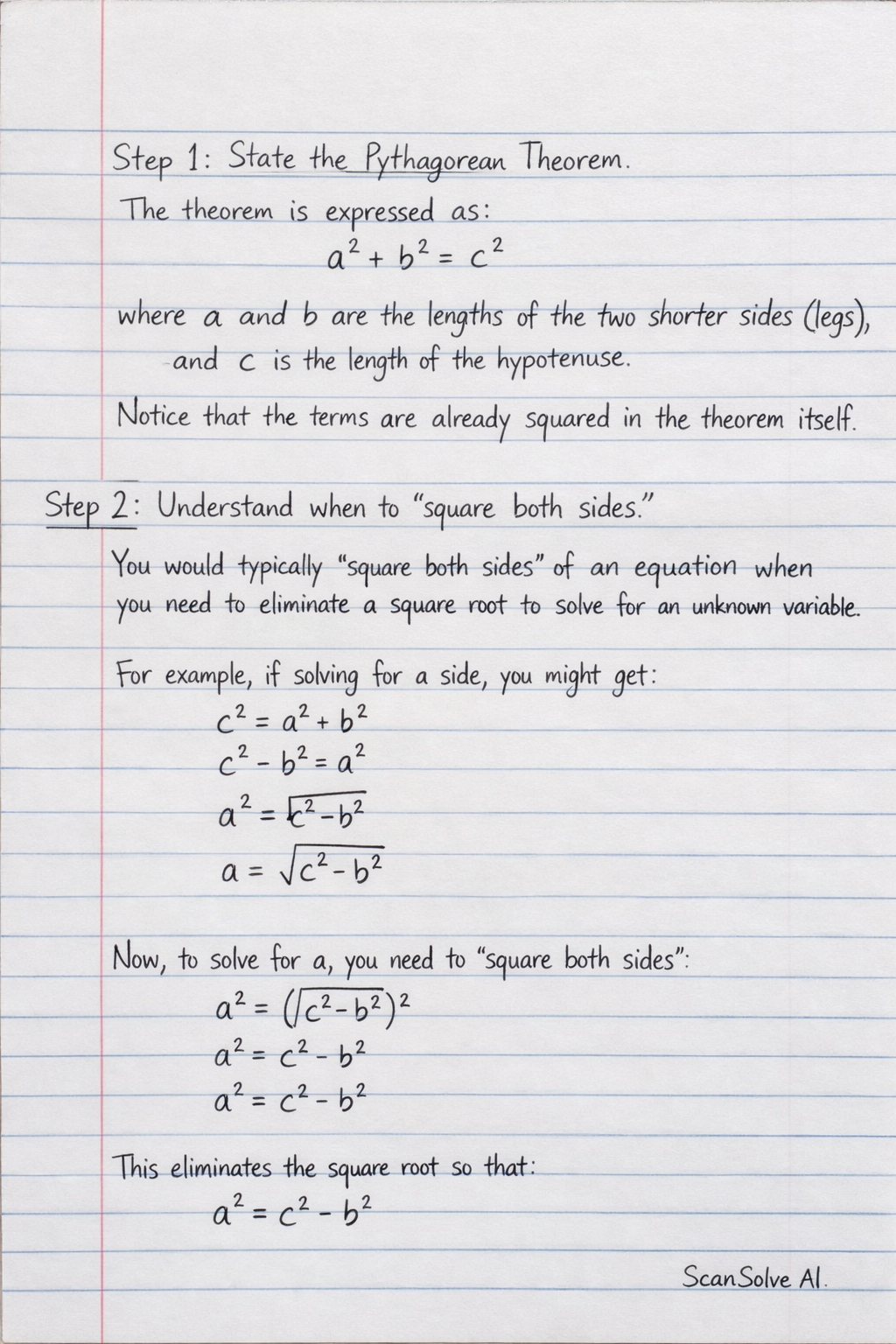
Handwritten Step-by-Step Solution
Get this as a handwritten image on WhatsApp — like a tutor wrote it for you.
Try on WhatsApp