

This mathematics problem involves applying core mathematical principles and formulas. Below you will find a complete step-by-step solution with detailed explanations for each step, helping you understand not just the answer but the method behind it.
ScanSolve AI Answer
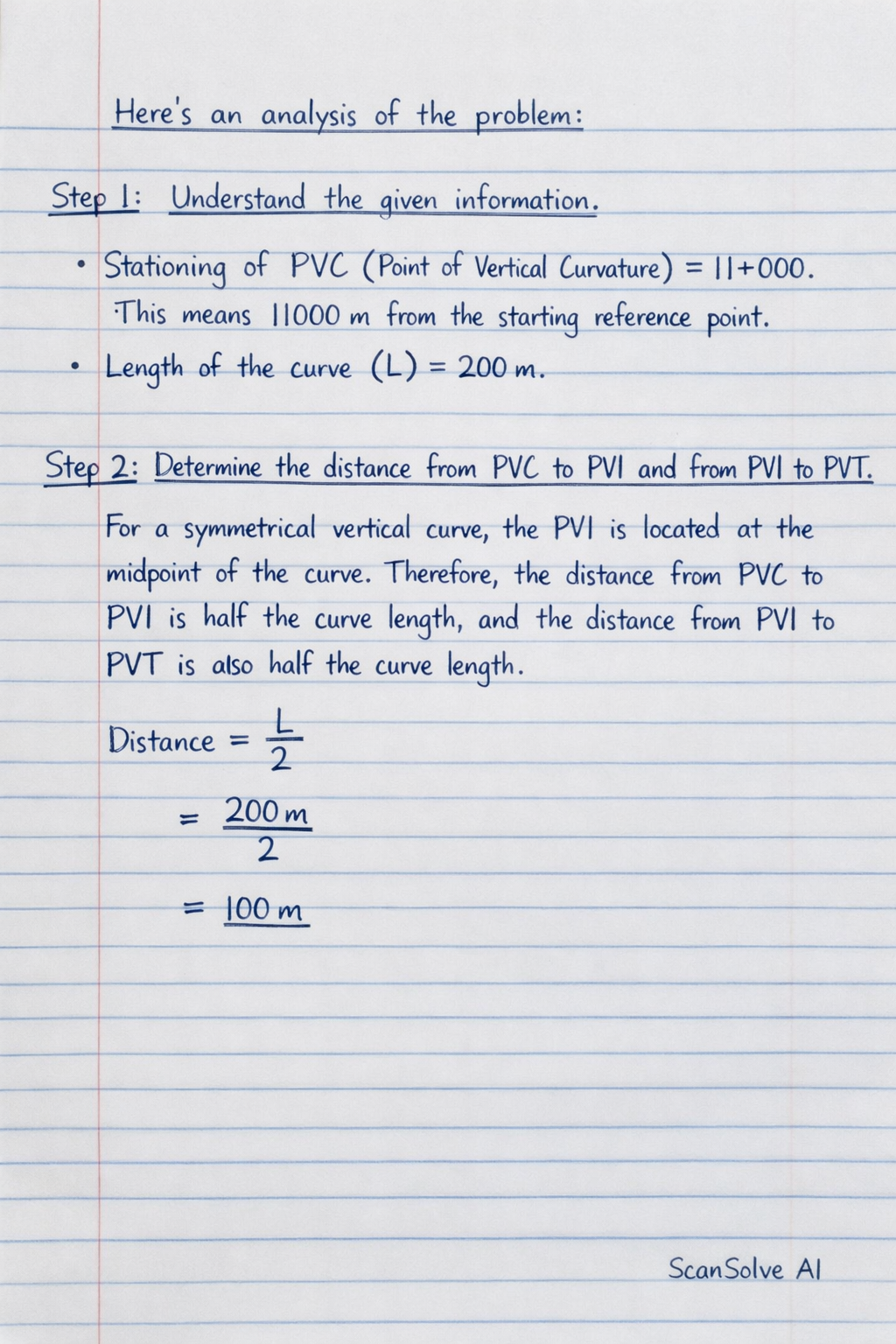
This problem involves calculating the stationing of the Point of Vertical Intersection (PVI) and the Point of Vertical Tangency (PVT) given the stationing of the Point of Vertical Curvature (PVC) and the length of the vertical curve. Step 1: Understand the given information. Stationing of PVC (Point of Vertical Curvature) = 11+000. This means 11000\, m from the starting reference point. Length of the curve (L) = 200\, m. Step 2: Determine the distance from PVC to PVI and from PVI to PVT. For a symmetrical vertical curve, the PVI is located at the midpoint of the curve. Therefore, the distance from PVC to PVI is half the curve length, and the distance from PVI to PVT is also half the curve length. Distance = (L)/(2) = 200\, m2 = 100\, m. Step 3: Calculate the Stationing of PVI. The PVI (Point of Vertical Intersection) is located after the PVC. To find its stationing, add the distance calculated in Step 2 to the PVC stationing. Stationing of PVI = Stationing of PVC + (L)/(2) Stationing of PVI = 11000\, m + 100\, m Stationing of PVI = 11100\, m In stationing notation, this is 11+100. Step 4: Calculate the Stationing of PVT. The PVT (Point of Vertical Tangency) is located after the PVI. To find its stationing, add the distance calculated in Step 2 to the PVI stationing. Stationing of PVT = Stationing of PVI + (L)/(2) Stationing of PVT = 11100\, m + 100\, m Stationing of PVT = 11200\, m In stationing notation, this is 11+200. The Stationing of PVI is 11+100. The Stationing of PVT is 11+200. Last free one today — make it count tomorrow, or type /upgrade for unlimited.