

This mathematics problem involves applying core mathematical principles and formulas. Below you will find a complete step-by-step solution with detailed explanations for each step, helping you understand not just the answer but the method behind it.
ScanSolve AI Answer
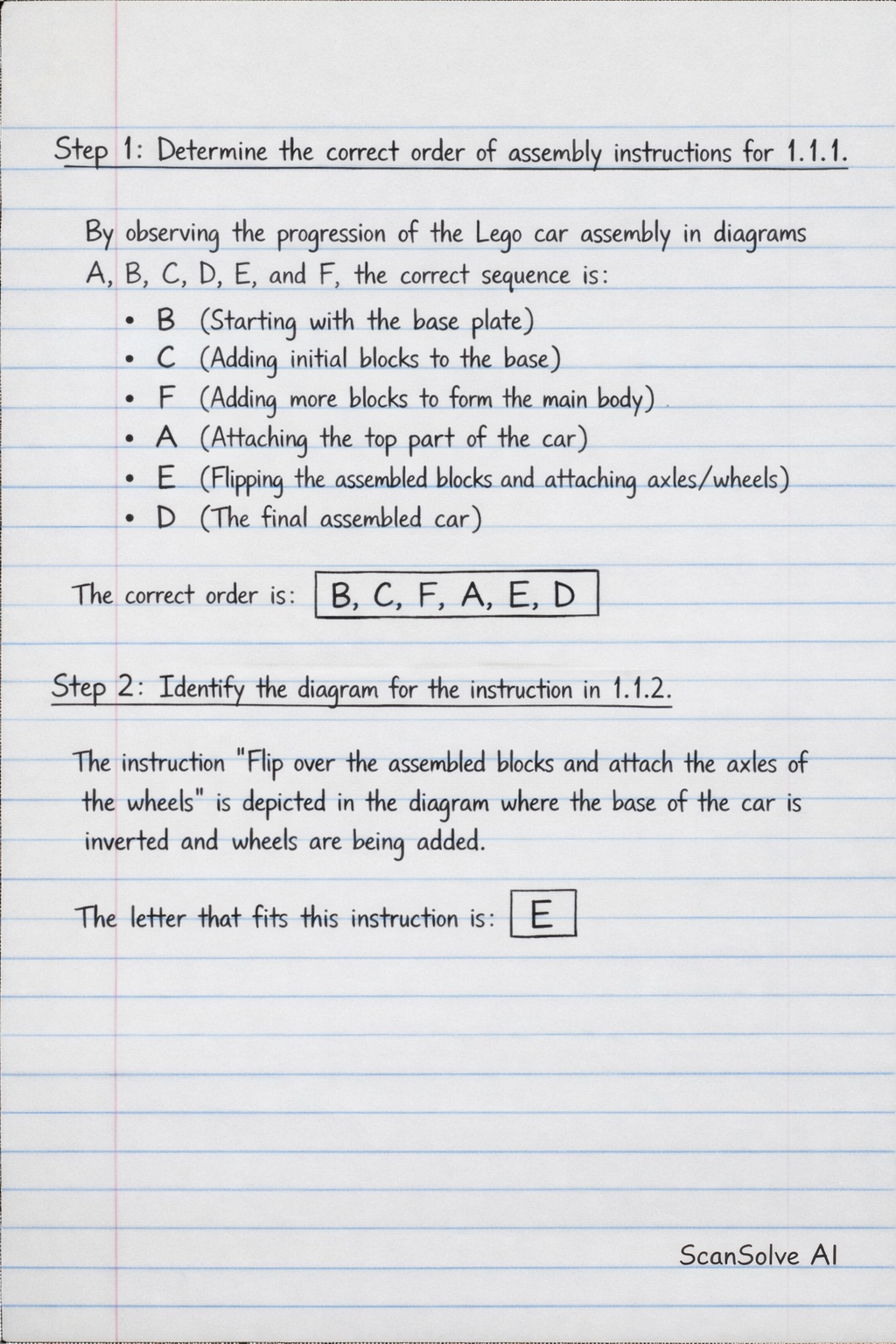
Step 1: Determine the correct order of assembly instructions for 1.1.1. By observing the progression of the Lego car assembly in diagrams A, B, C, D, E, and F, the correct sequence is: • B (Starting with the base plate) • C (Adding initial blocks to the base) • F (Adding more blocks to form the main body) • A (Attaching the top part of the car) • E (Flipping the assembled blocks and attaching the axles/wheels) • D (The final assembled car) The correct order is: B, C, F, A, E, D Step 2: Identify the diagram for the instruction in 1.1.2. The instruction "Flip over the assembled blocks and attach the axels of the wheels" is depicted in the diagram where the base of the car is inverted and wheels are being added. The letter that fits this instruction is: E Step 3: Address the incomplete question for 1.1.3. The total number of blocks in the set is calculated by summing the blocks of each color: Total blocks = 30 (red) + 25 (blue) + 25 (yellow) + 20 (white) Total blocks = 30 + 25 + 25 + 20 = 100 The question "Determine the probability, as a percentage, that the block" is incomplete. To provide a specific probability, the question needs to specify the characteristic of the block being selected (e.g., "that the block is red" or "that the block is blue"). Without this information, a specific probability cannot be determined. Send me the next one 📸