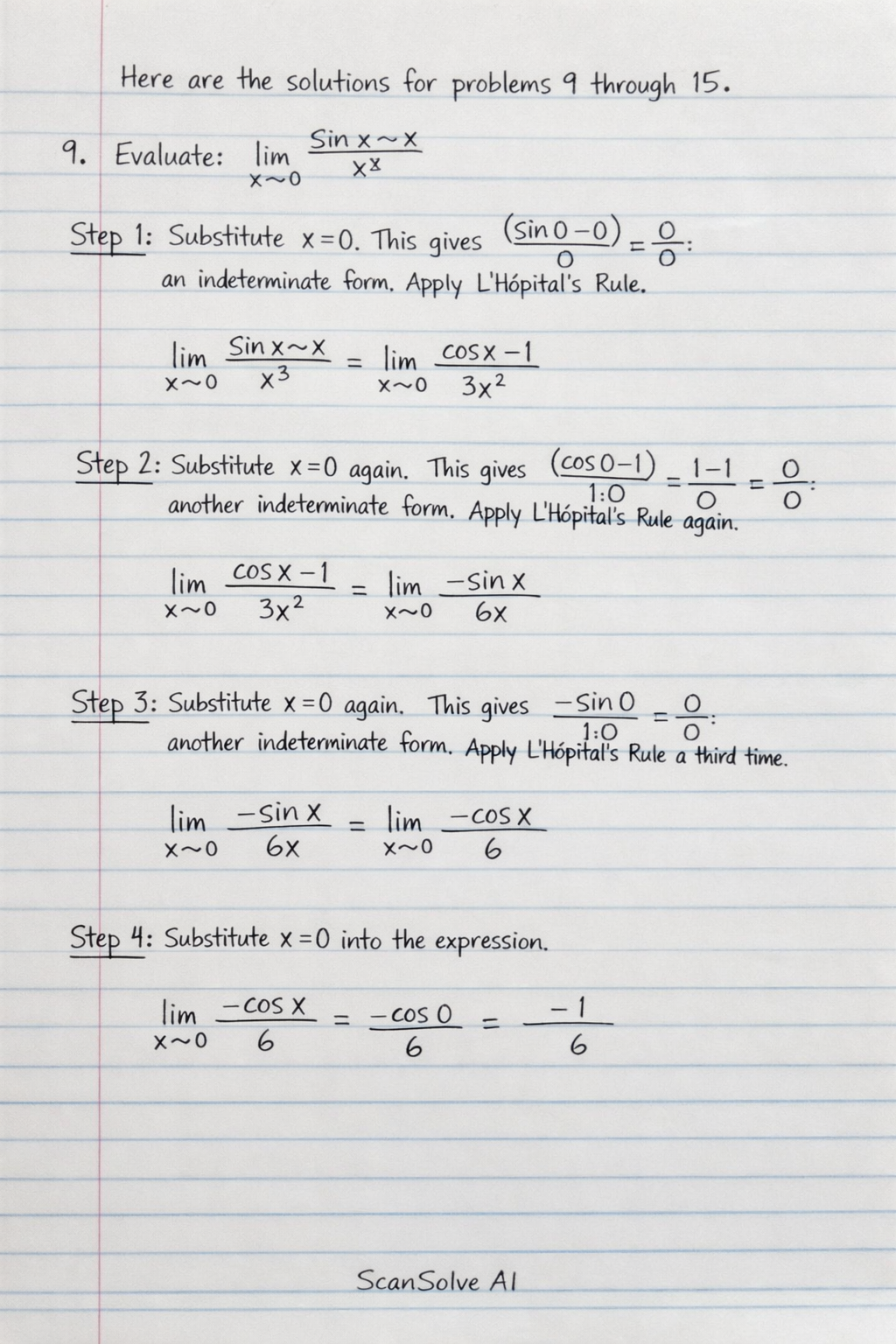
Here are the solutions for problems 9 through 15.
9. Evaluate: limx→0x3sinx−x
Step 1: Substitute x=0. This gives 03sin0−0=00, an indeterminate form. Apply L'Hôpital's Rule.
limx→0x3sinx−x=limx→0dxd(x3)dxd(sinx−x)=limx→03x2cosx−1
Step 2: Substitute x=0 again. This gives 3(0)2cos0−1=01−1=00, another indeterminate form. Apply L'Hôpital's Rule again.
limx→03x2cosx−1=limx→0dxd(3x2)dxd(cosx−1)=limx→06x−sinx
Step 3: Substitute x=0 again. This gives 6(0)−sin0=00, another indeterminate form. Apply L'Hôpital's Rule a third time.
limx→06x−sinx=limx→0dxd(6x)dxd(−sinx)=limx→06−cosx
Step 4: Substitute x=0 into the expression.
limx→06−cosx=6−cos0=6−1
The limit is −61.
10. Evaluate: limx→0x2ex−1−x
Step 1: Substitute x=0. This gives 02e0−1−0=01−1−0=00, an indeterminate form. Apply L'Hôpital's Rule.
limx→0x2ex−1−x=limx→0dxd(x2)dxd(ex−1−x)=limx→02xex−1
Step 2: Substitute x=0 again. This gives 2(0)e0−1=01−1=00, another indeterminate form. Apply L'Hôpital's Rule again.
limx→02xex−1=limx→0dxd(2x)dxd(ex−1)=limx→02ex
Step 3: Substitute x=0 into the expression.
limx→02ex=2e0=21
The limit is 21.
11. Evaluate: limx→∞lnxx3
Step 1: As x→∞, x3→∞ and lnx→∞. This is an indeterminate form ∞∞. Apply L'Hôpital's Rule.
limx→∞lnxx3=limx→∞dxd(lnx)dxd(x3)=limx→∞x13x2
Step 2: Simplify the expression.
limx→∞x13x2=limx→∞(3x2⋅x)=limx→∞3x3
Step 3: Evaluate the limit. As x→∞, 3x3→∞.
The limit is ∞.
12. Evaluate: limx→0+xlnx
Step 1: As x→0+, x→0 and lnx→−∞. This is an indeterminate form 0⋅(−∞). Rewrite the expression as a fraction.
limx→0+xlnx=limx→0+x1lnx
Step 2: As x→0+, lnx→−∞ and x1→∞. This is an indeterminate form ∞−∞. Apply L'Hôpital's Rule.
limx→0+x1lnx=limx→0+dxd(x1)dxd(lnx)=limx→0+−x21x1
Step 3: Simplify the expression.
limx→0+−x21x1=limx→0+(x1⋅(−x2))=limx→0+(−x)
Step 4: Substitute x=0 into the expression.
limx→0+(−x)=0
The limit is 0.
13. Evaluate: limx→∞(1+x1)x
Step 1: This is a standard definition of the mathematical constant e.
limx→∞(1+x1)x=e
The limit is e.
14. Evaluate: limx→0x2ln(1+x)−x
Step 1: Substitute x=0. This gives 02ln(1+0)−0=0ln1−0=00, an indeterminate form. Apply L'Hôpital's Rule.
limx→0x2ln(1+x)−x=limx→0dxd(x2)dxd(ln(1+x)−x)=limx→02x1+x1−1
Step 2: Substitute x=0 again. This gives 2(0)1+01−1=01−1=00, another indeterminate form. Apply L'Hôpital's Rule again.
limx→02x1+x1−1=limx→0dxd(2x)dxd((1+x)−1−1)=limx→02−1(1+x)−2
Step 3: Simplify and substitute x=0 into the expression.
limx→02−(1+x)21=2−(1+0)21=2−1
The limit is −21.
15. Evaluate: limx→∞xsin(x1)
Step 1: As x→∞, x→∞ and sin(x1)→sin(0)=0. This is an indeterminate form ∞⋅0.
Step 2: Let y=x1. As x→∞, y→0. Substitute x=y1 into the limit expression.
limx→∞xsin(x1)=limy→0y1sin(y)=limy→0ysiny
Step 3: This is a fundamental trigonometric limit.
limy→0ysiny=1
The limit is 1.
Last free one today — make it count tomorrow, or type /upgrade for unlimited.