
We read your photo as:
Solve the system of equations: 8^x−y = 2^x+y and 3^x+1 = 9^y.
ScanSolve AI Answer
Step-by-step solution
3 stepsTo solve the simultaneous equations and , we will first simplify each equation by expressing both sides with the same base and then equating the exponents.
Simplify the first equation.
The first equation is .
Since , we can rewrite the equation as:Equating the exponents:
Dividing by 2:
Simplify the second equation.
The second equation is .
Since , we can rewrite the equation as:Equating the exponents:
Solve the system of linear equations.
We now have a system of two linear equations:
Substitute equation into equation :
This result, , is a contradiction. This means that there are no values of and that can satisfy both equations simultaneously. Therefore, the system of equations has no solution.
The system of equations has no solution.
Still stuck on this one?
Ask a follow-up, and the answer starts from this question.
More Mathematics Questions
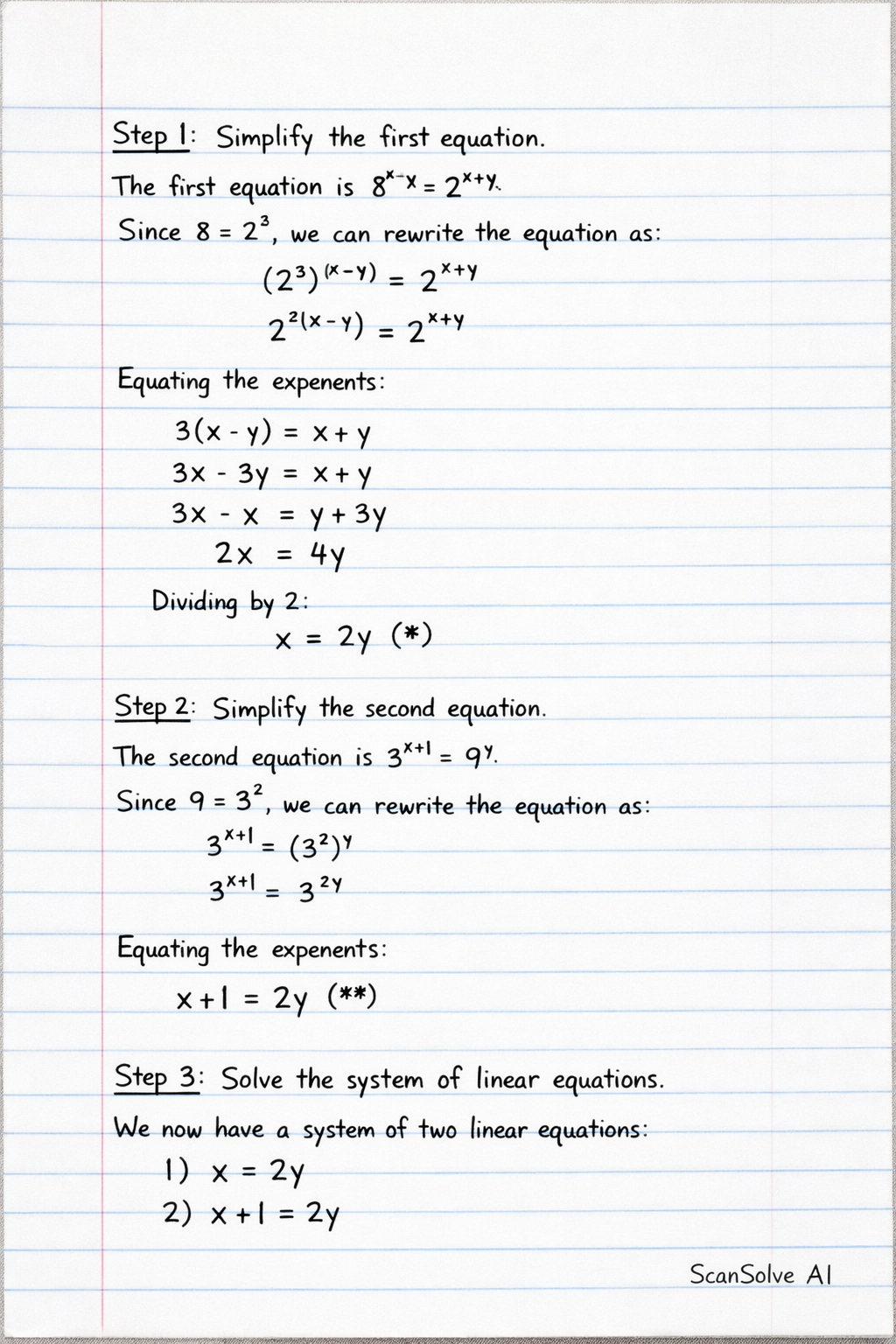
Handwritten Step-by-Step Solution
Get this as a handwritten image on WhatsApp — like a tutor wrote it for you.
Try on WhatsApp