
We read your photo as:
Take the natural logarithm of both sides of the inequality.
Mathematics
ScanSolve AI Answer
Answer
Step-by-step solution
5 stepsTake the natural logarithm of both sides of the inequality.
Since the base , the inequality sign remains the same.
Use the logarithm property to bring the exponent down.
Divide both sides by .
Since , is positive, so the inequality sign remains the same.
Calculate the numerical values of the logarithms.
Subtract 1 from both sides to solve for .
The solution for is:
Was this helpful?
Try one yourself
A new problem that tests the same skill.
Still stuck on this one?
Ask a follow-up, and the answer starts from this question.
Got a different question?Ask your own question
More Mathematics Questions
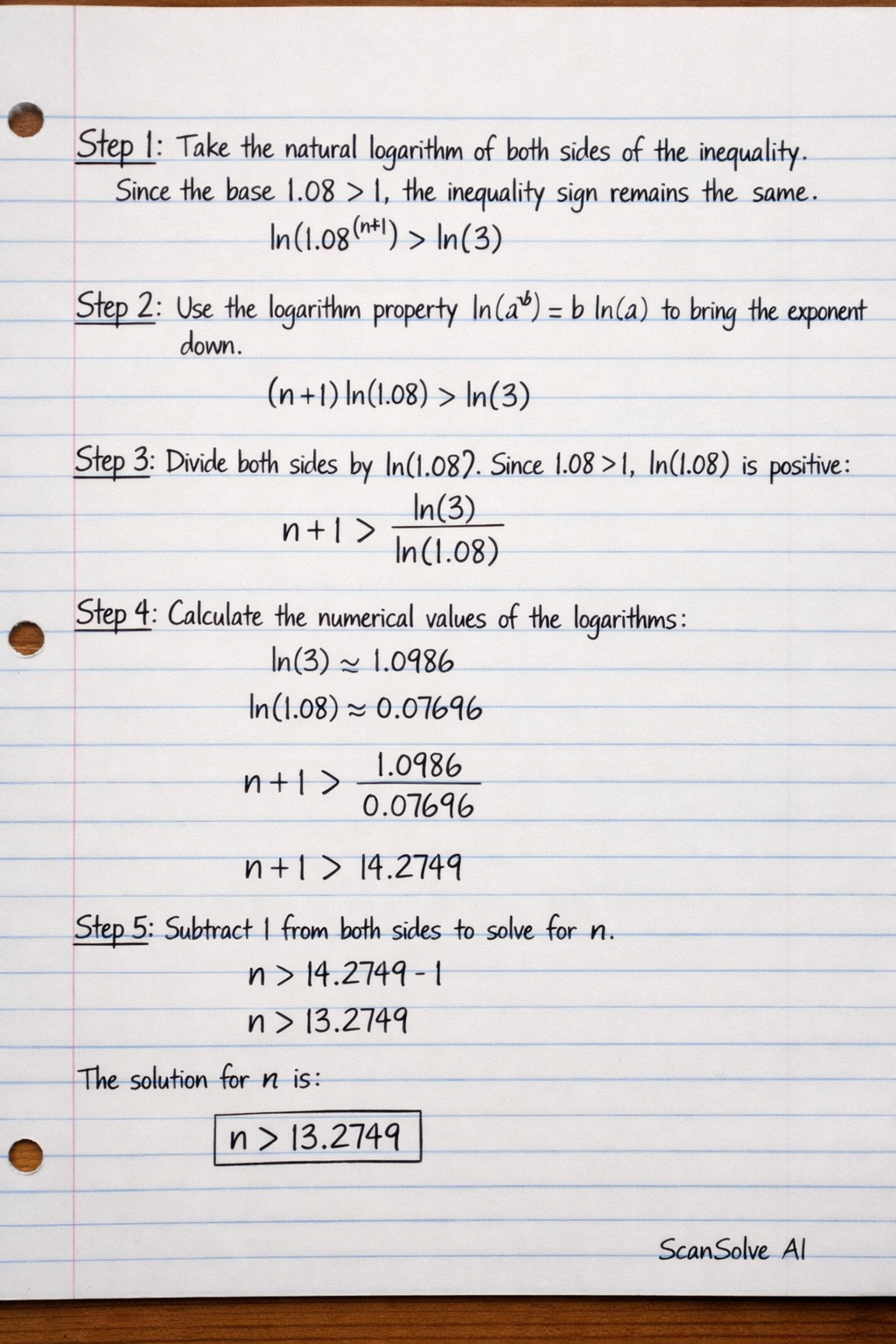
Handwritten Step-by-Step Solution
Get this as a handwritten image on WhatsApp — like a tutor wrote it for you.
Try on WhatsApp