
Can you teach me everything about polynomial
ScanSolve AI Answer
Answer
A polynomial is an expression consisting of variables and coefficients, that involves only the operations of addition, subtraction, multiplication, and non-negative integer exponents of variables.
Step-by-step solution
3 stepsHere, is the variable, are the coefficients, and is a non-negative integer representing the degree of the polynomial.
- Terms: Each part of the polynomial separated by addition or subtraction is a term. For example, in , the terms are , , and .
- Degree: The highest exponent of the variable in a polynomial is its degree. For , the degree is 2.
- Monomial: A polynomial with one term (e.g., ).
- Binomial: A polynomial with two terms (e.g., ).
- Trinomial: A polynomial with three terms (e.g., ).
Operations with Polynomials:
Addition/Subtraction
Combine like terms (terms with the same variable and exponent).
Example: .Multiplication
Use the distributive property. Multiply each term in the first polynomial by each term in the second.
Example: .Division
Can be done using polynomial long division or synthetic division.
Factoring Polynomials:
This is the reverse of multiplication. It involves finding polynomials that multiply together to give the original polynomial. Common methods include:- Factoring out the greatest common factor (GCF).
- Factoring quadratics (e.g., ).
- Difference of squares ().
- Sum/Difference of cubes ().
Still stuck on this one?
Ask a follow-up, and the answer starts from this question.
More Mathematics Questions
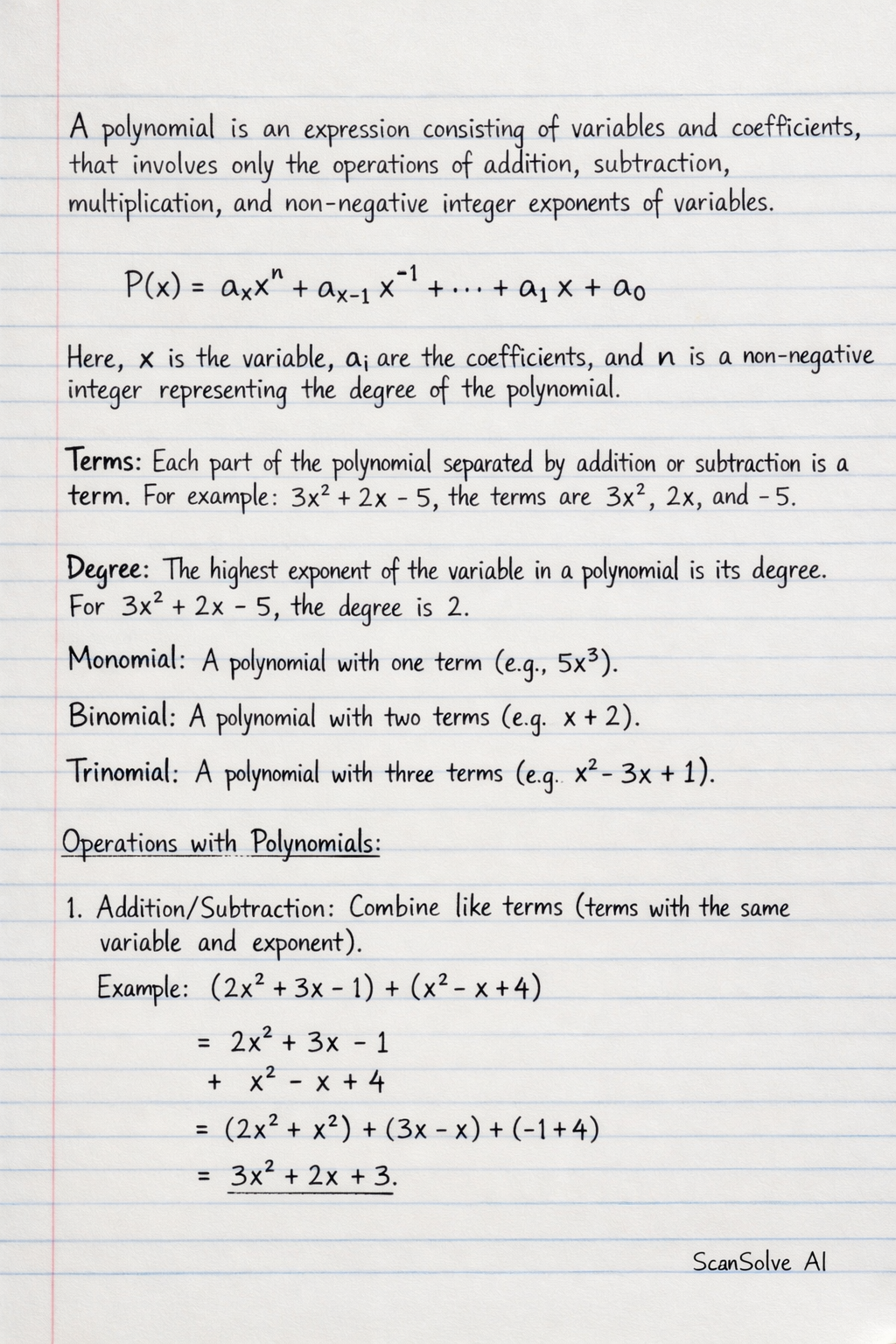
Handwritten Step-by-Step Solution
Get this as a handwritten image on WhatsApp — like a tutor wrote it for you.
Try on WhatsApp