
We read your photo as:
Prove that the determinant of the matrix [[b+c, a, a], [b, c+a, b], [c, c, a+b]] is 2abc.
Mathematics
ScanSolve AI Answer
Answer
a+b \end{vmatrix} = 4abc
Step-by-step solution
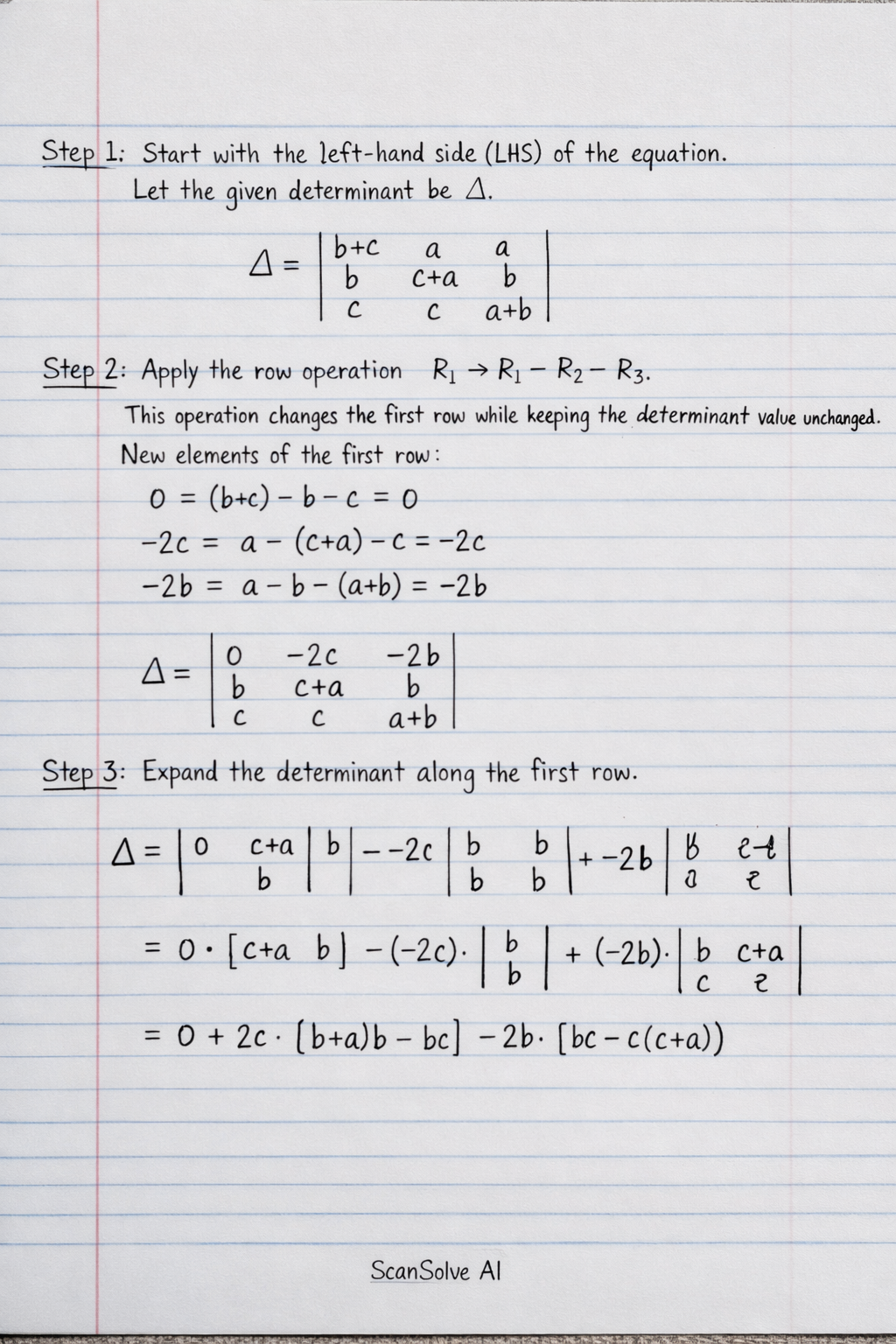
5 stepsStart with the left-hand side (LHS) of the equation.
Let the given determinant be .
Apply the row operation .
This operation changes the first row while keeping the determinant value unchanged.
The new elements of the first row will be:- First element:
- Second element:
- Third element:
Expand the determinant along the first row.
The determinant of a matrix is .
Simplify the expression.
Combine like terms.
This matches the right-hand side (RHS) of the given equation.
Therefore, it is proven that:
Was this helpful?
Still stuck on this one?
Ask a follow-up, and the answer starts from this question.
Got a different question?Ask your own question
More Mathematics Questions
QWithout expanding the determinant prove that |1 a bc| |1 b ca| |1 c ab| = (a-b)(b-c)(c-a)QShow that | a.b c | | a2 b3 c3 | | a3 b2 c2 | = abc(a-b)(b-c)(c-a)QShow that |1+a 1 1| |1 1+b 1| |1 1 1+c| = abc+ab+bc+ca.QIf abc=1, prove that (1)/(1+a+b⁻¹) + (1)/(1+b+c⁻¹) + (1)/(1+c+a⁻¹) = 1.QProve that in any acute angled \(\ ABC ) is \(c2 = a2 + b2 - 2ab C ).
Browse by topic:Linear Algebra
Handwritten Step-by-Step Solution
Get this as a handwritten image on WhatsApp — like a tutor wrote it for you.
Try on WhatsApp