
We read your photo as:
Prove that XZ bisects angle WZY given that W, X, Y, and Z are points on a circle and WX = YX. Calculate the standard deviation for the dataset 2, 7, 5, 6, 9.
ScanSolve AI Answer
Step-by-step solution
11 stepsHere are the solutions to the problems.
: Geometry Proof
Understand the given information.
We are given that points W, X, Y, and Z lie on a circle. We are also given that the chord WX is equal in length to the chord YX ().
Relate equal chords to equal arcs.
In a circle, equal chords subtend equal arcs. Since , the arc WX is equal to the arc YX.
Relate equal arcs to angles subtended at the circumference.
Angles subtended by equal arcs at any point on the remaining part of the circumference are equal.
The angle is subtended by arc WX at point Z on the circumference.
The angle is subtended by arc YX at point Z on the circumference.Conclude the equality of angles.
Since arc WX = arc YX, it follows that the angles they subtend at Z are equal:
Define angle bisection.
An angle is bisected if it is divided into two equal angles. Since and are the two parts of , and they are equal, the line segment XZ bisects .
Therefore, XZ bisects angle WZY.
: Standard Deviation
List the data and find the number of data points ().
The data set is .
The number of data points is .Calculate the mean () of the data.
The mean is the sum of all data points divided by the number of data points.
Calculate the squared difference of each data point from the mean .
For :
For :
For :
For :
For :Sum the squared differences.
Calculate the population variance ().
The population variance is the sum of the squared differences divided by .
Calculate the population standard deviation ().
The standard deviation is the square root of the variance.
Rounding to two decimal places:
The standard deviation of the data is .
Still stuck on this one?
Ask a follow-up, and the answer starts from this question.
More Mathematics Questions
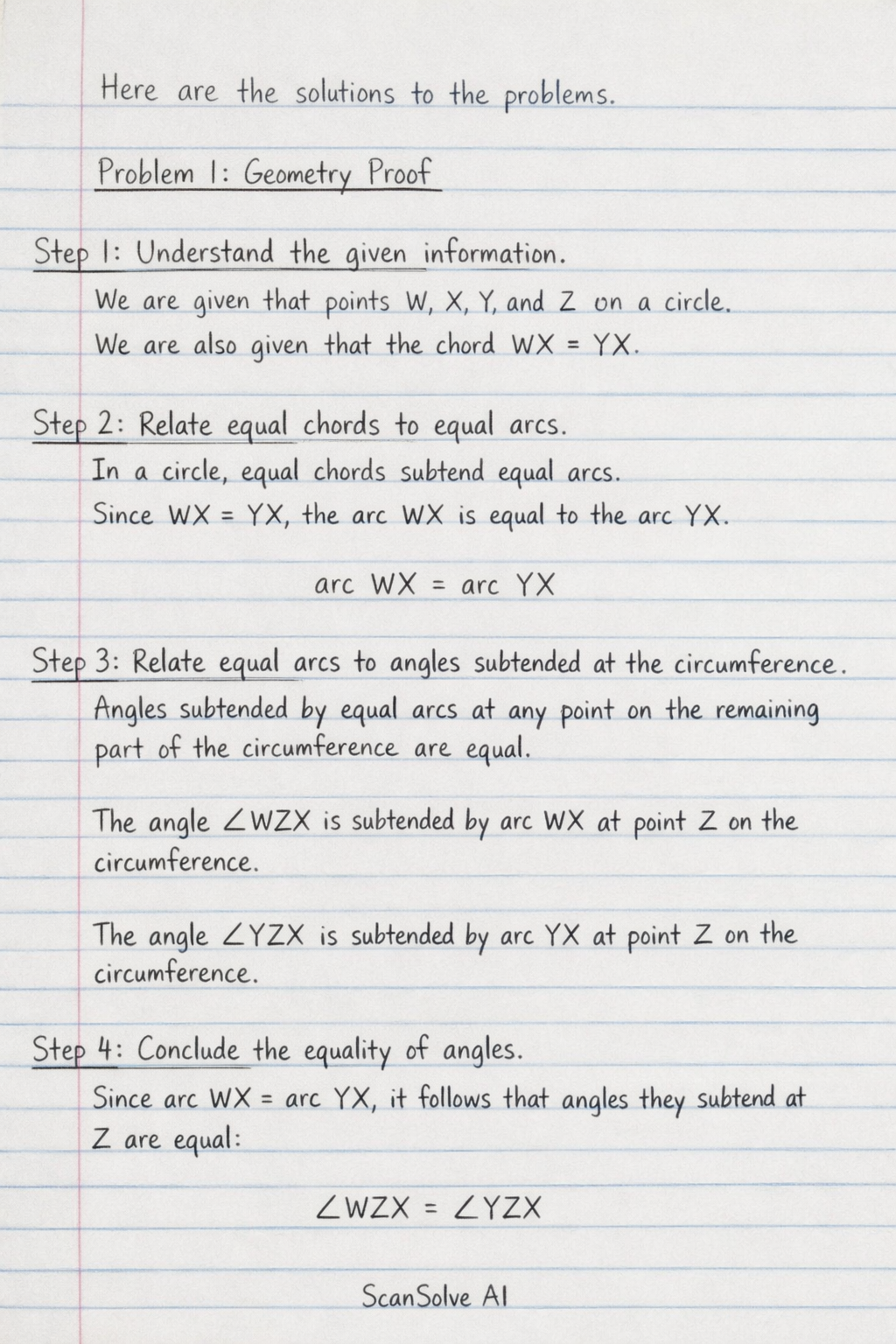
Handwritten Step-by-Step Solution
Get this as a handwritten image on WhatsApp — like a tutor wrote it for you.
Try on WhatsApp