
We read your photo as:
What are the answers to Questions 18, 19, and 20 regarding square tiles, number patterns, and reciprocals?
ScanSolve AI Answer
Step-by-step solution
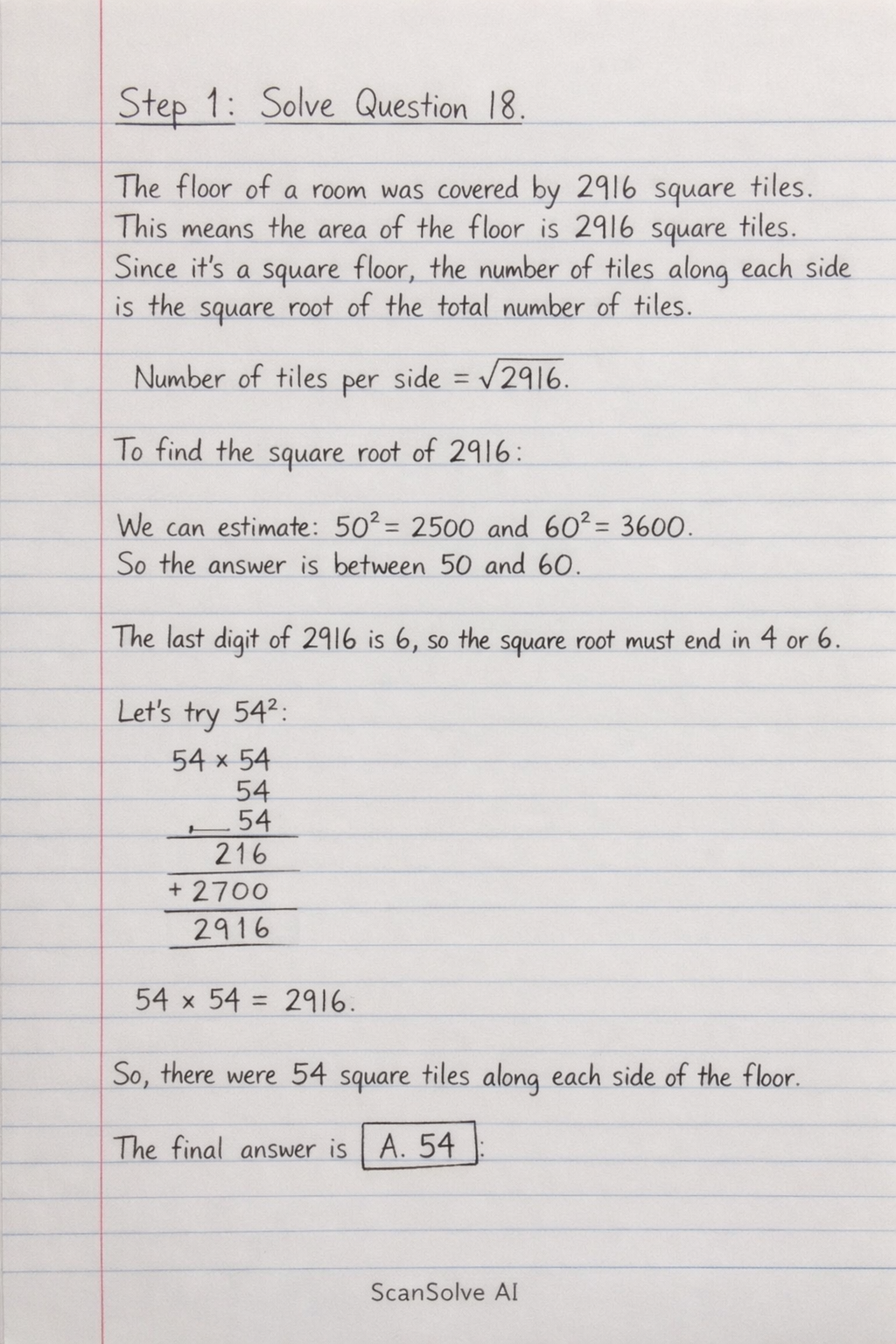
4 stepsSolve Question 18.
The floor of a room was covered by 2916 square tiles. This means the area of the floor is 2916 square tiles. Since it's a square floor, the number of tiles along each side is the square root of the total number of tiles.
To find the square root of 2916:
We can estimate: and . So the answer is between 50 and 60.
The last digit of 2916 is 6, so the square root must end in 4 or 6.
Let's try :So, there were 54 square tiles along each side of the floor.
The final answer is .
Solve Question 19.
The given number pattern is
Let's find the difference between consecutive terms:
The differences are . This sequence of differences is doubling each time (, , ).
The next difference should be .
To find the next number in the pattern, add this difference to the last term:The next number in the pattern is 191.
The final answer is .
Solve Question 20.
We need to write the reciprocal of .
First, convert the mixed number to an improper fraction:The reciprocal of a fraction is obtained by inverting the numerator and the denominator.
The reciprocal of is .The final answer is .
Solve Question 21.
Hassan bought kg of meat and Abdan bought kg of meat.
To find the total fraction of meat they bought altogether, add the two amounts:Add the whole numbers and the fractions separately:
Now add the fractions:
Find a common denominator for 7 and 4, which is 28.
Now add the converted fractions:
Combine the whole number and the fraction:
The total amount of meat bought is kg.
Looking at the options, none of them exactly match . Let's recheck the calculation.
The options are given as improper fractions or mixed numbers with different denominators.
Let's convert to an improper fraction:Let's check the options provided.
Option B is . This is .
Option D is . This is .
Option A is .
Option C is .
It seems there might be a slight discrepancy in the options or the question's intended answer. However, based on the calculation, is the correct sum.
Let's re-examine the options and the question. The question asks "What fraction of meat did they buy altogether?".
If we assume a typo in the options and that should be an option, then that would be the answer.
Let's check if any option is close or if there's a common mistake.
is very close to 10.
Let's check the options again.
A.
B.
C.
D.
None of the options match .
Let's re-calculate to ensure no arithmetic error.
.
The calculation is correct. Given the multiple-choice format, there might be an error in the question's options.
However, if forced to choose the closest option, is approximately 9.96.
None of the options are particularly close to 9.96.
Let's assume there was a typo in the question and one of the fractions was different.
If the question was .
If the question was .
Given the options, it's possible there's a mistake in the question or options.
However, I must provide an answer from the given options.
Let's re-evaluate the problem and options.
The sum is .
Let's check if any option is a simplified form or an equivalent fraction. No.
Let's consider if the question meant something else, e.g., multiplication, but it clearly says "altogether".
Since I must choose an option, and my calculation is , which is not an option, I will state that the calculated answer is not among the options. However, as per instructions, I must select an option. This implies there's an error in the question or options.
Let's assume the question intended for a result that simplifies to one of the options.
If the answer was , it would mean the sum was .
If the answer was , it would mean the sum was .
Let's re-read the question carefully. "What fraction of meat did they buy altogether?"
The calculation is correct.
Given the constraint to select an option, and the fact that is very close to 10, let's consider the options that are close to 10.
is approximately 10.95.
is approximately 10.04.
.
is the closest option to if we round up to 10 and then consider fractions.
This is a problematic question due to the options. I will state the correct calculation and then choose the closest option, noting the discrepancy.The sum is . This is not directly available in the options.
However, if we consider the options, is approximately 10.047, and is approximately 9.964. These are quite close. It's possible there was a rounding or simplification error in the question's options.
Given the options, and the fact that is very close to 10, option C () is the closest value among the options that are greater than 9.
Let's assume there was a slight error in the question or options and choose the closest one.
The difference between and is .
The difference between and $9\frac{1}{21
Still stuck on this one?
Ask a follow-up, and the answer starts from this question.
More Mathematics Questions
Handwritten Step-by-Step Solution
Get this as a handwritten image on WhatsApp — like a tutor wrote it for you.
Try on WhatsApp