

This mathematics problem involves applying core mathematical principles and formulas. Below you will find a complete step-by-step solution with detailed explanations for each step, helping you understand not just the answer but the method behind it.
ScanSolve AI Answer
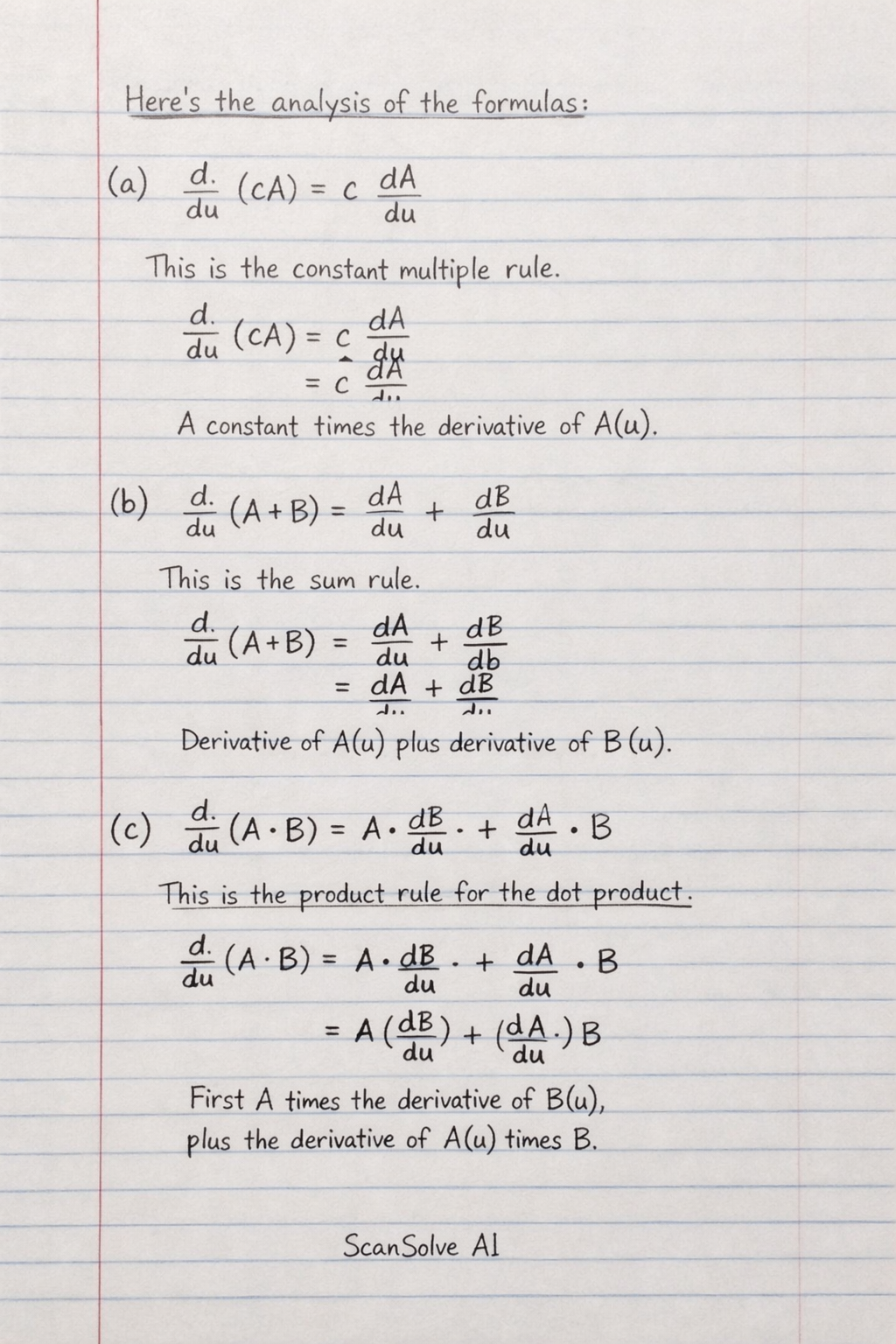
Here's the concept behind each formula: a)* (d)/(du)(cA) = c(dA)/(du) This is the constant multiple rule for vector differentiation. It states that the derivative of a constant scalar c multiplied by a vector function A(u) is equal to the constant scalar times the derivative of the vector function. b)* (d)/(du)(A+B) = (dA)/(du) + (dB)/(du) Assuming "AB" in the image refers to the sum A+B, this is the sum rule for vector differentiation. It states that the derivative of the sum of two vector functions A(u) and B(u) is the sum of their individual derivatives. c)* (d)/(du)(A · B) = A · (dB)/(du) + (dA)/(du) · B This is the product rule for the scalar (dot) product of two vector functions. It shows how to differentiate the dot product, similar to the scalar product rule, but maintaining the dot product operation. d)* (d)/(du)(A × B) = A × (dB)/(du) + (dA)/(du) × B This is the product rule for the vector (cross) product of two vector functions. It's similar to the scalar product rule, but it's crucial to maintain the original order of the vectors in the cross product due to its non-commutative nature. Drop the next question.