
We read your photo as:
The diagram below shows a regular pentagon ABCDE, centre O. The line OA lies on the north line, ON. Calculate (a) the size of AOB, (b) the bearing of E from O.
ScanSolve AI Answer
Answers
2 partsStep-by-step solution
6 stepsHere's how to solve the problem:
Part a· 3 steps
Calculate the size of .
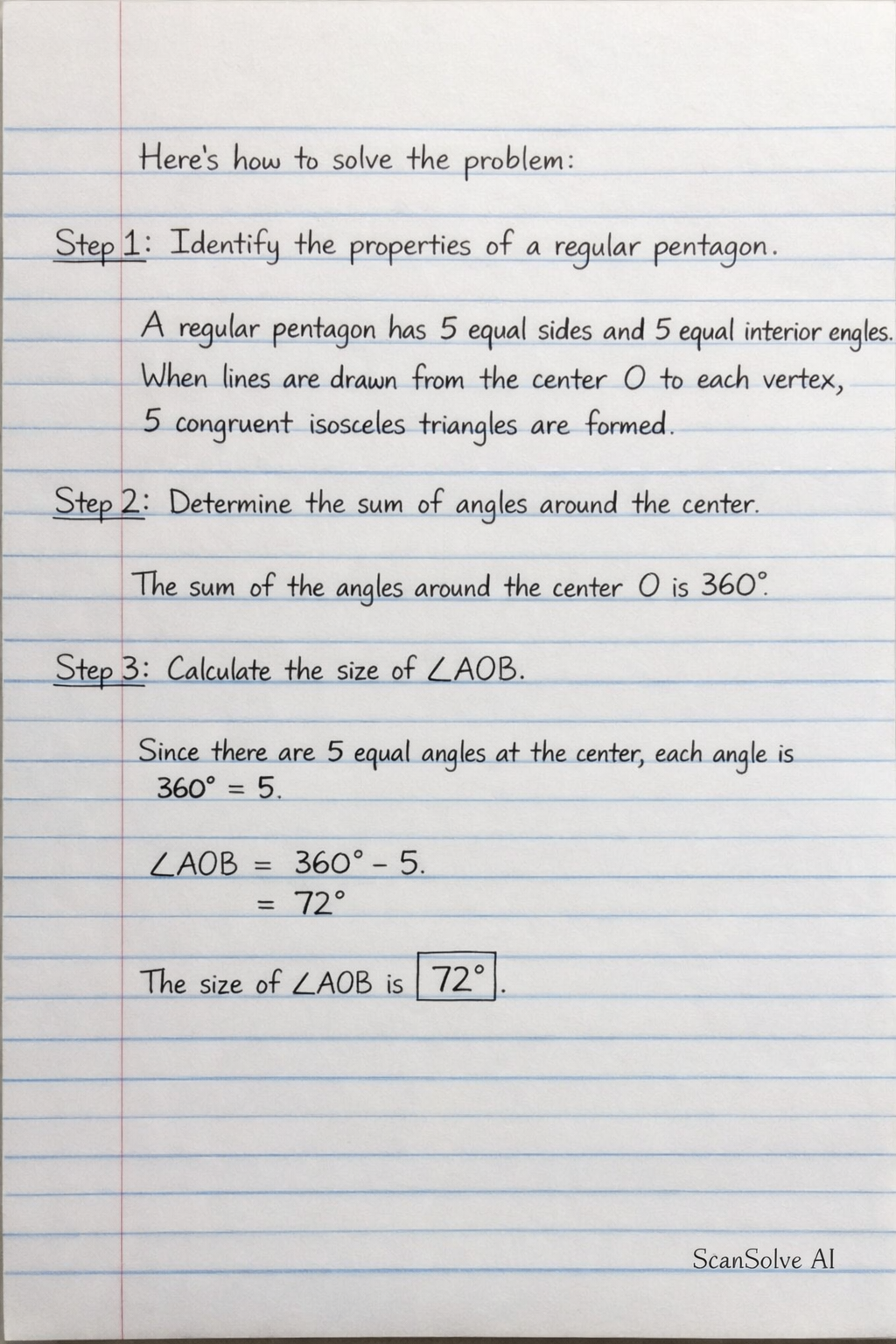
Identify the properties of a regular pentagon.
A regular pentagon has 5 equal sides and 5 equal interior angles. When lines are drawn from the center O to each vertex, 5 congruent isosceles triangles are formed.
Determine the sum of angles around the center.
The sum of the angles around the center O is .
Calculate the size of .
Since there are 5 equal angles at the center, each angle is divided by 5.
The size of is .
Part b
Calculate the bearing of E from O.
Understand what bearing means.
Bearing is the angle measured clockwise from the North line.
Identify the North line.
The problem states that the line OA lies on the North line, ON. So, the direction of OA is North ().
Determine the angle to OE.
The vertices of the pentagon are labeled A, B, C, D, E in a counter-clockwise direction. Each central angle (like ) is .
Starting from the North line (OA), we measure the angle clockwise to OE.- The bearing of B from O is .
- The bearing of C from O is .
- The bearing of D from O is .
- The bearing of E from O is . Bearings are typically written with three digits. The bearing of E from O is .
Try one yourself
A new problem that tests the same skill.
Still stuck on this one?
Ask a follow-up, and the answer starts from this question.
More Mathematics Questions
Handwritten Step-by-Step Solution
Get this as a handwritten image on WhatsApp — like a tutor wrote it for you.
Try on WhatsApp