
We read your photo as:
The diagram shows a cylindrical container of diameter 10 cm. It contains water to the depth of 4 cm. (i) Calculate the area of the container that is in contact with water. (ii) A solid cube of 6 cm sides is immersed into the cylinder. Calculate the new height of the level of water in the cylinder.
ScanSolve AI Answer
Answers
2 partsStep-by-step solution
6 stepsPart b(i)· 2 steps
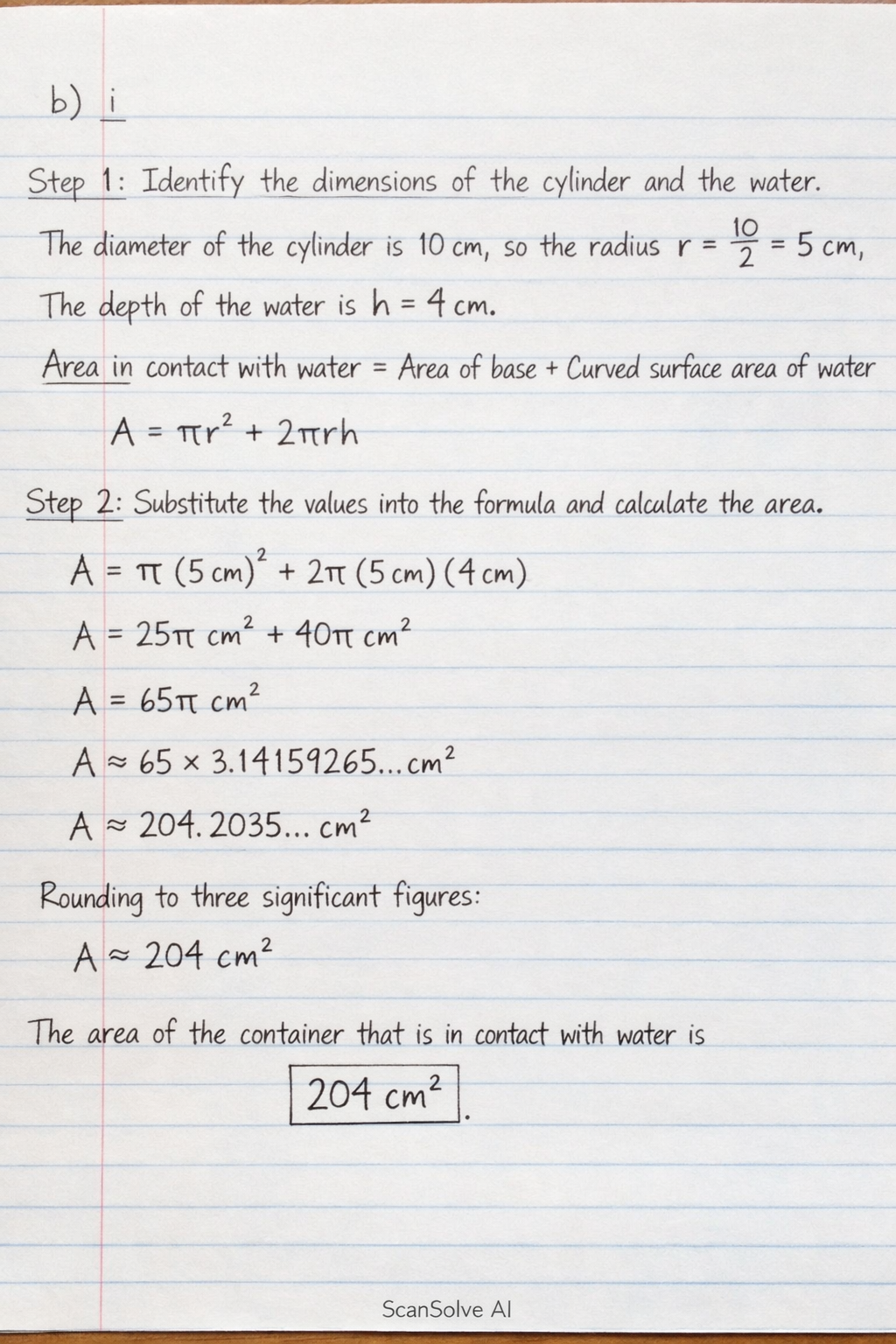
Identify the dimensions of the cylinder and the water.
The diameter of the cylinder is , so the radius .
The depth of the water is .
The area of the container in contact with water consists of the circular base and the curved surface area up to the water level.
Area in contact with water = Area of base + Curved surface area of waterSubstitute the values into the formula and calculate the area.
Rounding to three significant figures:
The area of the container that is in contact with water is .
Part b(ii)
Calculate the initial volume of water in the cylinder.
Initial volume of water
Calculate the volume of the solid cube.
The side of the cube is .
Volume of cubeDetermine the total volume when the cube is immersed.
Since the side of the cube (6 cm) is less than the diameter of the cylinder (10 cm), the cube fits inside the cylinder. Also, the height of the cube (6 cm) is greater than the initial water depth (4 cm), but we need to check if the new water level will fully submerge the cube.
The total volume occupied by water and the submerged cube is the sum of the initial water volume and the cube's volume.Calculate the new height of the water level.
The new total volume will occupy the cylindrical container with the same base area. Let the new height be .
Solve for :
Since is greater than the cube's height of , the cube is fully submerged, and our calculation is valid.
Rounding to three significant figures:The new height of the level of water in the cylinder is .
Try one yourself
A new problem that tests the same skill.
Still stuck on this one?
Ask a follow-up, and the answer starts from this question.
More Mathematics Questions
Handwritten Step-by-Step Solution
Get this as a handwritten image on WhatsApp — like a tutor wrote it for you.
Try on WhatsApp