
We read your photo as:
The diagram shows a prism, ABCDEF. AB = 13 cm, AC = 20 cm, CF = 24 cm and angle ABC = 90°. (a) Calculate the total surface area of the prism. (b) Calculate the angle that AF makes with the base BCPE.
ScanSolve AI Answer
Answers
2 partsStep-by-step solution
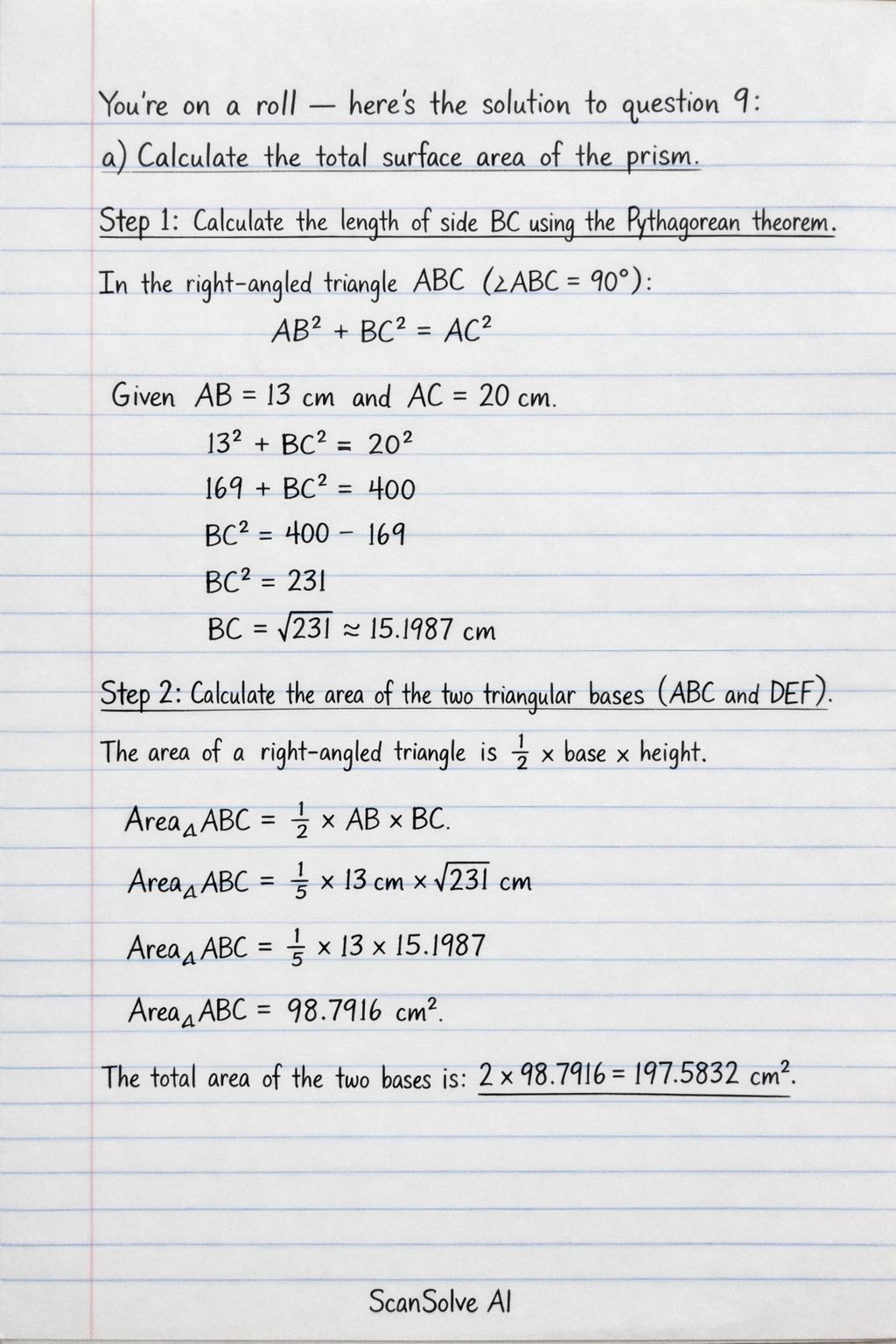
7 stepshere's the solution to question 9:
Part a· 4 steps
Calculate the total surface area of the prism.
Calculate the length of side BC using the Pythagorean theorem.
In the right-angled triangle ABC ():
Given cm and cm.
Calculate the area of the two triangular bases (ABC and DEF).
The area of a right-angled triangle is .
The total area of the two bases is .
Calculate the area of the three rectangular faces.
The height of the prism is cm.
Area of face ABED:Area of face BCFE:
Area of face ACFD:
Calculate the total surface area.
Rounding to three significant figures:
Part b
Calculate the angle that AF makes with the base BCPE.
Identify the relevant triangle and projection.
The angle that line AF makes with the base BCPE (which is rectangle BCFE) is the angle between AF and its projection onto the base. Since AB is perpendicular to the base (as and it's a right prism), the projection of A onto the base is B. Therefore, the projection of AF onto the base is BF. The angle required is .
Calculate the length of BF.
BF is the diagonal of the rectangle BCFE. In the right-angled triangle BCF:
We know and cm.
Calculate .
Consider the right-angled triangle ABF, where .
We have cm (opposite to ) and cm (adjacent to ).
Using the tangent function:Rounding to one decimal place:
Try one yourself
A new problem that tests the same skill.
Still stuck on this one?
Ask a follow-up, and the answer starts from this question.
More Mathematics Questions
Handwritten Step-by-Step Solution
Get this as a handwritten image on WhatsApp — like a tutor wrote it for you.
Try on WhatsApp