

This mathematics problem involves applying core mathematical principles and formulas. Below you will find a complete step-by-step solution with detailed explanations for each step, helping you understand not just the answer but the method behind it.
ScanSolve AI Answer
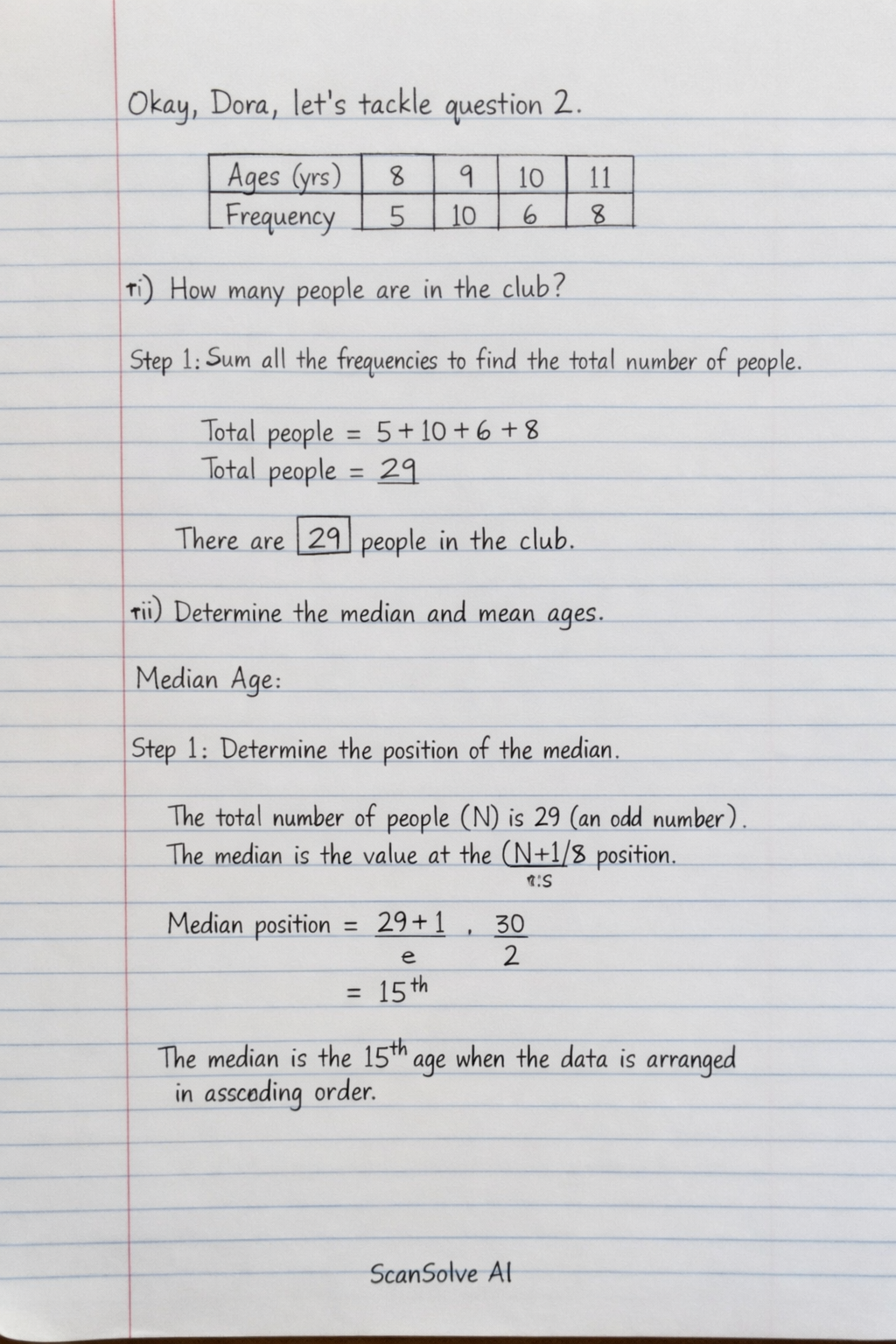
Okay, Dora, let's tackle question 2. The table shows the ages of members of a juvenile club: c — c — c — c — c Ages (yrs) & 8 & 9 & 10 & 11 \\ Frequency & 5 & 10 & 6 & 8 \\ i) How many people are in the club? Step 1: Sum all the frequencies to find the total number of people. Total people = 5 + 10 + 6 + 8 Total people = 29 There are 29 people in the club. ii) Determine the median and mean ages. Median Age: Step 1: Determine the position of the median. The total number of people (N) is 29 (an odd number). The median is the value at the (N+1)/(2) position. Median position = (29+1)/(2) = (30)/(2) = 15^th The median is the 15th age when the data is arranged in ascending order. Step 2: Find the 15th age using cumulative frequency. Ages 8: 5 members (cumulative: 5) Ages 9: 10 members (cumulative: 5+10=15) The 15th member's age falls within the group of ages 9. Specifically, the 15th age is 9. The median age is 9 years. Mean Age: Step 1: Calculate the sum of (age × frequency) for all ages. c — c — c Ages (x) & Frequency (f) & fx \\ 8 & 5 & 8 × 5 = 40 \\ 9 & 10 & 9 × 10 = 90 \\ 10 & 6 & 10 × 6 = 60 \\ 11 & 8 & 11 × 8 = 88 \\ Total & f = 29 & fx = 40+90+60+88 = 278 \\ Step 2: Calculate the mean using the formula x = ( fx)/( f). x = (278)/(29) x ≈ 9.586 The mean age is approximately 9.59 years. iii) What is the modal age? Step 1: Identify the age with the highest frequency from the table. Age 8 has a frequency of 5. Age 9 has a frequency of 10. Age 10 has a frequency of 6. Age 11 has a frequency of 8. The highest frequency is 10, which corresponds to the age of 9 years. The modal age is 9 years.