
We read your photo as:
The GCD of three numbers is 30 and their LCM is 900. Two of the numbers are 60 and 150. Find the least possible value of the third number.
ScanSolve AI Answer
Answers
3 partsStep-by-step solution
14 stepshere are the solutions to questions 9, 10, and 11:
Part 9· 4 steps
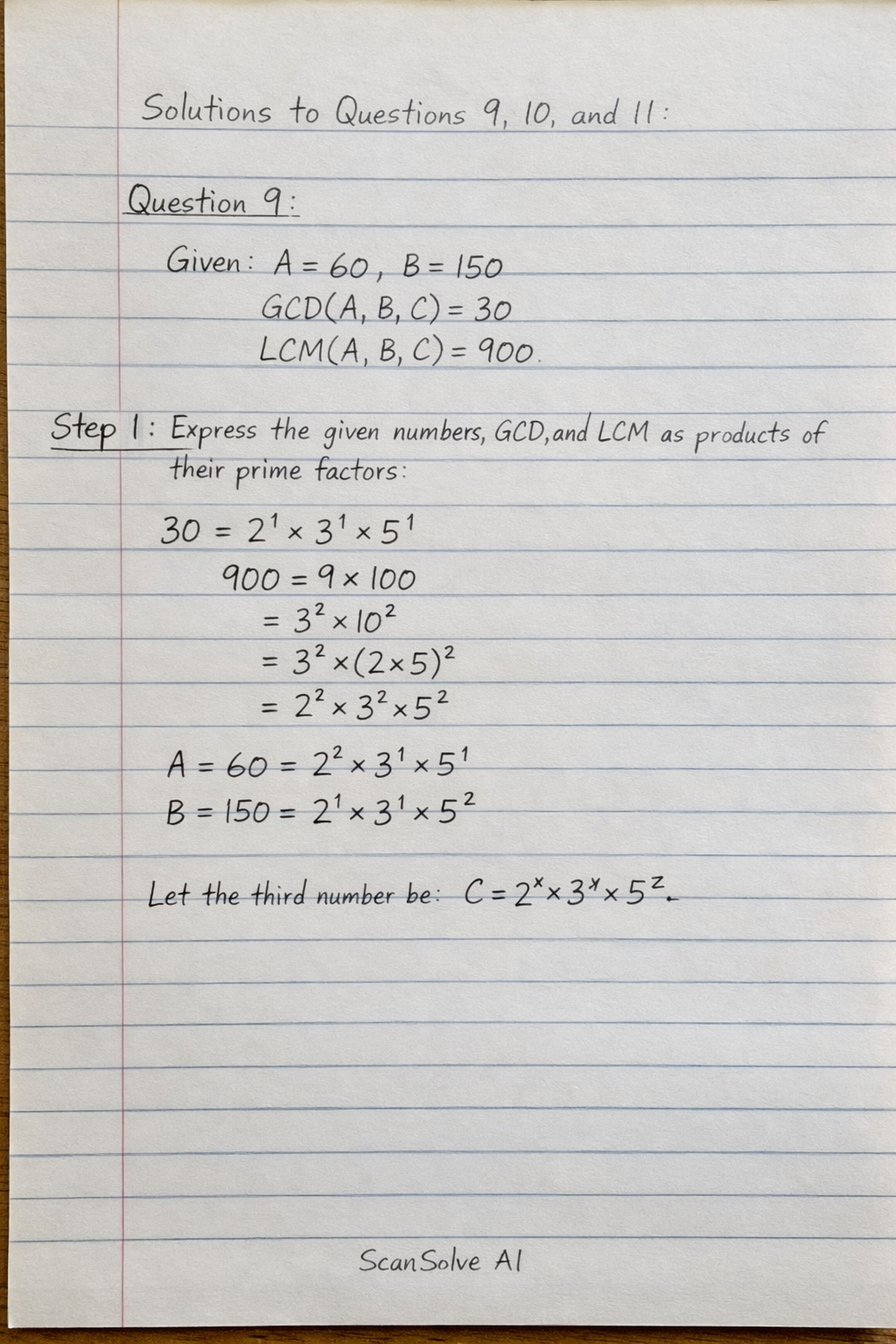
The GCD of three numbers is 30 and their LCM is 900. Two of the numbers are 60 and 150. We need to find the least possible value of the third number.
Let the three numbers be .
Given: , .
Express the given numbers, GCD, and LCM as products of their prime factors.
Let the third number be .
Use the properties of GCD to determine the minimum exponents.
For GCD, the exponent of each prime factor is the minimum of its exponents in the numbers.
This implies:
Use the properties of LCM to determine the maximum exponents.
For LCM, the exponent of each prime factor is the maximum of its exponents in the numbers.
This implies:
- (since )
- (since )
Determine the least possible value for .
To find the least possible value of , we choose the smallest possible exponents for that satisfy all conditions.
- For : and . The smallest possible integer value is .
- For : .
- For : . So, .
The least possible value of the third number is .
Part 10
Solve for in the equation .
Express all terms with a common base, which is 3.
Substitute these into the equation:
Apply the power rule .
Apply the product rule in the numerator.
Apply the quotient rule .
Equate the exponents since the bases are the same.
Solve for .
The value of is .
Part 118
The sum of interior angles of two regular polygons of sides and are in the ratio . Calculate the value of and hence find the size of each exterior angle of the polygon with sides.
Write the formula for the sum of interior angles of a polygon.
The sum of interior angles of a polygon with sides is .
Set up the ratio for the sums of interior angles.
For the polygon with sides: .
For the polygon with sides: .
The ratio means:Solve for .
Cancel out from the numerator and denominator:
Cross-multiply:
The value of is .
Find the size of each exterior angle of the polygon with sides.
The polygon has sides.
The formula for each exterior angle of a regular polygon with sides is .
For the polygon with sides:The size of each exterior angle of the polygon with sides is .
Try one yourself
A new problem that tests the same skill.
Still stuck on this one?
Ask a follow-up, and the answer starts from this question.
More Mathematics Questions
Handwritten Step-by-Step Solution
Get this as a handwritten image on WhatsApp — like a tutor wrote it for you.
Try on WhatsApp