
We read your photo as:
The geyser is cylindrical. Write the formula for the total surface area of a cylinder.
ScanSolve AI Answer
Step-by-step solution
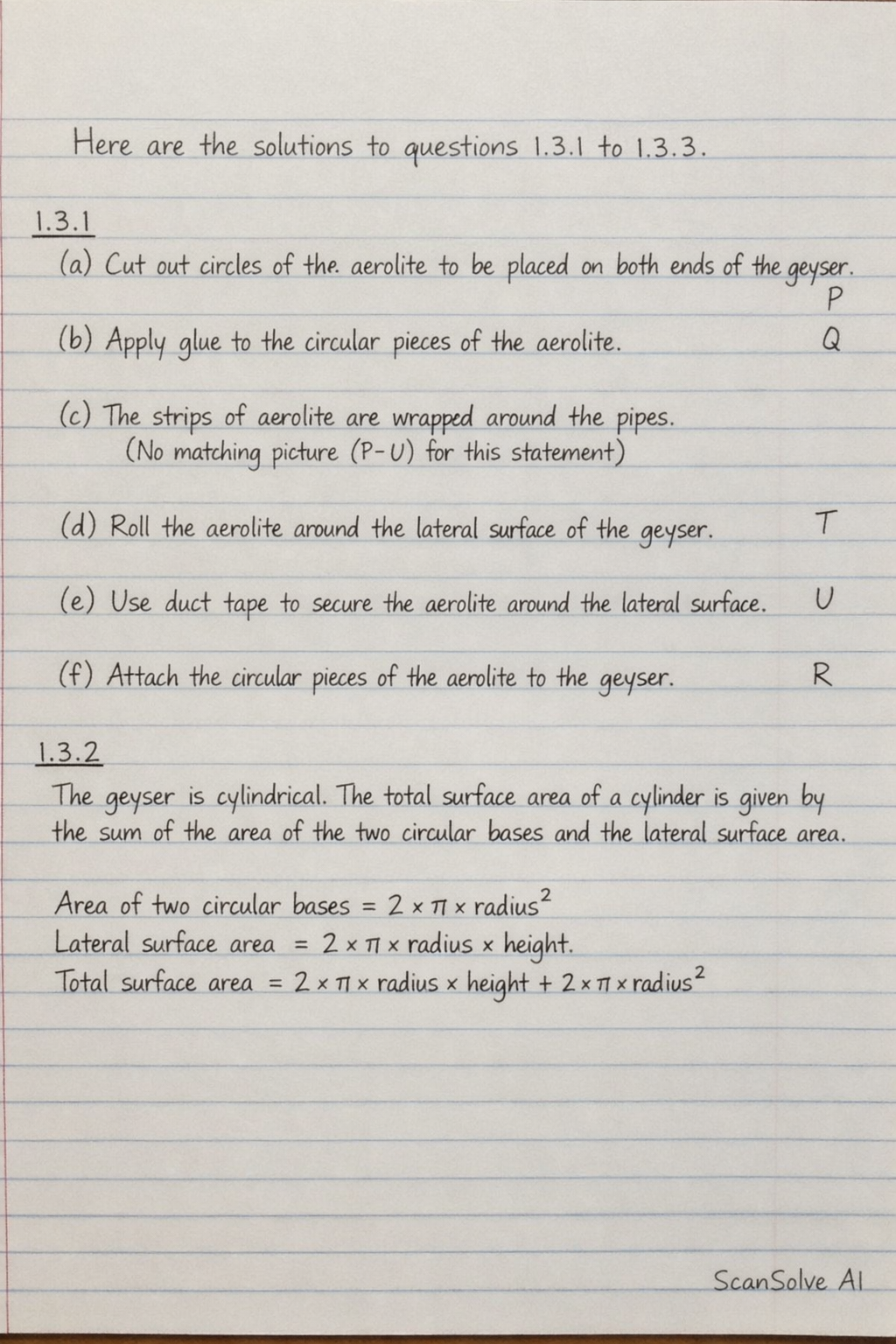
2 stepsHere are the solutions to questions 1.3.1 to 1.3.3.
1.3.1
a) Cut out circles of the aerolite to be placed on both ends of the geyser.
P
b) Apply glue to the circular pieces of the aerolite.
Q
c) The strips of aerolite are wrapped around the pipes.
There is no matching picture (P-U) for this statement, as the pictures show wrapping the geyser, not pipes.
d) Roll the aerolite around the lateral surface of the geyser.
T
e) Use duct tape to secure the aerolite around the lateral surface.
U
f) Attach the circular pieces of the aerolite to the geyser.
R
1.3.2
The geyser is cylindrical. The total surface area of a cylinder is given by the sum of the area of the two circular bases and the lateral surface area.
Area of two circular bases
Lateral surface area
Total surface area
Comparing this with the given options:
A:
B:
C:
D:
The correct formula is option C.
The letter next to the question number (1.3.2) is C.
1.3.3
Identify the conversion factor between meters (m) and millimeters (mm).
Convert the given length from meters to millimeters.
The length of the geyser in mm is .
Still stuck on this one?
Ask a follow-up, and the answer starts from this question.
More Mathematics Questions
Handwritten Step-by-Step Solution
Get this as a handwritten image on WhatsApp — like a tutor wrote it for you.
Try on WhatsApp