
We read your photo as:
What is the greatest number that can divide 36 without leaving a remainder?
ScanSolve AI Answer
Step-by-step solution
18 stepsQuestion 8:
Find the total number of parts in the ratio.
The ratio of boys to girls is .
Total parts .Calculate the number of girls.
There are 200 learners in total. The girls represent 3 out of 5 parts.
Number of girls .Simplify the expression.
Number of girls .
The number of girls is .Question 9:
Find the factors of 36.
Factors of 36 are $1, 2, 3, 4, 6, 9, 12, 18, 36$.
Find the factors of 54.
Factors of 54 are $1, 2, 3, 6, 9, 18, 27, 54$.
Identify the greatest common factor (GCD).
The common factors are . The greatest among these is 18.
The greatest number that can divide 36 and 54 without leaving a remainder is c) 18.
The answer is .Question 10:
Calculate each term in the expression.
Add the terms together.
.
The short form is .Question 11:
Identify the numbers to arrange.
The numbers are .
Arrange the numbers in descending order (from largest to smallest).
Start with the largest positive numbers, then zero, then the largest (least negative) negative numbers.
.
The numbers in descending order are .Question 12 A:
Convert the actual distance to centimeters.
The actual distance is .
So, .
Actual distance .Use the map scale to find the length on the drawing.
The scale is , which means .
Length on drawing .
Length on drawing .Calculate the length on the drawing.
Length on drawing .
None of the options match . Let's recheck the calculation or options.
If the scale is , then map distance = actual distance / 1,50,000.
Map distance .
.Let's re-examine the options and the question. It's possible there's a typo in the question or options.
If the question meant 1.5 km, then:
Map distance .Let's assume there might be a typo in the scale or the actual distance, or the options.
If the actual distance was , then map distance . This matches option a).
Given the options, it's highly probable that the actual distance was intended to be to match option a) .
However, based strictly on the given :
Length on drawing .
Converting to centimeters: .
Since is not an option, and is not an option, let's check if any option is .
. This would imply the actual distance was .Given the discrepancy, I will state the answer based on the provided numbers and note the mismatch.
Length on drawing .
Since is not among the options, and is also not an option, there might be an error in the question or options. If we assume the answer should be one of the options, and (option a) is a common answer for such problems, it would imply the actual distance was .
However, sticking to the given numbers:
Length on drawing .
As this is not an option, I cannot select one. If forced to choose the closest or most likely intended answer based on typical exam patterns, it's often that (option a) is the answer for a distance. Without clarification, I cannot definitively pick an option.Let's assume the question intended for the answer to be (option a), which would mean the actual distance was .
If actual distance :
Length on drawing .
So, if the actual distance was , the answer would be a) 30cm.
Given the problem as stated, the calculated answer is . Since this is not an option, I cannot provide a definitive option from the list.Question 12 B:
Write the formula for the circumference of a circle.
The circumference .
Substitute the given values.
Given radius and .
.Calculate the circumference.
.
The circumference of the circle is .Question 13:
Break down the number into its place values.
"Six million" means 6,000,000.
"Fourteen thousand" means 14,000.
"Three hundred forty" means 340.Combine the parts.
.
The number in figures is .
Still stuck on this one?
Ask a follow-up, and the answer starts from this question.
More Mathematics Questions
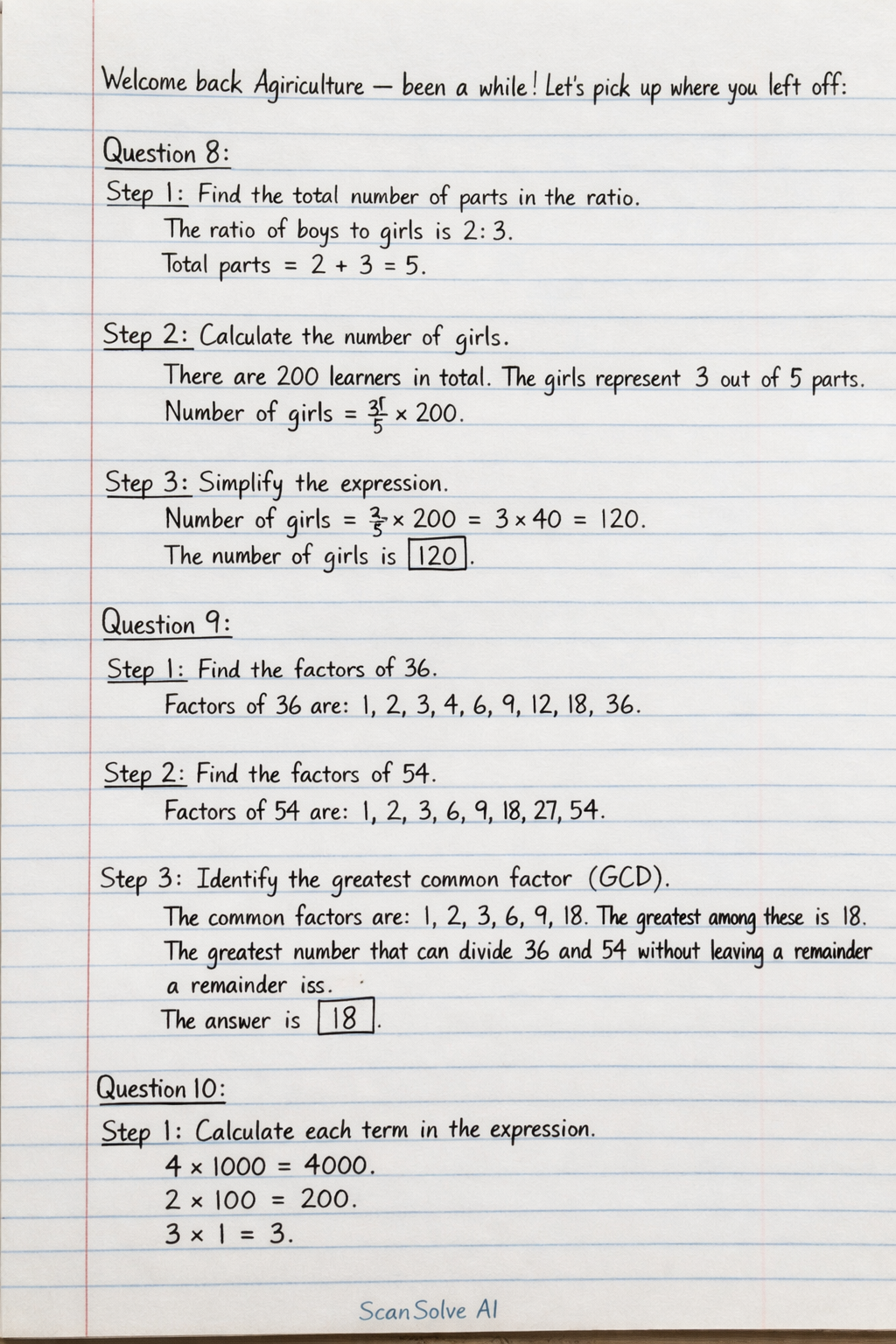
Handwritten Step-by-Step Solution
Get this as a handwritten image on WhatsApp — like a tutor wrote it for you.
Try on WhatsApp