

This mathematics problem involves applying core mathematical principles and formulas. Below you will find a complete step-by-step solution with detailed explanations for each step, helping you understand not just the answer but the method behind it.
ScanSolve AI Answer
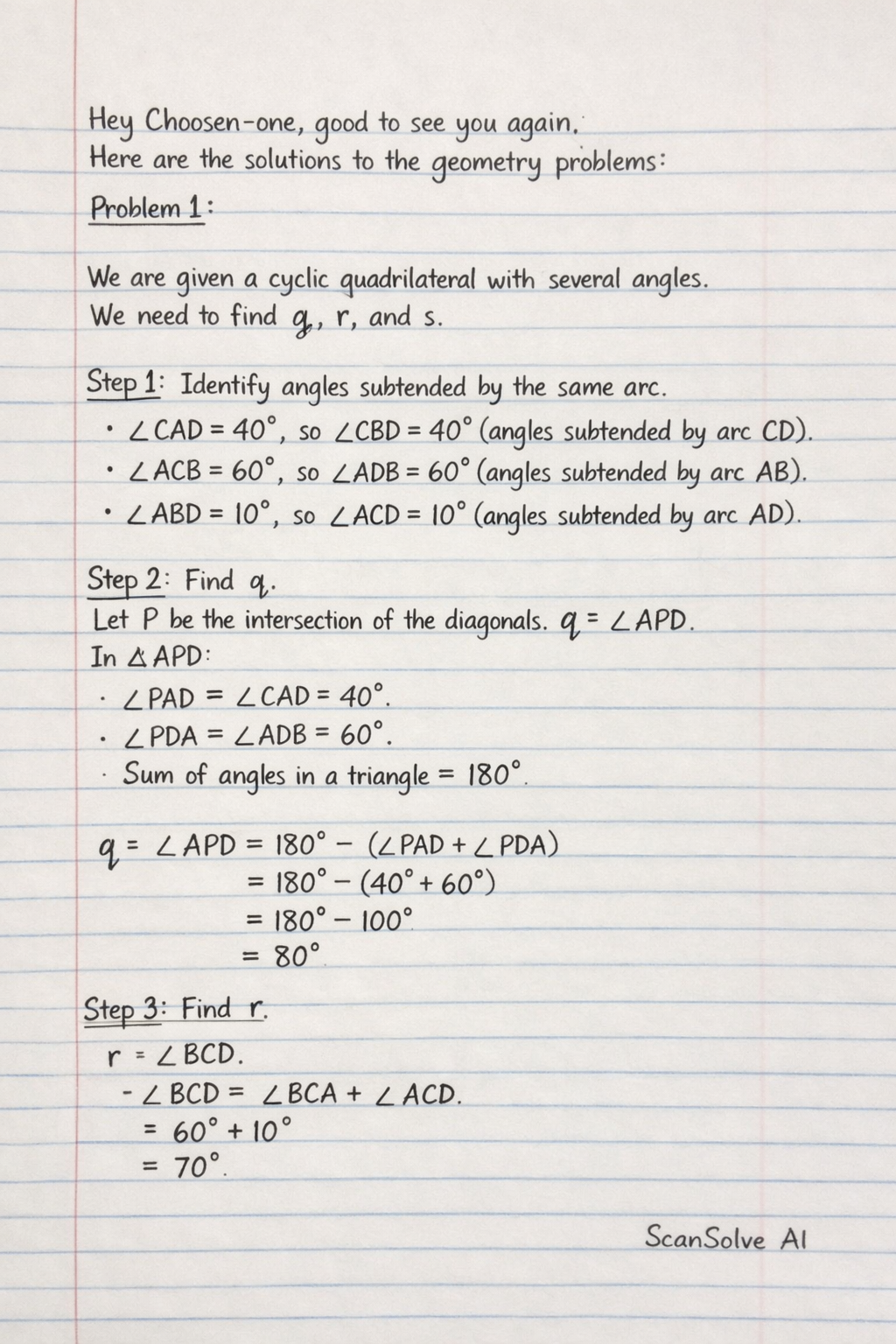
Here are the solutions to the geometry problems: Problem 1: We are given a cyclic quadrilateral with several angles. We need to find q, r, and s. Step 1: Identify angles subtended by the same arc. • CAD = 40^, so CBD = 40^ (angles subtended by arc CD). • ACB = 60^, so ADB = 60^ (angles subtended by arc AB). • ABD = 10^, so ACD = 10^ (angles subtended by arc AD). Step 2: Find q. Let P be the intersection of the diagonals. q is APD. In APD: PAD = CAD = 40^. PDA = ADB = 60^. The sum of angles in a triangle is 180^. q = APD = 180^ - ( PAD + PDA) = 180^ - (40^ + 60^) = 180^ - 100^ = 80^ Step 3: Find r. r is BCD. BCD = BCA + ACD = 60^ + 10^ = 70^ Step 4: Find s. s is ADC. In a cyclic quadrilateral, opposite angles sum to 180^. First, find ABC: ABC = ABD + DBC = 10^ + 40^ = 50^ Now, find s: s = ADC = 180^ - ABC = 180^ - 50^ = 130^ The values are: q = 80^, r = 70^, s = 130^ Problem 2: We are given a circle with center O and a cyclic quadrilateral. We need to find g and h. Step 1: Find h. The angle 30^ is OQR. Since O is the center, OQ and OR are radii, making OQR an isosceles triangle. Therefore, ORQ = OQR = 30^. The sum of angles in OQR is 180^. h = QOR = 180^ - ( OQR + ORQ) = 180^ - (30^ + 30^) = 180^ - 60^ = 120^ Step 2: Find g. g is QSR. This is an angle at the circumference subtended by arc QR. QOR is the central angle subtended by the same arc QR. The angle at the circumference is half the angle at the center. g = QSR = (1)/(2) QOR = (1)/(2) × 120^ = 60^ The 126^ angle is QPS, which is consistent with the other angles but not needed for finding g and h. The values are: g = 60^, h = 120^ Problem 3: We are given a cyclic quadrilateral WXYZ with equal chords WX = XY = YZ. We need to find WYX and YWZ. Step 1: Determine the measure of the arcs. Given WZY = 42^. This angle subtends arc WXY. The measure of the arc is twice the angle at the circumference. arc WXY = 2 × WZY = 2 × 42^ = 84^ Since chords WX = XY = YZ are equal, the arcs they subtend are also equal. Let arc WX = arc XY = arc YZ = x_arc. Then arc WXY = arc WX + arc XY = x_arc + x_arc = 2x_arc. 2x_arc = 84^ x_arc = 42^ So, arc WX = 42^, arc XY = 42^, and arc YZ = 42^. Step 2: Find WYX. WYX subtends arc WX. WYX = (1)/(2) × arc WX = (1)/(2) × 42^ = 21^ Step 3: Find YWZ. YWZ subtends arc YZ. YWZ = (1)/(2) × arc YZ = (1)/(2) × 42^ = 21^ The values are: i) WYX = 21^, ii) YWZ = 21^ Problem 4: We are given a cyclic quadrilateral ABCD with equal chords AB = BC = CD. We need to find ACD and ADC. Step 1: Relate angles using equal chords. Since chords AB = BC = CD are equal, they subtend equal angles at the circumference. Let ADB = BDC = CAD = . Also, BCA subtends arc AB, so BCA = . And CBD subtends arc CD, so CBD = . Step 2: Find in terms of p. Given BCD = p^. We know BCD = BCA + ACD. Also, consider BCD. The angles are CBD, BDC, and BCD. CBD + BDC + BCD = 180^ + + p^ = 180^ 2 + p^ = 180^ = (180^ - p^)/(2) = 90^ - (p^)/(2) Step 3: Find ACD. We know BCD = BCA + ACD. p^ = + ACD ACD = p^ - Substitute the expression for : ACD = p^ - (90^ - (p^)/(2)) = p^ - 90^ + (p^)/(2) = (2p^ + p^)/(2) - 90^ = (3p^)/(2) - 90^ Step 4: Find ADC. ADC subtends arc ABC. Arc ABC = arc AB + arc BC. The angle subtended by arc AB at the circumference is . So arc AB = 2. The angle subtended by arc BC at the circumference is . So arc BC = 2. Thus, arc ABC = 2 + 2 = 4. The angle at the circumference subtended by arc ABC is ADC. ADC = (1)/(2) × arc ABC = (1)/(2) (4) = 2 Substitute the expression for : ADC = 2(90^ - (p^)/(2)) = 180^ - p^ The values are: i) ACD = (3p^)/(2) - 90^, ii) ADC = 180^ - p^ Drop the next question! 📸