We read your photo as:

The image shows a triangle ABC with a point D on BC. AD is perpendicular to AC. If AC = 5, AB = 13, and AD = 12, find the length of CD.

Mathematics

ScanSolve AI Answer

Answer

x=arctan⁡(125)≈67.38∘x = \mathbf{\arctan\left(\frac{12}{5}\right) \approx 67.38^\circ}

y=arctan⁡(512)≈22.62∘y = \mathbf{\arctan\left(\frac{5}{12}\right) \approx 22.62^\circ}

Step-by-step solution

4 steps

Here's how to find the values of xx and yy:

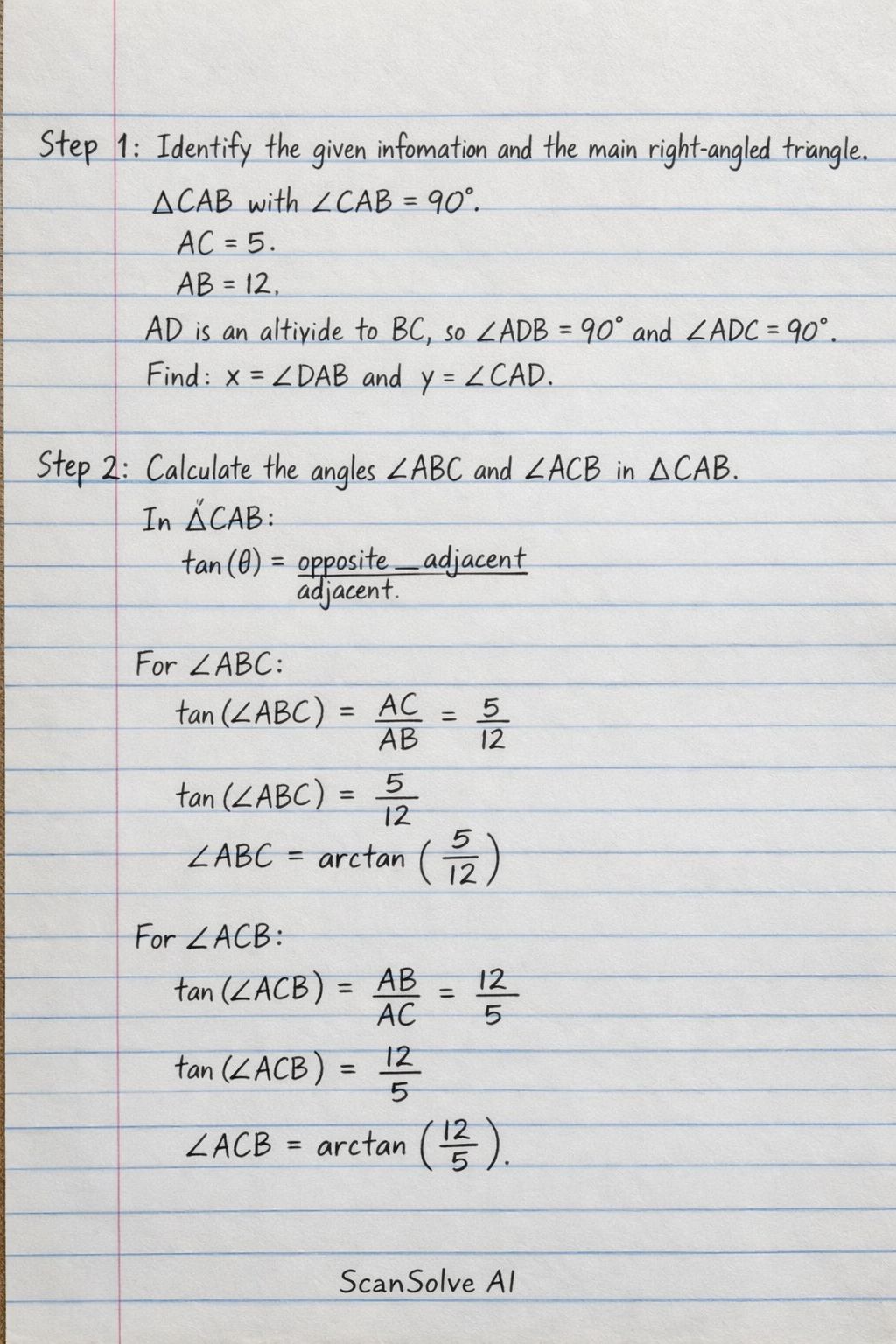
  1. Identify the given information and the main right-angled triangle.

    The image shows △CAB\triangle CAB with ∠CAB=90∘\angle CAB = 90^\circ.
    The length of side AC=5AC = 5.
    The length of side AB=12AB = 12.
    ADAD is an altitude to BCBC, which means ∠ADB=90∘\angle ADB = 90^\circ and ∠ADC=90∘\angle ADC = 90^\circ.
    We need to find the angles x=∠DABx = \angle DAB and y=∠CADy = \angle CAD.

  2. Calculate the angles ∠ABC\angle ABC and ∠ACB\angle ACB in △CAB\triangle CAB.

    In the right-angled triangle △CAB\triangle CAB:
    We can use the tangent function, which is tan⁡(θ)=oppositeadjacent\tan(\theta) = \frac{\text{opposite}}{\text{adjacent}}.
    For ∠ABC\angle ABC:

    tan⁡(∠ABC)=ACAB=512\tan(\angle ABC) = \frac{AC}{AB} = \frac{5}{12} ∠ABC=arctan⁡(512)\angle ABC = \arctan\left(\frac{5}{12}\right)

    For ∠ACB\angle ACB:

    tan⁡(∠ACB)=ABAC=125\tan(\angle ACB) = \frac{AB}{AC} = \frac{12}{5} ∠ACB=arctan⁡(125)\angle ACB = \arctan\left(\frac{12}{5}\right)
  3. Determine angle xx using △ADB\triangle ADB.

    In the right-angled triangle △ADB\triangle ADB, the sum of angles is 180∘180^\circ.
    We have ∠ADB=90∘\angle ADB = 90^\circ, ∠DAB=x\angle DAB = x, and ∠ABD=∠ABC\angle ABD = \angle ABC.
    Therefore, x+∠ABC+90∘=180∘x + \angle ABC + 90^\circ = 180^\circ.

    x=90∘−∠ABCx = 90^\circ - \angle ABC

    Substitute the value of ∠ABC\angle ABC:

    x=90∘−arctan⁡(512)x = 90^\circ - \arctan\left(\frac{5}{12}\right)

    Using the trigonometric identity 90∘−arctan⁡(k)=arctan⁡(1k)90^\circ - \arctan(k) = \arctan\left(\frac{1}{k}\right):

    x=arctan⁡(125)x = \arctan\left(\frac{12}{5}\right)

    Calculating the numerical value:

    x≈67.38∘x \approx 67.38^\circ
  4. Determine angle yy using △ADC\triangle ADC.

    In the right-angled triangle △ADC\triangle ADC, the sum of angles is 180∘180^\circ.
    We have ∠ADC=90∘\angle ADC = 90^\circ, ∠CAD=y\angle CAD = y, and ∠ACD=∠ACB\angle ACD = \angle ACB.
    Therefore, y+∠ACB+90∘=180∘y + \angle ACB + 90^\circ = 180^\circ.

    y=90∘−∠ACBy = 90^\circ - \angle ACB

    Substitute the value of ∠ACB\angle ACB:

    y=90∘−arctan⁡(125)y = 90^\circ - \arctan\left(\frac{12}{5}\right)

    Using the trigonometric identity 90∘−arctan⁡(k)=arctan⁡(1k)90^\circ - \arctan(k) = \arctan\left(\frac{1}{k}\right):

    y=arctan⁡(512)y = \arctan\left(\frac{5}{12}\right)

    Calculating the numerical value:

    y≈22.62∘y \approx 22.62^\circ

    The values of the angles are:
    x=arctan⁡(125)≈67.38∘x = \boxed{\mathbf{\arctan\left(\frac{12}{5}\right) \approx 67.38^\circ}}
    y=arctan⁡(512)≈22.62∘y = \boxed{\mathbf{\arctan\left(\frac{5}{12}\right) \approx 22.62^\circ}}

Was this helpful?

Try one yourself

A new problem that tests the same skill.

Still stuck on this one?

Ask a follow-up, and the answer starts from this question.

Got a different question?Ask your own question
Handwritten step-by-step solution preview

Handwritten Step-by-Step Solution

Get this as a handwritten image on WhatsApp — like a tutor wrote it for you.

Try on WhatsApp