
We read your photo as:
The larger container in (a) above has a volume of 875 cm³. Calculate the volume of the smaller container.
ScanSolve AI Answer
Answer
Step-by-step solution
3 stepsPart b
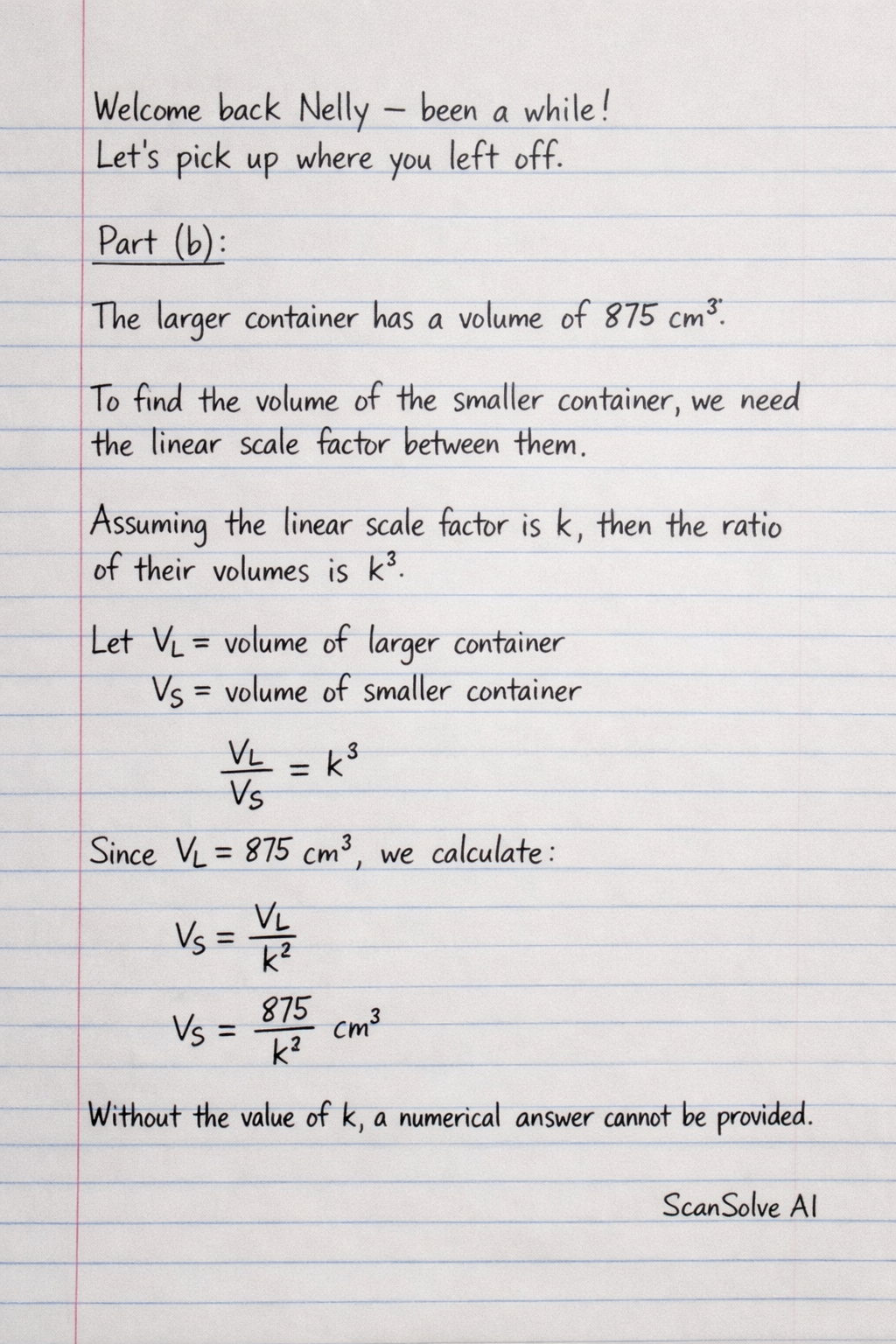
The problem states that the larger container has a volume of . To calculate the volume of the smaller container, we need the linear scale factor between the two similar containers. This scale factor is typically provided in part (a) of the question, which is not visible here.
Assuming the linear scale factor from the smaller container to the larger container is , then the ratio of their volumes is .
Let be the volume of the larger container and be the volume of the smaller container.
Given , we would calculate as:
Without the value of (the linear scale factor), a numerical answer cannot be provided.
Part c(1, 2)
Three conditions necessary for two solids to be similar are:
- All corresponding linear dimensions (e.g., lengths, widths, heights, radii) must be in the same constant ratio (scale factor).
- All corresponding angles (e.g., angles between faces, angles within faces) must be equal.
- The solids must have the same shape and the same number of corresponding faces, edges, and vertices.
Part 27(a):
We are given the vertices of triangle ABC and its image A'B'C' after an enlargement.
Original vertices: $A(1, 2)$, $B(3, 2)$, $C(3, 5)$
Image vertices: $A'(1, 2)$, $B'(7, 2)$, $C'(7, 11)$
Observe the coordinates of the original point A and its image A'.
We have $A(1, 2)$ and $A'(1, 2)$. Since the coordinates of A and A' are identical, point A is invariant under the enlargement.
Identify the center of enlargement.
If a point remains unchanged after an enlargement, that point is the center of enlargement.
Therefore, the center of enlargement is $A(1, 2)$.(Optional) Verify the scale factor using other points.
Let the center of enlargement be .
For point B:
Vector
Vector
The scale factor is found by , so , which implies .For point C:
Vector
Vector
The scale factor is found by , so , which implies and .
The scale factor is consistently 3.The coordinates of the center of enlargement are .
Try one yourself
A new problem that tests the same skill.
Still stuck on this one?
Ask a follow-up, and the answer starts from this question.
More Mathematics Questions
Handwritten Step-by-Step Solution
Get this as a handwritten image on WhatsApp — like a tutor wrote it for you.
Try on WhatsApp