
We read your photo as:
The length, l cm, of a sheet of paper is 29.7 cm, correct to the nearest millimeter. Complete the statement about the value of l.
ScanSolve AI Answer
Step-by-step solution
7 stepsHere are the solutions to the problems from the image:
8. The length, cm, of a sheet of paper is 29.7 cm, correct to the nearest millimeter. Complete the statement about the value of .
To find the lower and upper bounds when a measurement is given to the nearest millimeter (which is 0.1 cm), we take half of the precision (0.1 cm / 2 = 0.05 cm).
Calculate the lower bound.
Lower bound =
Calculate the upper bound.
Upper bound =
The value of is between the lower bound (inclusive) and the upper bound (exclusive).
9. Lucia invests $5000 at a rate of 4.5% per year simple interest. Calculate the value of her investment after 7 years.
Calculate the simple interest earned.
The formula for simple interest is , where is the principal, is the annual interest rate, and is the time in years.
Calculate the total value of the investment.
Total value = Principal + Interest The value of her investment after 7 years is
\boxed{\6575}$.10. Rectangle A measures 3 cm by 8 cm. Five rectangles congruent to A are joined to make a shape. Work out the perimeter of the shape.
Each rectangle has dimensions: width = 3 cm, length = 8 cm.
Let's trace the outer edges of the combined shape shown in the diagram.Identify and sum the horizontal segments of the perimeter.
- There are three horizontal segments at the top of the shape: 3 cm (left), 8 cm (middle), 3 cm (right).
- There are three horizontal segments at the bottom of the shape: 3 cm (left), 8 cm (middle), 3 cm (right). Total horizontal perimeter = Total horizontal perimeter = .
Identify and sum the vertical segments of the perimeter.
- There are two outer vertical segments on the far left: 8 cm (top) + 8 cm (bottom).
- There are two outer vertical segments on the far right: 8 cm (top) + 8 cm (bottom).
- There are four inner vertical segments where the central horizontal rectangle connects to the vertical rectangles. Each of these segments is 3 cm (the width of a rectangle). Total vertical perimeter = Total vertical perimeter = .
Calculate the total perimeter.
Total perimeter = Total horizontal perimeter + Total vertical perimeter
Total perimeter =
Total perimeter = .
The perimeter of the shape is .
Still stuck on this one?
Ask a follow-up, and the answer starts from this question.
More Mathematics Questions
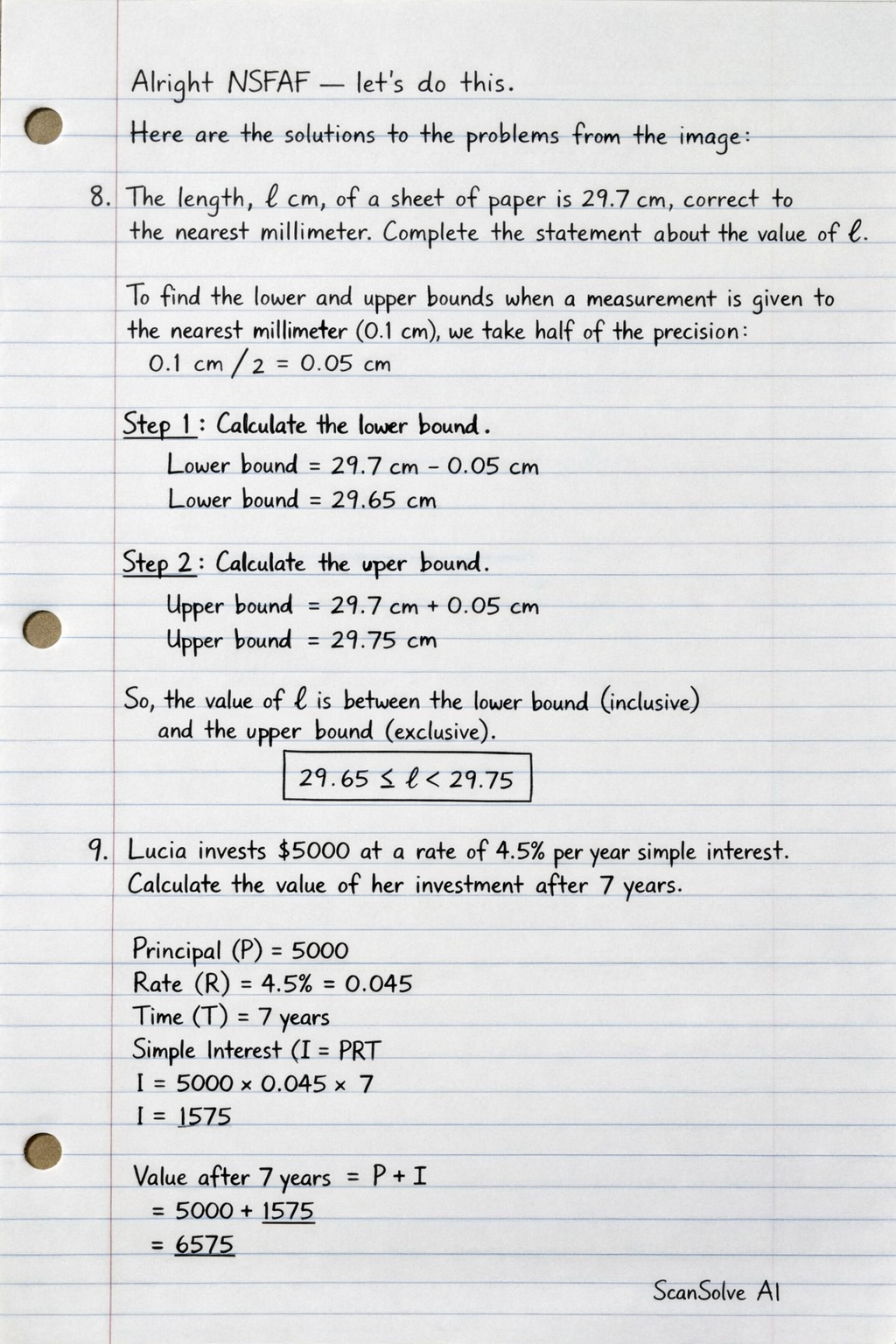
Handwritten Step-by-Step Solution
Get this as a handwritten image on WhatsApp — like a tutor wrote it for you.
Try on WhatsApp