
We read your photo as:
What is the maximum reading on these scales?
Mathematics
ScanSolve AI Answer
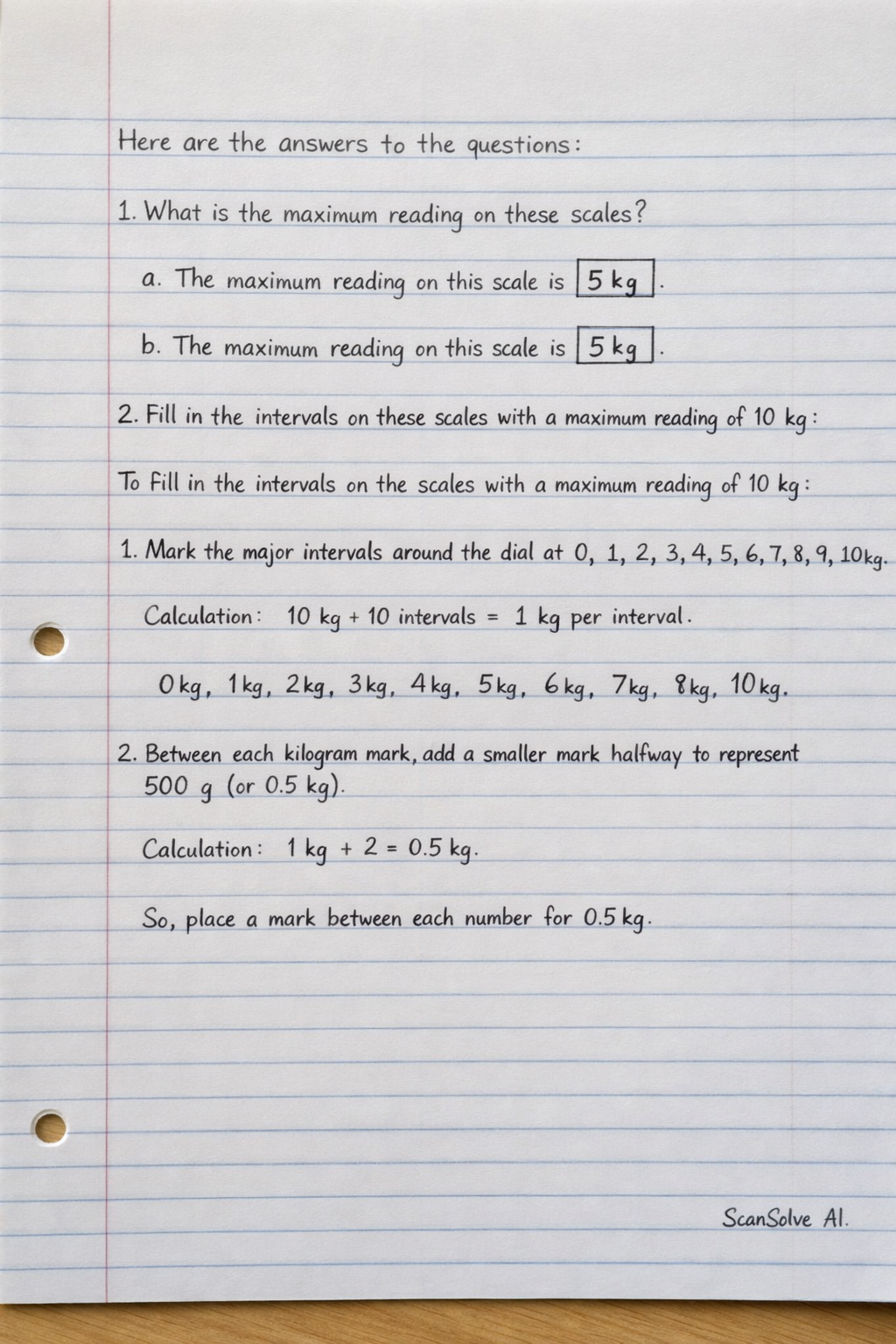
Here are the answers to the questions:
1. What is the maximum reading on these scales?
- a. The maximum reading on this scale is .
- b. The maximum reading on this scale is .
2. Fill in the intervals on these scales with a maximum reading of 10 kg.
To fill in the intervals on the scales with a maximum reading of 10 kg:
- Mark the major intervals around the dial at and 10 kg.
- Between each kilogram mark, add a smaller mark halfway to represent 500 g (or 0.5 kg).
5. Do this practical activity using a kitchen scale and suitable objects.
- We see that the apple weighs 167 g.
- Find objects that weigh about:
- 20 g: A small handful of coins, a large marshmallow
- 90 g: A small bar of soap, a medium-sized egg
- 35 g: A small chocolate bar, a small packet of crisps
- 67 g: A small orange, a medium-sized apple
- 500 g: A standard bag of sugar, a small loaf of bread
- Find objects that weigh about:
- The meat weighs 2 kg 850 g.
- Find objects that weigh about:
- 3 kg: A small bag of potatoes, a large chicken
- 1 kg 500 g: A 1.5-liter bottle of water, a small bag of rice
- 3 kg 200 g: A small bag of potatoes, a large roast
- 2 kg 900 g: A small bag of flour, a large roast
- 4 kg 750 g: A large bag of flour, a a small pet (e.g., a cat)
- Find objects that weigh about:
Was this helpful?
Still stuck on this one?
Ask a follow-up, and the answer starts from this question.
Got a different question?Ask your own question
More Mathematics Questions
QHow much do the objects weigh on these scales which have a maximum reading of 10 kg?QWhat are the readings on the spring scales, given the markings and plunger positions? Specifically…QRead the main scale reading.QDetermine the Main Scale Reading (MSR).QRead and write the mass on each of the scales in: a) grams b) kilograms.
Handwritten Step-by-Step Solution
Get this as a handwritten image on WhatsApp — like a tutor wrote it for you.
Try on WhatsApp