

This mathematics problem involves applying core mathematical principles and formulas. Below you will find a complete step-by-step solution with detailed explanations for each step, helping you understand not just the answer but the method behind it.
ScanSolve AI Answer
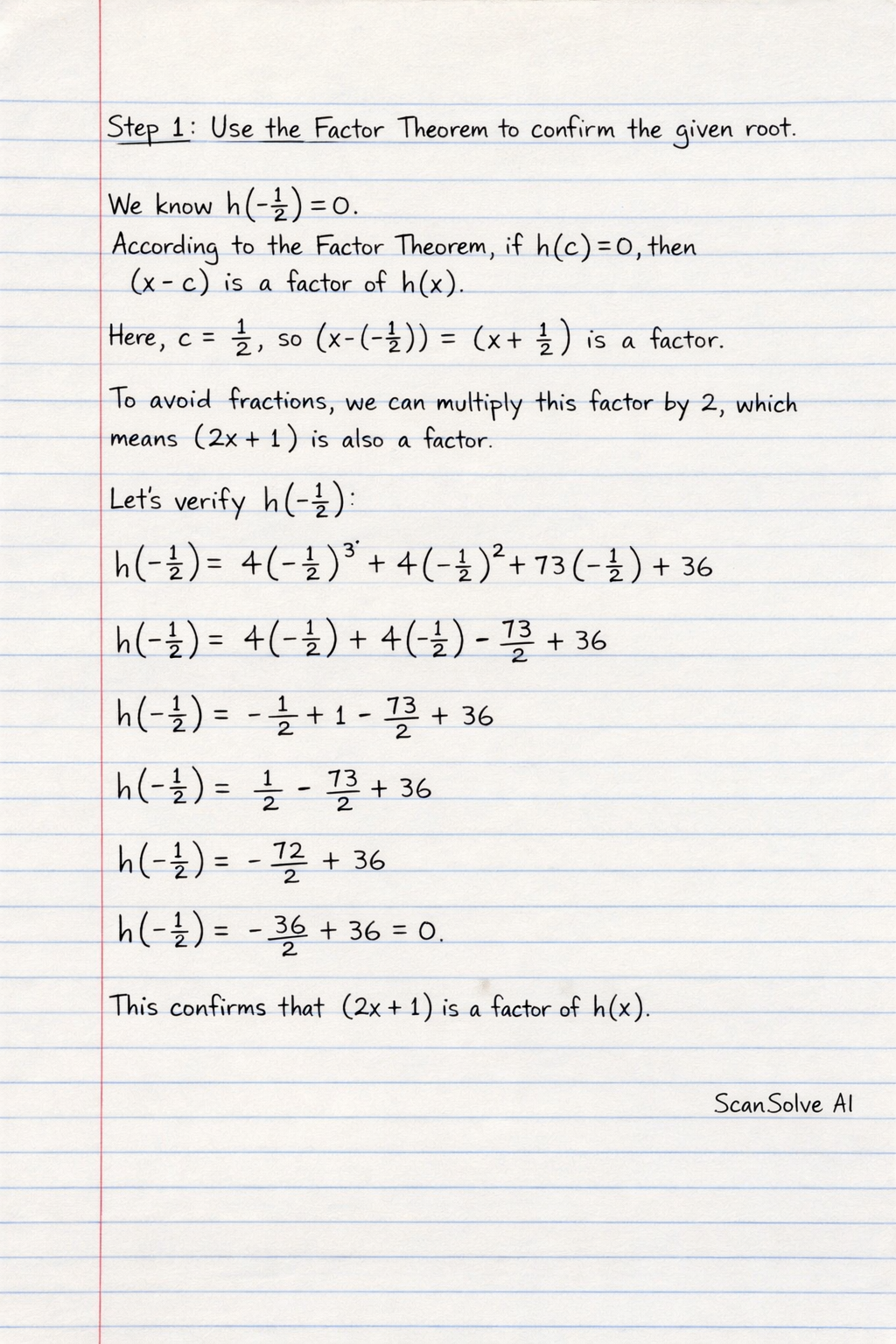
Step 1: Use the Factor Theorem to confirm the given root. The problem states that h(-(1)/(2)) = 0. According to the Factor Theorem, if h(c)=0, then (x-c) is a factor of h(x). Here, c = -(1)/(2), so (x - (-(1)/(2))) = (x + (1)/(2)) is a factor. To avoid fractions, we can multiply this factor by 2, which means (2x+1) is also a factor. Let's verify h(-(1)/(2)): h(-(1)/(2)) = 4(-(1)/(2))^3 + 4(-(1)/(2))^2 + 73(-(1)/(2)) + 36 h(-(1)/(2)) = 4(-(1)/(8)) + 4((1)/(4)) - (73)/(2) + 36 h(-(1)/(2)) = -(1)/(2) + 1 - (73)/(2) + 36 h(-(1)/(2)) = (1)/(2) - (73)/(2) + 36 h(-(1)/(2)) = -(72)/(2) + 36 h(-(1)/(2)) = -36 + 36 = 0 This confirms that (2x+1) is a factor of h(x). Step 2: Divide the polynomial h(x) by (2x+1) to find the other factor. We can use polynomial long division: c|cc cc 2r2x^2 & +x & +36 \\ 2-5 2x+1 & 4x^3 & +4x^2 & +73x & +36 \\ 2r-(4x^3 & +2x^2) \\ 2-3 2r0 & 2x^2 & +73x \\ 2r & -(2x^2 & +x) \\ 3-4 2r & 0 & 72x & +36 \\ 2r & & -(72x & +36) \\ 4-5 2r & & 0 & 0 \\ The quotient is 2x^2 + x + 36. So, h(x) = (2x+1)(2x^2 + x + 36). Step 3: Attempt to factor the quadratic term 2x^2 + x + 36. We check the discriminant = b^2 - 4ac for the quadratic ax^2+bx+c. For 2x^2 + x + 36, we have a=2, b=1, c=36. = (1)^2 - 4(2)(36) = 1 - 288 = -287 Since the discriminant < 0, the quadratic factor 2x^2 + x + 36 has no real roots and cannot be factored further into linear factors with real coefficients. Therefore, the factorization of h(x) over real numbers is: (2x+1)(2x^2+x+36) Last free one today — make it count tomorrow, or type /upgrade for unlimited.