
We read your photo as:
The random variable X has a normal distribution with mean mu and standard deviation sigma. The mean and standard deviation are also related by the equation 2sigma = 5mu, where mu eq 0. Calculate P(X >
ScanSolve AI Answer
Answer
Step-by-step solution
6 stepsHere are the solutions for questions 18, 19, and 20.
18. The random variable has a normal distribution with mean and standard deviation . The mean and standard deviation are also related by the equation , where . Calculate .
Express the standard deviation in terms of the mean .
Given , we can write:
Standardize the value using the Z-score formula.
The Z-score formula is .
Substitute and :Calculate the probability , which is equivalent to .
Using a standard normal distribution table or calculator, .
Therefore, :The correct option is A.
The probability is .19. In a Durban suburb, 10% of houses have solar geyser. 16 houses are chosen at random. Find the probability that fewer than 4 houses have solar geyser.
Identify the parameters for the binomial distribution.
This is a binomial distribution problem, where is the number of trials and is the probability of success.
Number of houses chosen, .
Probability of a house having a solar geyser, .
Probability of a house not having a solar geyser, .
We need to find the probability that fewer than 4 houses have a solar geyser, which means or .
This is .Use the binomial probability formula for each value of .
For :
For :
For :
For :
Sum the probabilities.
Rounding to four decimal places, $P(X < 4) \approx 0.931
Try one yourself
A new problem that tests the same skill.
Still stuck on this one?
Ask a follow-up, and the answer starts from this question.
More Mathematics Questions
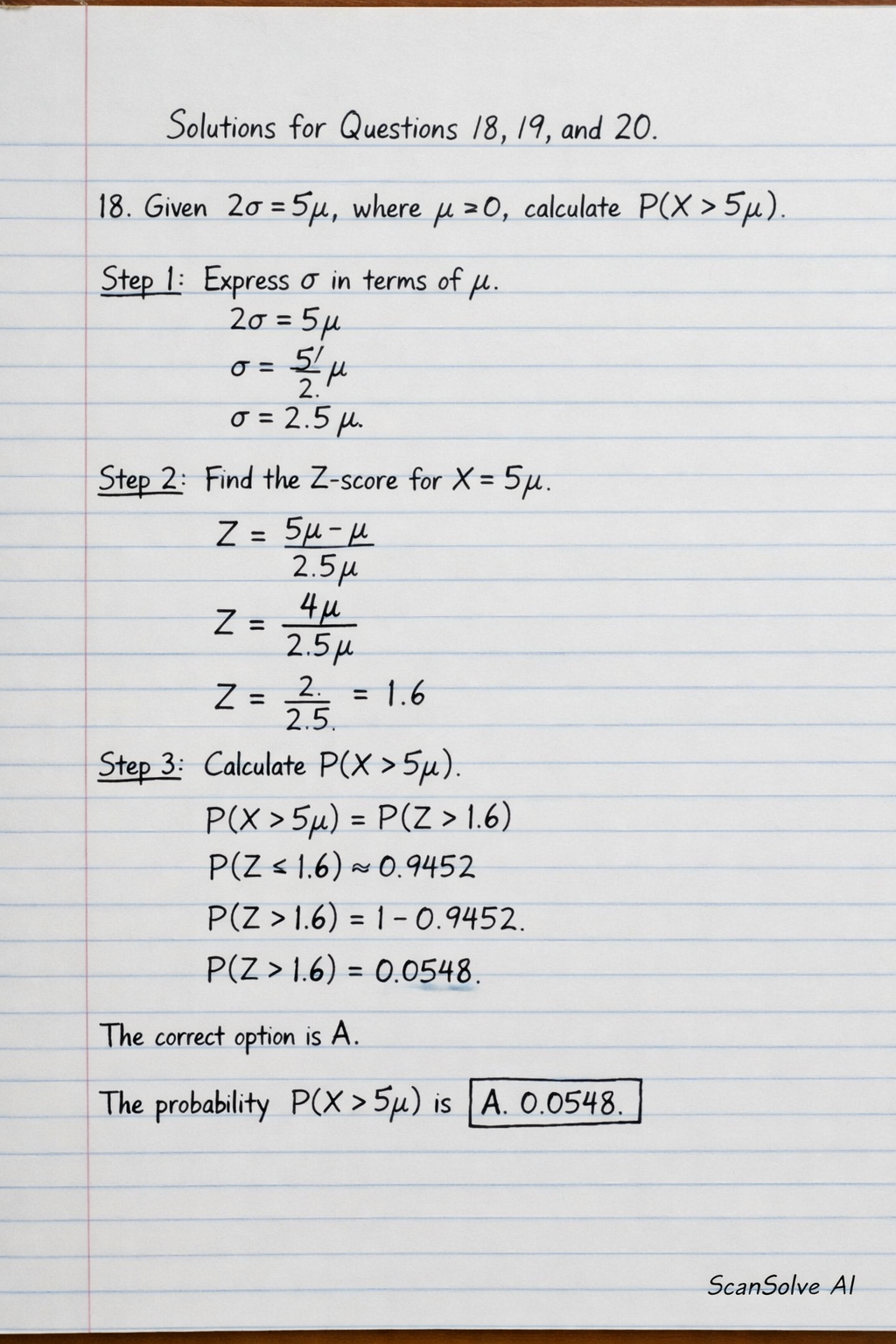
Handwritten Step-by-Step Solution
Get this as a handwritten image on WhatsApp — like a tutor wrote it for you.
Try on WhatsApp