
We read your photo as:
The sketches are not necessarily drawn to scale. Classify the triangle(s) and then solve for x, y, z, ... with reasons. It may only be possible to classify the triangle once you have completed your calculations.
ScanSolve AI Answer
Step-by-step solution
14 stepsSum of angles in a triangle.
The sum of the interior angles of a triangle is .
Solve for .
Combine like terms:
Subtract 15 from both sides:
Divide by 11:
Calculate the measure of each angle.
Angle A:
Angle B:
Angle C:
The sum of angles is .Classify the triangle.
Since all three angles () are different, all sides must also be different. Therefore, it is a scalene triangle.
Since all three angles are less than , it is an acute triangle.
Thus, the triangle is an acute scalene triangle.The value of is .
The triangle is an acute scalene triangle.Classify the triangle based on side markings.
The sides DE and DF have single tick marks, indicating that their lengths are equal (DE = DF).
A triangle with two equal sides is an isosceles triangle.Analyze the given information for .
Angle D is labeled as . Since is isosceles with DE = DF, the angles opposite these sides are equal: .
The sum of angles in a triangle is :The side EF is given as 10 cm. However, there is no additional information (like another angle measure or side length that can be used with the Law of Sines without knowing ) that would allow us to determine a numerical value for .
The triangle is an isosceles triangle.
The value of cannot be determined from the given information.Classify the triangle based on angle measures.
The triangle has two angles measuring .
A triangle with two equal angles is an isosceles triangle.Solve for .
The sum of the interior angles of a triangle is .
Solve for .
Since the triangle is isosceles with base angles , the sides opposite these angles are equal (both are ). The side opposite angle is 13 cm.
We can use the Law of Sines:Substitute :
Using approximate values (, ):
Rounding to one decimal place:
The value of is .
The value of is .
The triangle is an isosceles triangle.Identify parallel lines and angle relationships.
The problem states that line JK is parallel to line ML (indicated by the arrows on the lines). This means JKLM is a trapezoid. To solve for $x, y, z$ uniquely, we assume JKLM is a parallelogram, which is a common implication when parallel lines are given in such a context and a unique solution is expected. In a parallelogram, opposite sides are parallel (JK || ML and JM || KL) and opposite angles are equal.
Use properties of parallel lines and parallelograms to set up equations.
- Since JK || ML, and JL is a transversal, and are alternate interior angles.
- Since JK || ML, and KM is a transversal, and are alternate interior angles.
- Assuming JKLM is a parallelogram, opposite angles are equal. Specifically, .
Solve for using Equation 3.
Subtract from both sides:
Add 80 to both sides:
Solve for using Equation 1 and the value of .
Substitute :
Add 10 to both sides:
Divide by 2:
Solve for using Equation 2 and the value of .
Substitute :
The values are , , and .
The quadrilateral JKLM is a parallelogram.
Still stuck on this one?
Ask a follow-up, and the answer starts from this question.
More Mathematics Questions
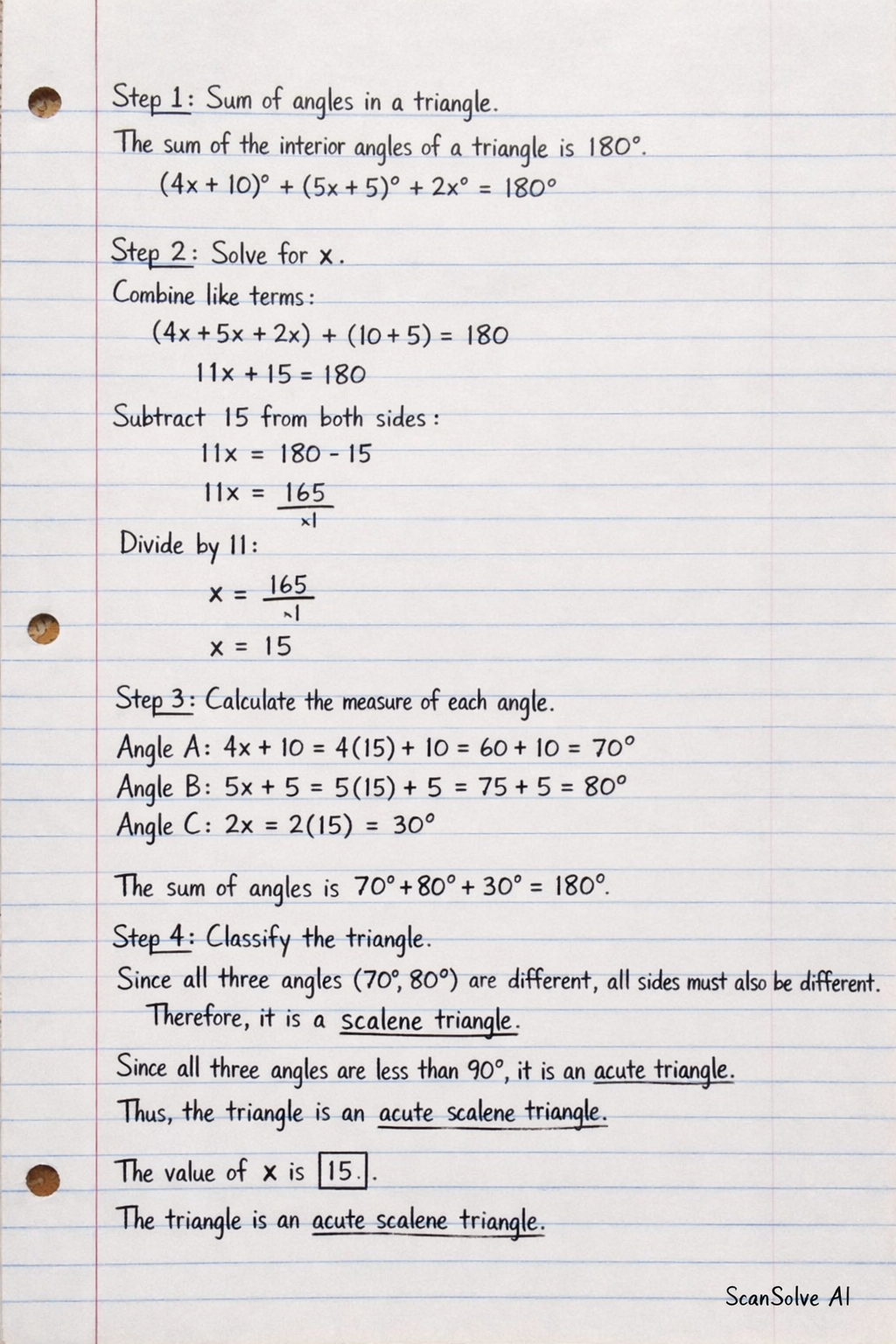
Handwritten Step-by-Step Solution
Get this as a handwritten image on WhatsApp — like a tutor wrote it for you.
Try on WhatsApp