
We read your photo as:
The solution includes two distinct parts: logical propositions and geometric calculations. What was the original question?
ScanSolve AI Answer
Step-by-step solution
10 stepsHere are the solutions to the problems you've provided:
1. Given the statements P and Q:
P: He is strong
Q: He is handsome
Write in ordinary English:
-
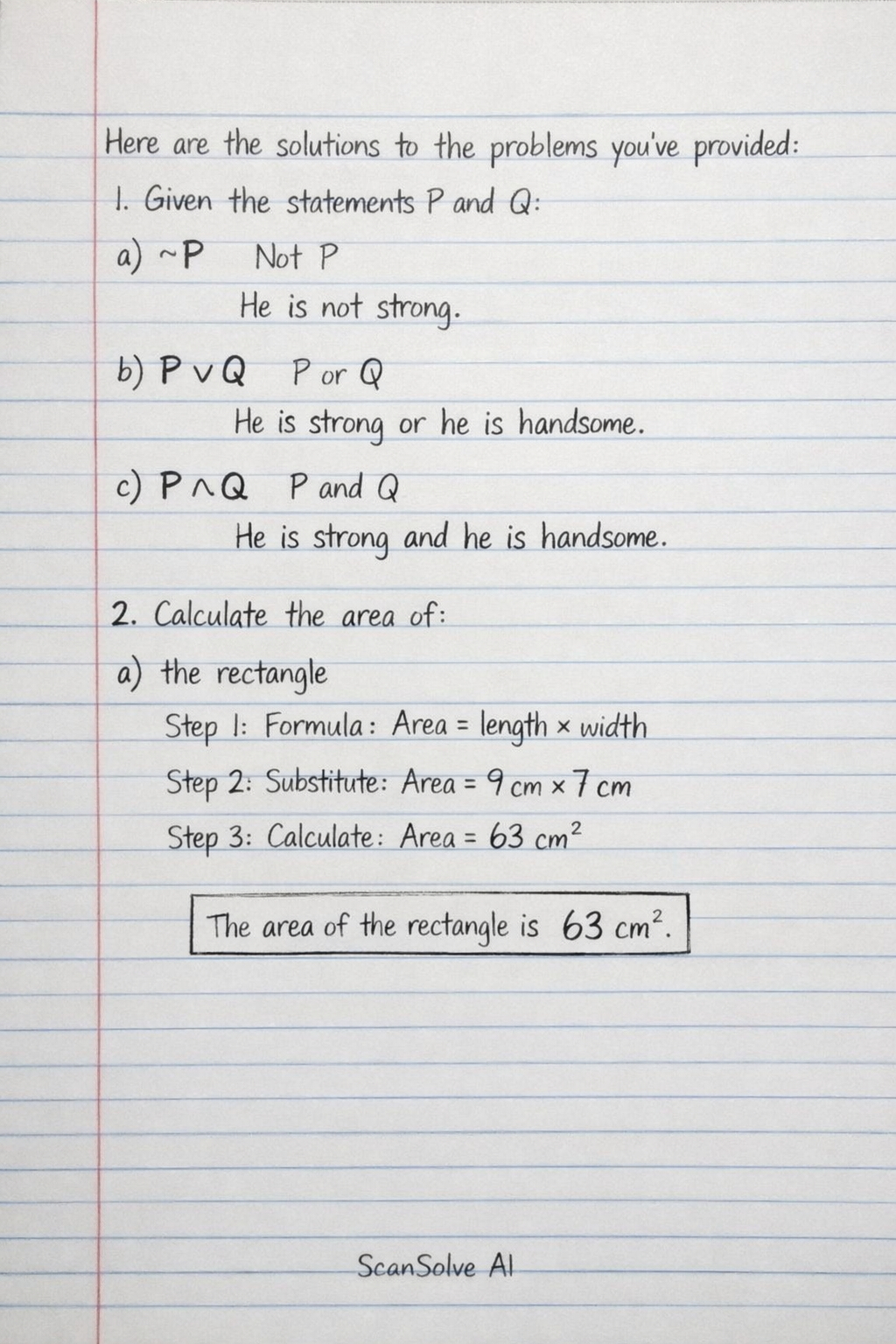
a. This symbol means "not P". He is not strong.
-
b. This symbol means "P or Q". He is strong or he is handsome.
-
c. This symbol means "P and Q". He is strong and he is handsome.
2. Figure 3 shows a circle with radius, cm inside a rectangle PQRS. Given that PQ = 9 cm, PS = 7 cm, taking . Calculate the area of:
- a. the rectangle
Identify the formula for the area of a rectangle.
$$ \text{Area}_{\text{rectangle}} = \text{length} \times \text{width} $$Substitute the given values for length (PQ) and width (PS).
$$ \text{Area}_{\text{rectangle}} = 9 \text{ cm} \times 7 \text{ cm} $$Calculate the area.
$$ \text{Area}_{\text{rectangle}} = 63 \text{ cm}^2 $$ The area of the rectangle is $\boxed{63 \text{ cm}^2}$.- b. the circle
Identify the formula for the area of a circle.
$$ \text{Area}_{\text{circle}} = \pi r^2 $$Substitute the given values for and .
$$ \text{Area}_{\text{circle}} = \frac{22}{7} \times (2.5 \text{ cm})^2 $$Calculate .
$$ (2.5)^2 = 6.25 $$Substitute and calculate the area.
$$ \text{Area}_{\text{circle}} = \frac{22}{7} \times 6.25 \text{ cm}^2 $$ $$ \text{Area}_{\text{circle}} = \frac{137.5}{7} \text{ cm}^2 $$ $$ \text{Area}_{\text{circle}} \approx 19.64 \text{ cm}^2 $$ The area of the circle is $\boxed{19.64 \text{ cm}^2}$.- c. the shaded region
The area of the shaded region is the area of the rectangle minus the area of the circle.
$$ \text{Area}_{\text{shaded}} = \text{Area}_{\text{rectangle}} - \text{Area}_{\text{circle}} $$Substitute the calculated areas.
$$ \text{Area}_{\text{shaded}} = 63 \text{ cm}^2 - \frac{137.5}{7} \text{ cm}^2 $$Perform the subtraction.
$$ \text{Area}_{\text{shaded}} = \frac{63 \times 7 - 137.5}{7} \text{ cm}^2 $$ $$ \text{Area}_{\text{shaded}} = \frac{441 - 137.5}{7} \text{ cm}^2 $$ $$ \text{Area}_{\text{shaded}} = \frac{303.5}{7} \text{ cm}^2 $$ $$ \text{Area}_{\text{shaded}} \approx 43.36 \text{ cm}^2 $$ The area of the shaded region is $\boxed{43.36 \text{ cm}^2}$.3. Figure 1 represents the height of a boy, PQ, and his shadow RQ, 2.4m long on a flat ground.
This problem is incomplete. It provides the length of the shadow (RQ = 2.4 m) but does not provide the height of the boy (PQ) or the angle of elevation. To calculate the distance PQ or the angle of elevation, one of these missing values is required.
Still stuck on this one?
Ask a follow-up, and the answer starts from this question.
More Mathematics Questions
Handwritten Step-by-Step Solution
Get this as a handwritten image on WhatsApp — like a tutor wrote it for you.
Try on WhatsApp