

This mathematics problem involves applying core mathematical principles and formulas. Below you will find a complete step-by-step solution with detailed explanations for each step, helping you understand not just the answer but the method behind it.
ScanSolve AI Answer
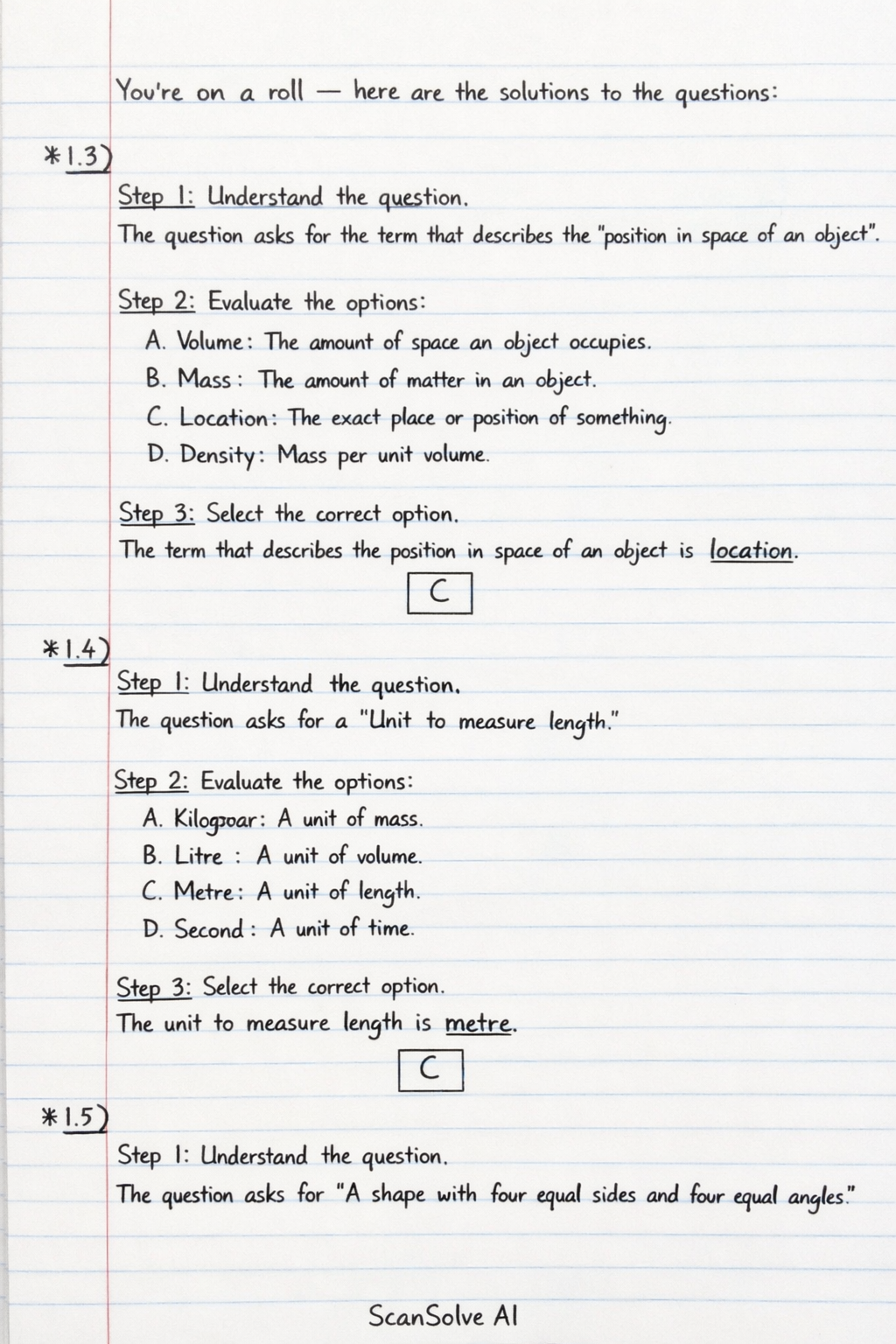
You're on a roll — here are the solutions to the questions: 1.3) Step 1: Understand the question. The question asks for the term that describes the "position in space of an object". Step 2: Evaluate the options. • A. Volume: The amount of space an object occupies. • B. Mass: The amount of matter in an object. • C. Location: The exact place or position of something. • D. Density: Mass per unit volume. Step 3: Select the correct option. The term that describes the position in space of an object is location. C 1.4) Step 1: Understand the question. The question asks for a "Unit to measure length". Step 2: Evaluate the options. • A. Kilogram: A unit of mass. • B. Litre: A unit of volume. • C. Metre: A unit of length. • D. Second: A unit of time. Step 3: Select the correct option. The unit to measure length is metre. C 1.5) Step 1: Understand the question. The question asks for "A shape with four equal sides and four equal angles". Step 2: Evaluate the options. • A. Triangle: Has three sides and three angles. • B. Pentagon: Has five sides and five angles. • C. Square: Has four equal sides and four equal angles (all 90^). • D. Circle: Has no straight sides or angles. Step 3: Select the correct option. The shape described is a square. C 1.6) Step 1: Understand the question. The question asks for the term describing "The chance that a given event will occur". Step 2: Evaluate the options. • A. Grouped data: Data organized into categories or intervals. • B. Probability: The measure of the likelihood that an event will occur. • C. Uncertainty: The state of being unsure or not knowing. • D. Tally: A method of counting using marks. Step 3: Select the correct option. The chance that a given event will occur is called probability. B 1.7) Step 1: Analyze the image provided for question 1.7. The image shows a horizontal line segment with markings and numbers (0 m, 10 m, 20 m, 30 m) indicating distances. This is a graphical representation of a scale on a map. Step 2: Evaluate the options. • A. Number line: A line on which numbers are marked at intervals. While it uses numbers, this specific representation on a map is more precise. • B. Ratio scale: Expresses the scale as a ratio (e.g., 1:10000). • C. Bar scale: A line or bar divided into units to represent distances on a map. This matches the visual. • D. Number scale: A general term, but "bar scale" is more specific for this visual representation. Step 3: Select the correct option. The feature shown is a bar scale. C 1.8) Step 1: Analyze the graph provided for question 1.8. The graph shows different "Modes of Transport" on the horizontal axis and "Number of Students" on the vertical axis. Each mode of transport is represented by a separate vertical bar, and the height of the bar corresponds to the number of students. Step 2: Identify the type of graph. This type of graph, which uses bars to show comparisons between different categories, is known as a bar graph or bar chart. Step 3: State the answer. The type of graph is a bar graph. Bar graph Drop the next question!