We read your photo as:

Solve the three Bernoulli equations shown on the whiteboard.

Mathematics

ScanSolve AI Answer

This answer stops before the end.

It was cut off when it was first written. Ask ScanSolve this question again for the full working.

I will solve the three Bernoulli equations shown on the whiteboard.

The general form of a Bernoulli equation is dydx+P(x)y=Q(x)yn\frac{dy}{dx} + P(x)y = Q(x)y^n.

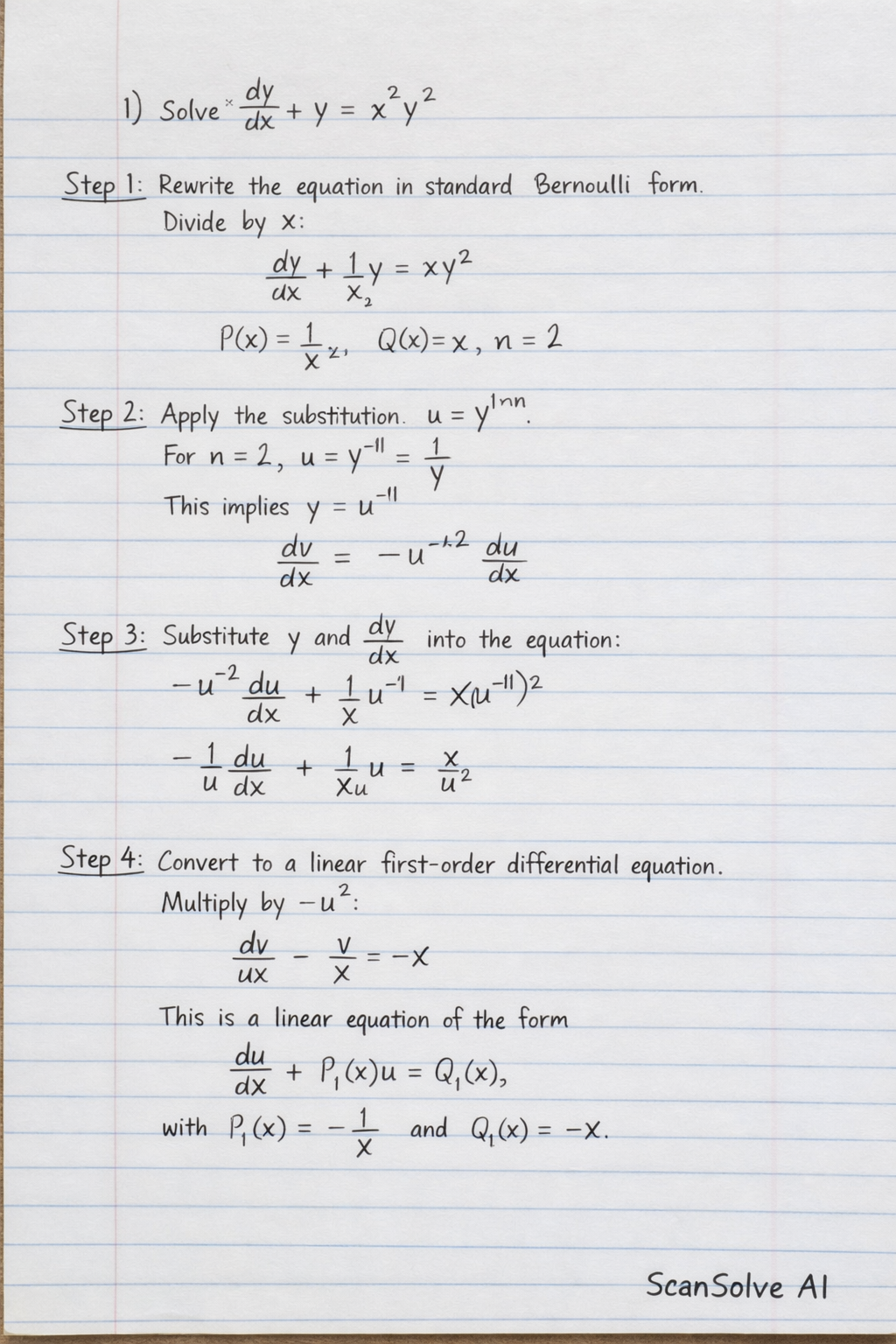
1) Solve xdydx+y=x2y2x \frac{dy}{dx} + y = x^2 y^2

Step 1: Rewrite the equation in standard Bernoulli form.
Divide by xx:

dydx+1xy=xy2\frac{dy}{dx} + \frac{1}{x}y = xy^2

Here, P(x)=1xP(x) = \frac{1}{x}, Q(x)=xQ(x) = x, and n=2n=2.

Step 2: Apply the substitution u=y1−nu = y^{1-n}.
For n=2n=2, u=y1−2=y−1=1yu = y^{1-2} = y^{-1} = \frac{1}{y}.
This implies y=u−1y = u^{-1}.
Differentiate yy with respect to xx: dydx=−u−2dudx\frac{dy}{dx} = -u^{-2} \frac{du}{dx}.

Step 3: Substitute yy and dydx\frac{dy}{dx} into the equation.

−u−2dudx+1xu−1=x(u−1)2-u^{-2} \frac{du}{dx} + \frac{1}{x}u^{-1} = x(u^{-1})^2 −1u2dudx+1xu=xu2-\frac{1}{u^2} \frac{du}{dx} + \frac{1}{xu} = \frac{x}{u^2}

Step 4: Convert to a linear first-order differential equation.
Multiply by −u2-u^2:

dudx−ux=−x\frac{du}{dx} - \frac{u}{x} = -x

This is a linear equation of the form dudx+P1(x)u=Q1(x)\frac{du}{dx} + P_1(x)u = Q_1(x), with P1(x)=−1xP_1(x) = -\frac{1}{x} and Q1(x)=−xQ_1(x) = -x.

Step 5: Find the integrating factor (IF).

IF=e∫P1(x)dx=e∫−1xdx=e−ln⁡∣x∣=eln⁡∣x−1∣=x−1=1xIF = e^{\int P_1(x) dx} = e^{\int -\frac{1}{x} dx} = e^{-\ln|x|} = e^{\ln|x^{-1}|} = x^{-1} = \frac{1}{x}

Step 6: Multiply the linear equation by the integrating factor.

1xdudx−1x2u=−x⋅1x\frac{1}{x} \frac{du}{dx} - \frac{1}{x^2}u = -x \cdot \frac{1}{x} ddx(1xu)=−1\frac{d}{dx}\left(\frac{1}{x}u\right) = -1

Step 7: Integrate both sides with respect to xx.

∫ddx(1xu)dx=∫−1dx\int \frac{d}{dx}\left(\frac{1}{x}u\right) dx = \int -1 dx 1xu=−x+C\frac{1}{x}u = -x + C

Step 8: Solve for uu and substitute back u=1yu = \frac{1}{y}.

u=−x2+Cxu = -x^2 + Cx 1y=Cx−x2\frac{1}{y} = Cx - x^2

Step 9: Solve for yy.

y=1Cx−x2y = \frac{1}{Cx - x^2}

The final answer is y=1Cx−x2\boxed{y = \frac{1}{Cx - x^2}}.

2) Solve dydx+xy=xy3\frac{dy}{dx} + xy = xy^3

Step 1: Identify the components of the Bernoulli equation.
The equation is already in the standard form dydx+P(x)y=Q(x)yn\frac{dy}{dx} + P(x)y = Q(x)y^n.
Here, P(x)=xP(x) = x, Q(x)=xQ(x) = x, and n=3n=3.

Step 2: Apply the substitution u=y1−nu = y^{1-n}.
For n=3n=3, u=y1−3=y−2=1y2u = y^{1-3} = y^{-2} = \frac{1}{y^2}.
This implies y=u−1/2y = u^{-1/2}.
Differentiate yy with respect to xx: dydx=−12u−3/2dudx\frac{dy}{dx} = -\frac{1}{2}u^{-3/2} \frac{du}{dx}.

Step 3: Substitute yy and dydx\frac{dy}{dx} into the equation.

−12u−3/2dudx+xu−1/2=x(u−1/2)3-\frac{1}{2}u^{-3/2} \frac{du}{dx} + x u^{-1/2} = x(u^{-1/2})^3 −12u−3/2dudx+xu−1/2=xu−3/2-\frac{1}{2}u^{-3/2} \frac{du}{dx} + x u^{-1/2} = x u^{-3/2}

Step 4: Convert to a linear first-order differential equation.
Multiply by −2u3/2-2u^{3/2}:

dudx−2xu(3/2−1/2)=−2x\frac{du}{dx} - 2x u^{(3/2 - 1/2)} = -2x dudx−2xu=−2x\frac{du}{dx} - 2xu = -2x

This is a linear equation with P1(x)=−2xP_1(x) = -2x and Q1(x)=−2xQ_1(x) = -2x.

Step 5: Find the integrating factor (IF).

IF=e∫P1(x)dx=e∫−2xdx=e−x2IF = e^{\int P_1(x) dx} = e^{\int -2x dx} = e^{-x^2}

Step 6: Multiply the linear equation by the integrating factor.

e−x2dudx−2xe−x2u=−2xe−x2e^{-x^2} \frac{du}{dx} - 2x e^{-x^2} u = -2x e^{-x^2} ddx(e−x2u)=−2xe−x2\frac{d}{dx}(e^{-x^2}u) = -2x e^{-x^2}

Step 7: Integrate both sides with respect to xx.

Was this helpful?

Still stuck on this one?

Ask a follow-up, and the answer starts from this question.

Got a different question?Ask your own question
Handwritten step-by-step solution preview

Handwritten Step-by-Step Solution

Get this as a handwritten image on WhatsApp — like a tutor wrote it for you.

Try on WhatsApp