
We read your photo as:
To calculate Pearson's correlation coefficient (r), we first need to complete the table with x2, y2, and xy values for each data point, and then find the sums of all columns.
ScanSolve AI Answer
Answer
Step-by-step solution
5 stepsTo calculate Pearson's correlation coefficient (), we first need to complete the table with , , and values for each data point, and then find the sums of all columns.
The formula for Pearson's correlation coefficient is:
where is the number of data points. In this case, .
Complete the table with , , and values.
62 71 75 84 41 56 69 73 82 90 Calculate the sums for each column.
Substitute these sums and into the Pearson's correlation coefficient formula.
Calculate the numerator:
Calculate the first part of the denominator under the square root:
Calculate the second part of the denominator under the square root:
Calculate the full denominator and then .
Now, calculate :
Round the result to three decimal places.
This value matches option A.
The final answer is .
Try one yourself
A new problem that tests the same skill.
Still stuck on this one?
Ask a follow-up, and the answer starts from this question.
More Mathematics Questions
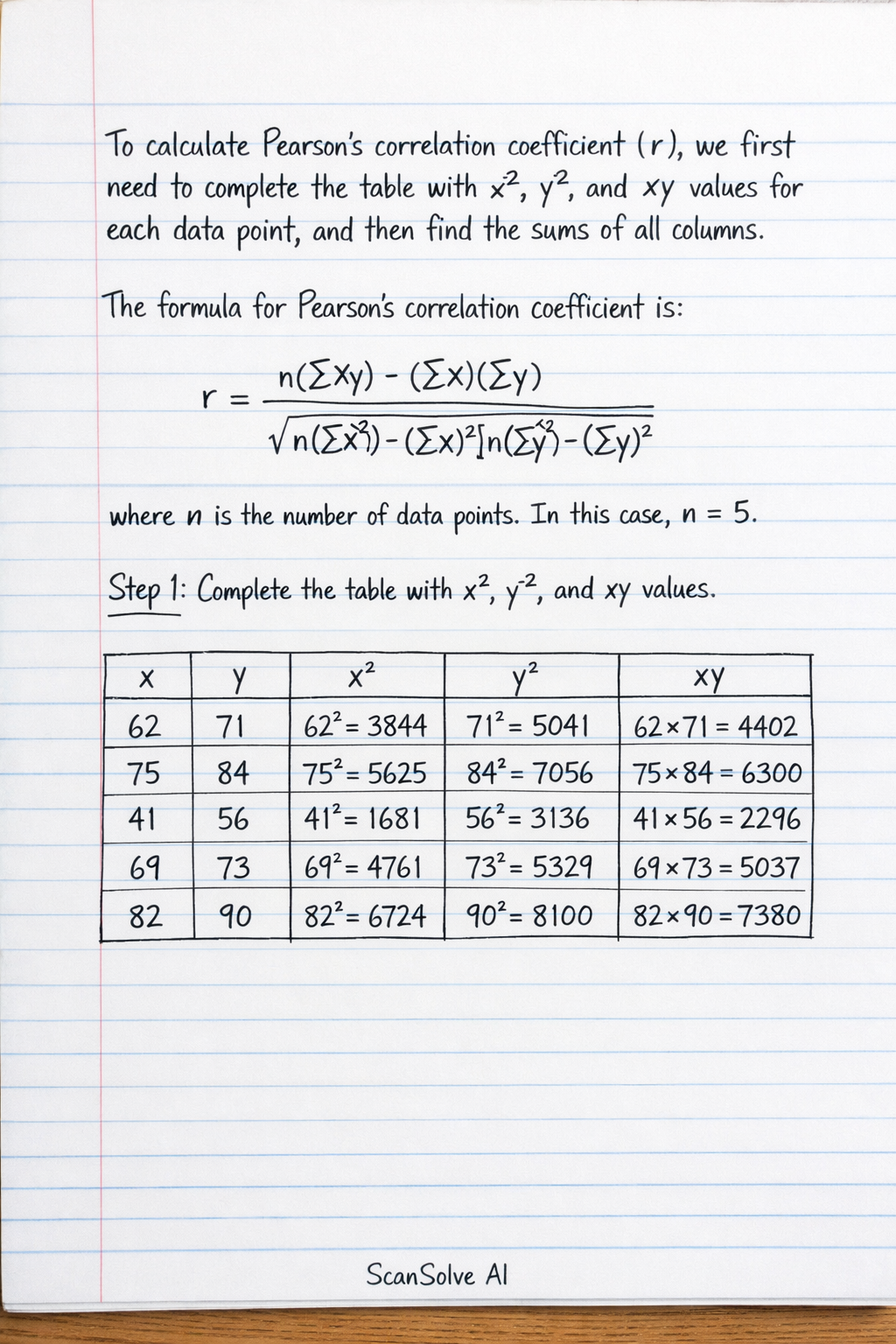
Handwritten Step-by-Step Solution
Get this as a handwritten image on WhatsApp — like a tutor wrote it for you.
Try on WhatsApp