
We read your photo as:
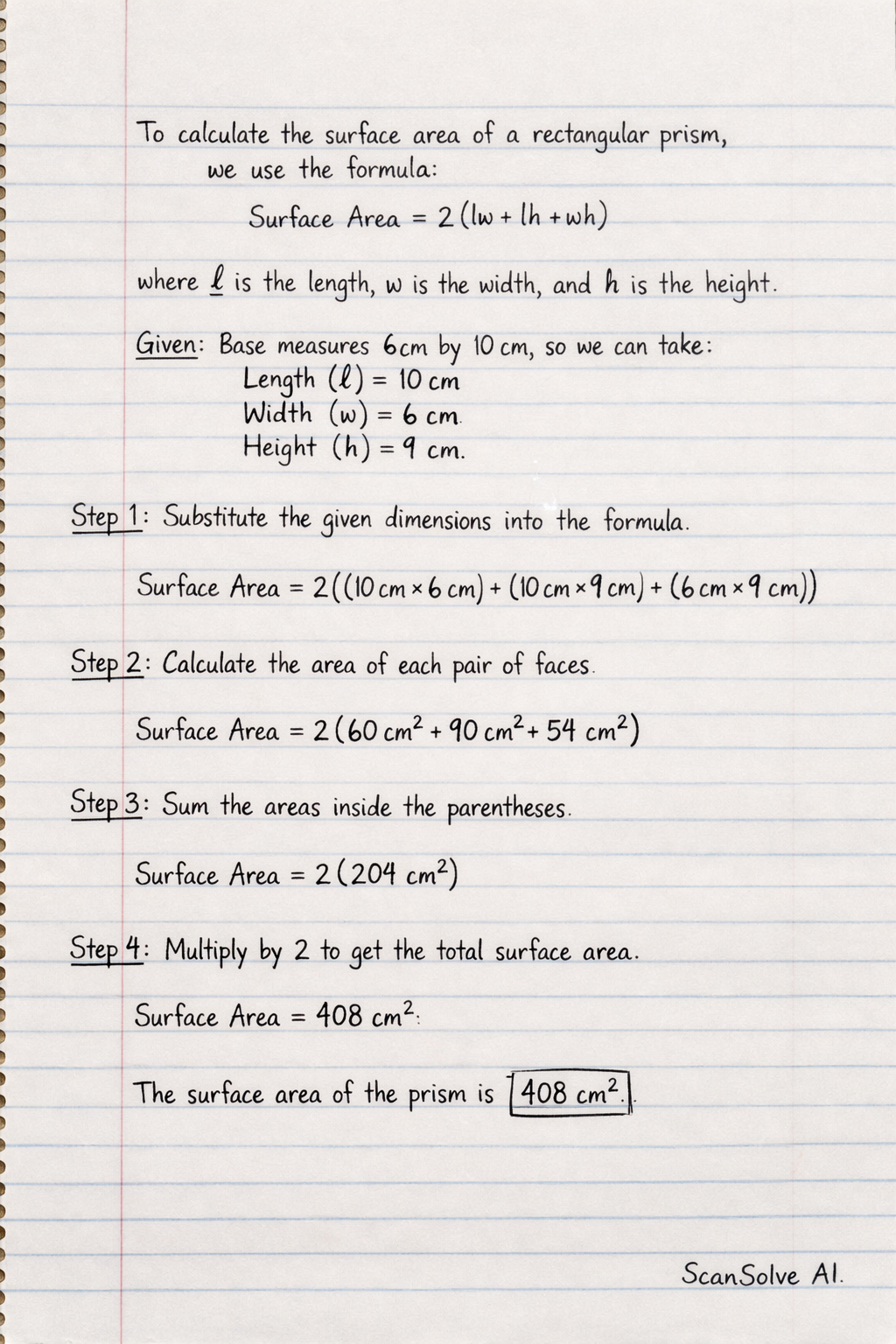
To calculate the surface area of a rectangular prism, we use the formula:
Mathematics
ScanSolve AI Answer
Answer
Step-by-step solution
4 stepsTo calculate the surface area of a rectangular prism, we use the formula:
where is the length, is the width, and is the height.
Given:
Base measures 6 cm by 10 cm, so we can take:
Length () = 10 cm
Width () = 6 cm
Height () = 9 cm
Substitute the given dimensions into the formula.
Calculate the area of each pair of faces.
Sum the areas inside the parentheses.
Multiply by 2 to get the total surface area.
The surface area of the prism is .
Was this helpful?
Try one yourself
A new problem that tests the same skill.
Still stuck on this one?
Ask a follow-up, and the answer starts from this question.
Got a different question?Ask your own question
More Mathematics Questions
QThe total surface area of a triangular prism is given by the formula:QTo calculate the simple area of a rectangle, we use the formula:QCalculate the Surface Area of each of the following triangular-based prisms.QIdentify the dimensions and calculate the volume of the base rectangular prism.QA rectangular prism has a length of 12 cm, width of 5 cm, and height of 8 cm. a) Calculate its total…
Browse by topic:Geometry
Handwritten Step-by-Step Solution
Get this as a handwritten image on WhatsApp — like a tutor wrote it for you.
Try on WhatsApp