This mathematics problem involves applying core mathematical principles and formulas. Below you will find a complete step-by-step solution with detailed explanations for each step, helping you understand not just the answer but the method behind it.
ScanSolve AI Answer
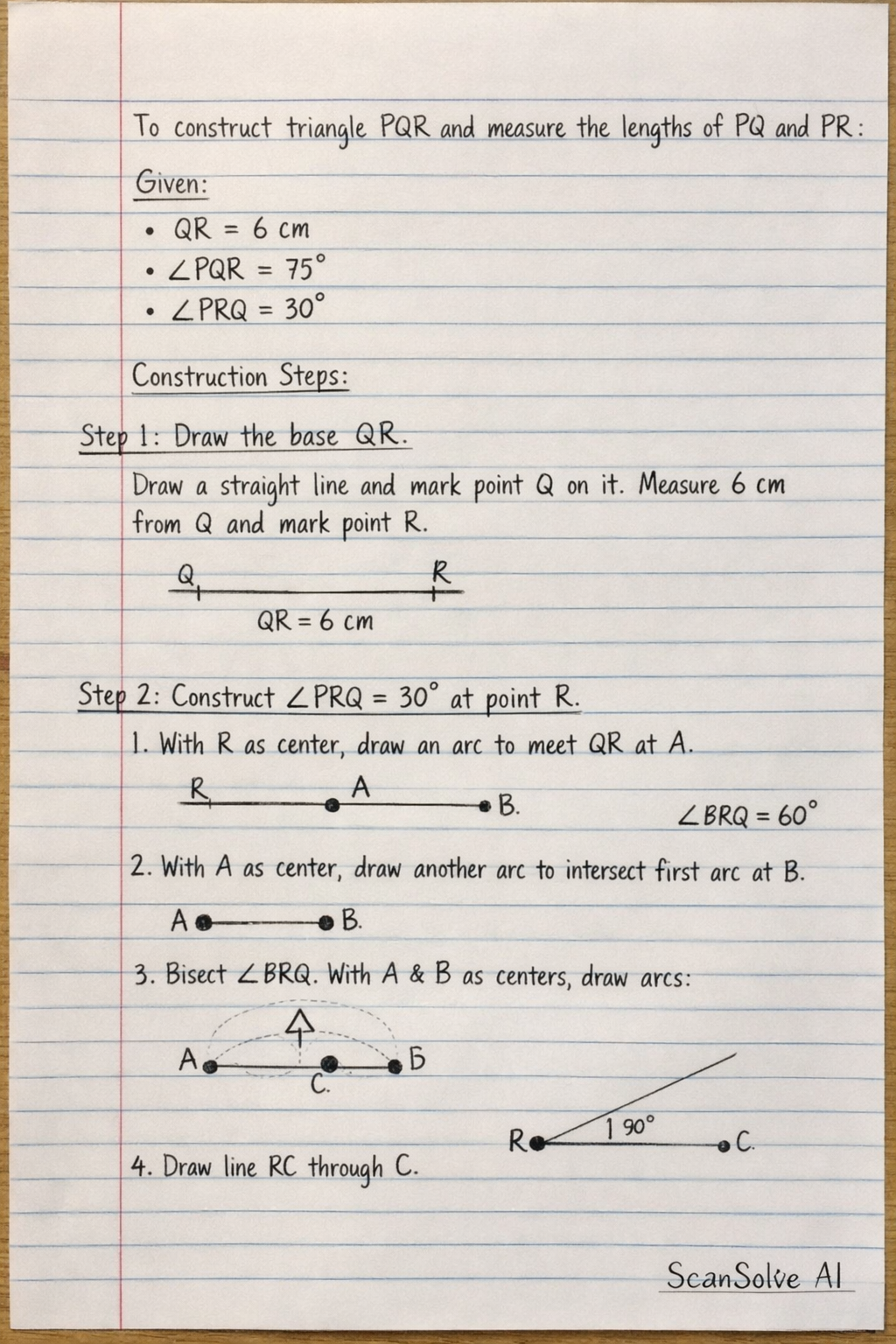
To construct triangle PQR and measure the lengths of $PQ$ and $PR$:
Given:
• $QR = 6 \text{ cm}$
• $\angle PQR = 75^\circ$
• $\angle PRQ = 30^\circ$
Construction Steps:
Step 1: Draw the base $QR$.
Draw a straight line and mark a point Q on it. Using a ruler, measure $6 \text{ cm}$ from Q and mark point R. So, $QR = 6 \text{ cm}$.
Step 2: Construct $\angle PRQ = 30^\circ$ at point R.
• With R as the center, draw an arc of any convenient radius to intersect $QR$ at a point, say A.
• With A as the center and the same radius, draw another arc to intersect the first arc at a point, say B. $\angle BRQ = 60^\circ$.
• Bisect $\angle BRQ$. With A and B as centers, draw arcs of the same radius (larger than half the distance AB) to intersect at a point, say C.
• Draw a line from R through C. This line forms an angle of $30^\circ$ with $QR$.
Step 3: Construct $\angle PQR = 75^\circ$ at point Q.
• With Q as the center, draw an arc of any convenient radius to intersect $QR$ at a point, say D.
• With D as the center and the same radius, draw an arc to intersect the first arc at E ($60^\circ$).
• With E as the center and the same radius, draw an arc to intersect the first arc at F ($120^\circ$).
• Bisect the angle between E and F to construct $90^\circ$. With E and F as centers, draw arcs of the same radius to intersect at G.
• Draw a dashed line from Q through G. This line represents $90^\circ$. Let the intersection of this line with the initial arc be H.
• Now, bisect the angle between E ($60^\circ$) and H ($90^\circ$). With E and H as centers, draw arcs of the same radius to intersect at I.
• Draw a line from Q through I. This line forms an angle of $60^\circ + 15^\circ = 75^\circ$ with $QR$.
Step 4: Locate point P.
The intersection of the line from R (from Step 2) and the line from Q (from Step 3) is point P. Connect P to Q and P to R to complete triangle PQR.
Measurement of $|PQ|$ and $|PR|$:
Since physical measurement cannot be performed by an AI, we will calculate the lengths using trigonometry.
First, find the third angle $\angle QPR$:
The sum of angles in a triangle is $180^\circ$.
$$ \angle QPR = 180^\circ - \angle PQR - \angle PRQ $$
$$ \angle QPR = 180^\circ - 75^\circ - 30^\circ $$
$$ \angle QPR = 180^\circ - 105^\circ $$
$$ \angle QPR = 75^\circ $$
Since $\angle PQR = \angle QPR = 75^\circ$, triangle PQR is an isosceles triangle with sides opposite these angles being equal.
Therefore, $PR = QR$.
Given $QR = 6 \text{ cm}$,
$$ PR = 6 \text{ cm} $$
Now, use the Sine Rule to find the length of $PQ$:
$$ \frac{PQ}{\sin(\angle PRQ)} = \frac{QR}{\sin(\angle QPR)} $$
$$ \frac{PQ}{\sin(30^\circ)} = \frac{6 \text{ cm}}{\sin(75^\circ)} $$
$$ PQ = \frac{6 \text{ cm} \times \sin(30^\circ)}{\sin(75^\circ)} $$
We know $\sin(30^\circ) = 0.5$ and $\sin(75^\circ) = \frac{\sqrt{6} + \sqrt{2}}{4} \approx 0.9659$.
$$ PQ = \frac{6 \text{ cm} \times 0.5}{0.9659} $$
$$ PQ = \frac{3 \text{ cm}}{0.9659} $$
$$ PQ \approx 3.1058 \text{ cm} $$
Rounding to two decimal places:
$$ PQ \approx 3.11 \text{ cm} $$
The measured lengths are:
$|PQ| = \boxed{\text{3.11 cm}}$
$|PR| = \boxed{\text{6.00 cm}}$
Q
To construct triangle PQR and measure the lengths of PQ and PR:
|Mathematics
To construct triangle PQR and measure the lengths of PQ and PR:
ScanSolve AI Answer
To construct triangle PQR and measure the lengths of PQ and PR:
Given:
• QR=6 cm
• ∠PQR=75∘
• ∠PRQ=30∘
Construction Steps:
Step 1: Draw the base QR.
Draw a straight line and mark a point Q on it. Using a ruler, measure 6 cm from Q and mark point R. So, QR=6 cm.
Step 2: Construct ∠PRQ=30∘ at point R.
• With R as the center, draw an arc of any convenient radius to intersect QR at a point, say A.
• With A as the center and the same radius, draw another arc to intersect the first arc at a point, say B. ∠BRQ=60∘.
• Bisect ∠BRQ. With A and B as centers, draw arcs of the same radius (larger than half the distance AB) to intersect at a point, say C.
• Draw a line from R through C. This line forms an angle of 30∘ with QR.
Step 3: Construct ∠PQR=75∘ at point Q.
• With Q as the center, draw an arc of any convenient radius to intersect QR at a point, say D.
• With D as the center and the same radius, draw an arc to intersect the first arc at E (60∘).
• With E as the center and the same radius, draw an arc to intersect the first arc at F (120∘).
• Bisect the angle between E and F to construct 90∘. With E and F as centers, draw arcs of the same radius to intersect at G.
• Draw a dashed line from Q through G. This line represents 90∘. Let the intersection of this line with the initial arc be H.
• Now, bisect the angle between E (60∘) and H (90∘). With E and H as centers, draw arcs of the same radius to intersect at I.
• Draw a line from Q through I. This line forms an angle of 60∘+15∘=75∘ with QR.
Step 4: Locate point P.
The intersection of the line from R (from Step 2) and the line from Q (from Step 3) is point P. Connect P to Q and P to R to complete triangle PQR.
Measurement of ∣PQ∣ and ∣PR∣:
Since physical measurement cannot be performed by an AI, we will calculate the lengths using trigonometry.
First, find the third angle ∠QPR:
The sum of angles in a triangle is 180∘.
∠QPR=180∘−∠PQR−∠PRQ∠QPR=180∘−75∘−30∘∠QPR=180∘−105∘∠QPR=75∘
Since ∠PQR=∠QPR=75∘, triangle PQR is an isosceles triangle with sides opposite these angles being equal.
Therefore, PR=QR.
Given QR=6 cm,
PR=6cm
Now, use the Sine Rule to find the length of PQ:
sin(∠PRQ)PQ=sin(∠QPR)QRsin(30∘)PQ=sin(75∘)6cmPQ=sin(75∘)6cm×sin(30∘)
We know sin(30∘)=0.5 and sin(75∘)=46+2≈0.9659.
PQ=0.96596cm×0.5PQ=0.96593cmPQ≈3.1058cm
Rounding to two decimal places:
PQ≈3.11cm
The measured lengths are:
∣PQ∣=3.11 cm∣PR∣=6.00 cm
Need help with your own homework?
Get instant step-by-step solutions to any question. Free to start.