
We read your photo as:
To determine the congruence between the triangles, we compare their side lengths.
ScanSolve AI Answer
Answer
Step-by-step solution
4 stepsTo determine the congruence between the triangles, we compare their side lengths.
Given information:
For :
For :
- (This side is common to both triangles)
Compare the corresponding sides.
Let's list the sides of and try to match them with the sides of .
-
Side in .
-
Side in . So, .
-
Side in .
-
Side in . So, .
-
Side in .
-
Side in . So, .
-
Determine the congruence criterion.
Since all three corresponding sides of are equal to the three corresponding sides of , the triangles are congruent by the SSS (Side-Side-Side) congruence criterion.
Write the correct congruence statement.
To write the congruence statement, we need to match the vertices correctly based on the equal sides:
- Since , vertex A corresponds to vertex D, and vertex B corresponds to vertex C.
- Since , vertex B corresponds to vertex C, and vertex C corresponds to vertex B.
- Since , vertex A corresponds to vertex D, and vertex C corresponds to vertex B.
Combining these, we get the correspondence:
- A D
- B C
- C B
Therefore, the correct congruence statement is .
Check the given options.
(1) , by SAS - Incorrect vertex correspondence and criterion.
(2) , by SAS - Incorrect criterion.
(3) , by SSS - Incorrect vertex correspondence.
(4) , by SSS - Correct vertex correspondence and criterion.The final answer is .
Try one yourself
A new problem that tests the same skill.
Still stuck on this one?
Ask a follow-up, and the answer starts from this question.
More Mathematics Questions
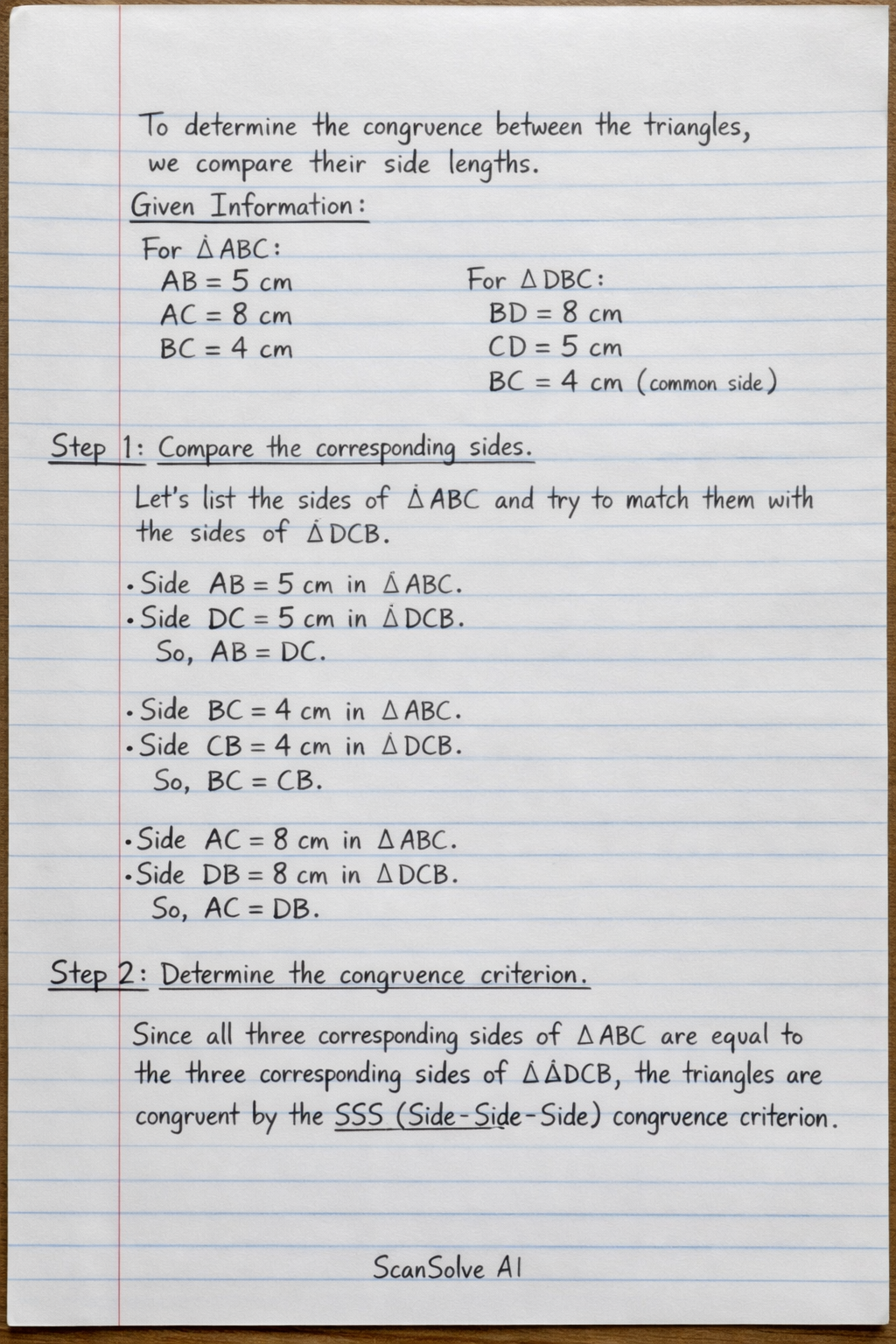
Handwritten Step-by-Step Solution
Get this as a handwritten image on WhatsApp — like a tutor wrote it for you.
Try on WhatsApp