This mathematics problem involves applying core mathematical principles and formulas. Below you will find a complete step-by-step solution with detailed explanations for each step, helping you understand not just the answer but the method behind it.
ScanSolve AI Answer
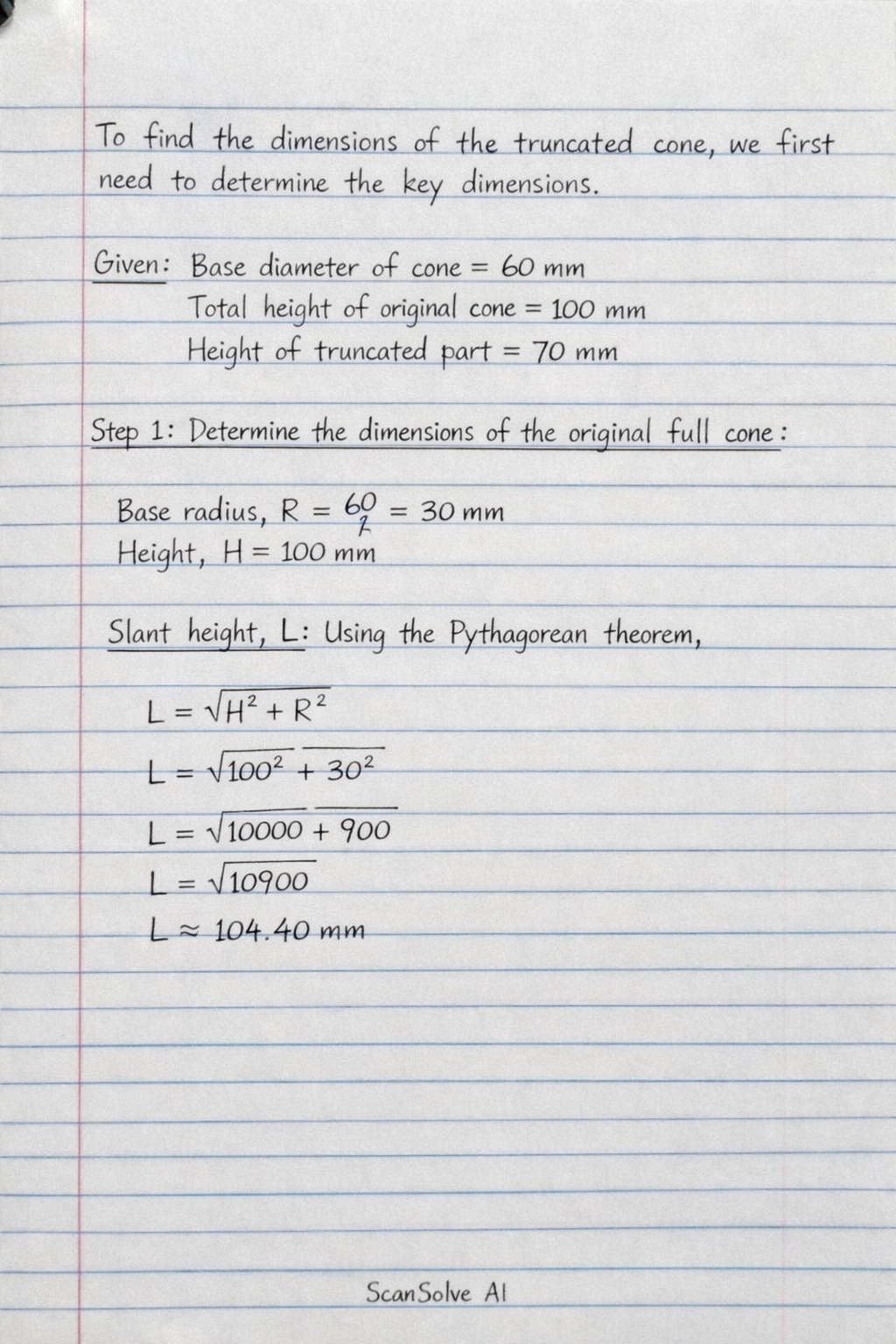
To show the development of the truncated cone, we first need to determine its key dimensions.
Given from Figure (a):
Base diameter of the cone = 60 mm
Total height of the original cone = 100 mm
Height of the truncated part (frustum) = 70 mm
Step 1: Determine the dimensions of the original full cone.
Base radius, $R = \frac{60}{2} = 30$ mm
Height, $H = 100$ mm
Slant height, $L$: Using the Pythagorean theorem,
$$L = \sqrt{H^2 + R^2}$$
$$L = \sqrt{100^2 + 30^2}$$
$$L = \sqrt{10000 + 900}$$
$$L = \sqrt{10900} \approx 104.40 \text{ mm}$$
Step 2: Determine the dimensions of the removed top cone.
The height of the removed top cone, $h = H - 70 = 100 - 70 = 30$ mm.
Using similar triangles, the radius of the top surface of the frustum (which is the base radius of the removed top cone), $r$, can be found:
$$\frac{r}{R} = \frac{h}{H}$$
$$r = R \times \frac{h}{H}$$
$$r = 30 \times \frac{30}{100}$$
$$r = 30 \times 0.3 = 9 \text{ mm}$$
The slant height of the removed top cone, $l$:
$$l = \sqrt{h^2 + r^2}$$
$$l = \sqrt{30^2 + 9^2}$$
$$l = \sqrt{900 + 81}$$
$$l = \sqrt{981} \approx 31.32 \text{ mm}$$
Step 3: Calculate the sector angle for the development.
The development of the full cone is a sector of a circle with radius $L$. The arc length of this sector is equal to the circumference of the base of the cone ($2\pi R$).
The sector angle $\theta$ (in degrees) is given by:
$$\theta = \frac{R}{L} \times 360^\circ$$
$$\theta = \frac{30}{104.40} \times 360^\circ$$
$$\theta \approx 0.287356 \times 360^\circ$$
$$\theta \approx 103.45^\circ$$
Step 4: Construct the development of the truncated cone (frustum).
The development of the frustum is a portion of an annulus.
1. Draw
To show the development of the truncated cone, we first need to determine its key dimensions.
|Mathematics
To show the development of the truncated cone, we first need to determine its key dimensions.
ScanSolve AI Answer
To show the development of the truncated cone, we first need to determine its key dimensions.
Given from Figure (a):
Base diameter of the cone = 60 mm
Total height of the original cone = 100 mm
Height of the truncated part (frustum) = 70 mm
Step 1: Determine the dimensions of the original full cone.
Base radius, R=260=30 mm
Height, H=100 mm
Slant height, L: Using the Pythagorean theorem,
L=H2+R2L=1002+302L=10000+900L=10900≈104.40 mm
Step 2: Determine the dimensions of the removed top cone.
The height of the removed top cone, h=H−70=100−70=30 mm.
Using similar triangles, the radius of the top surface of the frustum (which is the base radius of the removed top cone), r, can be found:
Rr=Hhr=R×Hhr=30×10030r=30×0.3=9 mm
The slant height of the removed top cone, l:
l=h2+r2l=302+92l=900+81l=981≈31.32 mm
Step 3: Calculate the sector angle for the development.
The development of the full cone is a sector of a circle with radius L. The arc length of this sector is equal to the circumference of the base of the cone (2πR).
The sector angle θ (in degrees) is given by:
θ=LR×360∘θ=104.4030×360∘θ≈0.287356×360∘θ≈103.45∘
Step 4: Construct the development of the truncated cone (frustum).
The development of the frustum is a portion of an annulus.
Draw
Need help with your own homework?
Get instant step-by-step solutions to any question. Free to start.