We read your photo as:

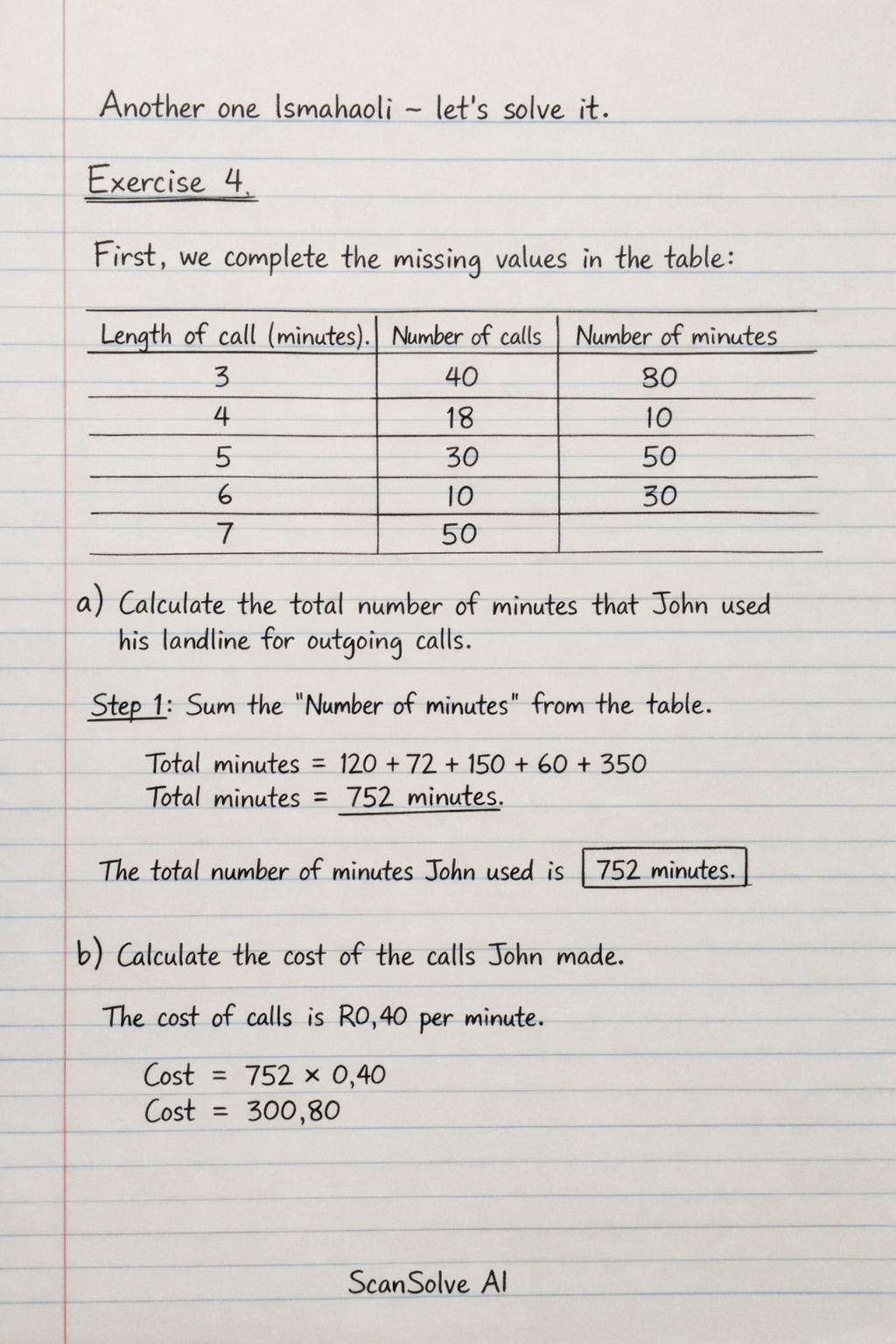
Calculate the total number of minutes that John used his landline for outgoing calls.

Mathematics

ScanSolve AI Answer

Step-by-step solution

7 steps

First, we complete the missing values in the table for "Number of minutes" and "Number of calls" using the relationship: Number of minutes = Length of call ×\times Number of calls.

  • For 5-minute calls: Number of minutes = 5 minutes/call×30 calls=150 minutes5 \text{ minutes/call} \times 30 \text{ calls} = 150 \text{ minutes}.
  • For 6-minute calls: Number of calls = 60 minutes/6 minutes/call=10 calls60 \text{ minutes} / 6 \text{ minutes/call} = 10 \text{ calls}.

The completed relevant parts of the table are:

  • Length of call (minutes): 3, 4, 5, 6, 7
  • Number of calls: 40, 18, 30, 10, 50
  • Number of minutes: 120, 72, 150, 60, 350

a) Calculate the total number of minutes that John used his landline for outgoing calls.

  1. Sum the "Number of minutes" from the table.

    Total minutes=120+72+150+60+350\text{Total minutes} = 120 + 72 + 150 + 60 + 350 Total minutes=752 minutes\text{Total minutes} = 752 \text{ minutes}

    The total number of minutes John used is 752 minutes\boxed{\text{752 minutes}}.

    b) Calculate the cost of the calls John made. The cost of calls is R0,40 per minute.

  2. Multiply the total minutes by the cost per minute.

    Cost of calls=752 minutes×R0,40/minute\text{Cost of calls} = 752 \text{ minutes} \times \text{R}0,40/\text{minute} Cost of calls=R300,80\text{Cost of calls} = \text{R}300,80

    The cost of the calls John made is R300,80\boxed{\text{R}300,80}.

    c) Calculate the total landline bill for the month, including rental.

  3. Add the cost of calls to the monthly rental.

    Total bill=Cost of calls+Monthly rental\text{Total bill} = \text{Cost of calls} + \text{Monthly rental} Total bill=R300,80+R165\text{Total bill} = \text{R}300,80 + \text{R}165 Total bill=R465,80\text{Total bill} = \text{R}465,80

    The total landline bill for the month is R465,80\boxed{\text{R}465,80}.


    a) What was the average rate at which the bread price increased from 2001 to 2008? Give your answer in cents per year.

  4. Calculate the price increase from 2001 to 2008.

    Price increase=Price in 2008−Price in 2001\text{Price increase} = \text{Price in 2008} - \text{Price in 2001} Price increase=R6,70−R3,30\text{Price increase} = \text{R}6,70 - \text{R}3,30 Price increase=R3,40\text{Price increase} = \text{R}3,40
  5. Calculate the number of years between 2001 and 2008.

    Number of years=2008−2001\text{Number of years} = 2008 - 2001 Number of years=7 years\text{Number of years} = 7 \text{ years}
  6. Calculate the average rate of increase in Rands per year.

    Average rate (R/year)=Price increaseNumber of years\text{Average rate (R/year)} = \frac{\text{Price increase}}{\text{Number of years}} Average rate (R/year)=R3,407 years\text{Average rate (R/year)} = \frac{\text{R}3,40}{7 \text{ years}} Average rate (R/year)≈R0,4857 per year\text{Average rate (R/year)} \approx \text{R}0,4857 \text{ per year}
  7. Convert the average rate from Rands per year to cents per year (1 Rand = 100 cents).

    Average rate (cents/year)=R0,4857×100 cents/Rand\text{Average rate (cents/year)} = \text{R}0,4857 \times 100 \text{ cents/Rand} Average rate (cents/year)≈48,57 cents per year\text{Average rate (cents/year)} \approx 48,57 \text{ cents per year}

    The average rate at which the bread price increased from 2001 to 2008 is approximately 48,57 cents per year\boxed{\text{48,57 cents per year}}.

Was this helpful?

Still stuck on this one?

Ask a follow-up, and the answer starts from this question.

Got a different question?Ask your own question
Handwritten step-by-step solution preview

Handwritten Step-by-Step Solution

Get this as a handwritten image on WhatsApp — like a tutor wrote it for you.

Try on WhatsApp