We read your photo as:

Town B is 150 km on a bearing of 050^ exto from town A. Town C is on a bearing of 110^ exto from town A and on a bearing of 150^ exto from town B. A fourth town D is 240 km on a bearing of 320^ exto f

Mathematics

ScanSolve AI Answer

Answers

3 parts
a

432 km432 \text{ km}

b

651 km651 \text{ km}

c

380 km380 \text{ km}

Step-by-step solution

5 steps

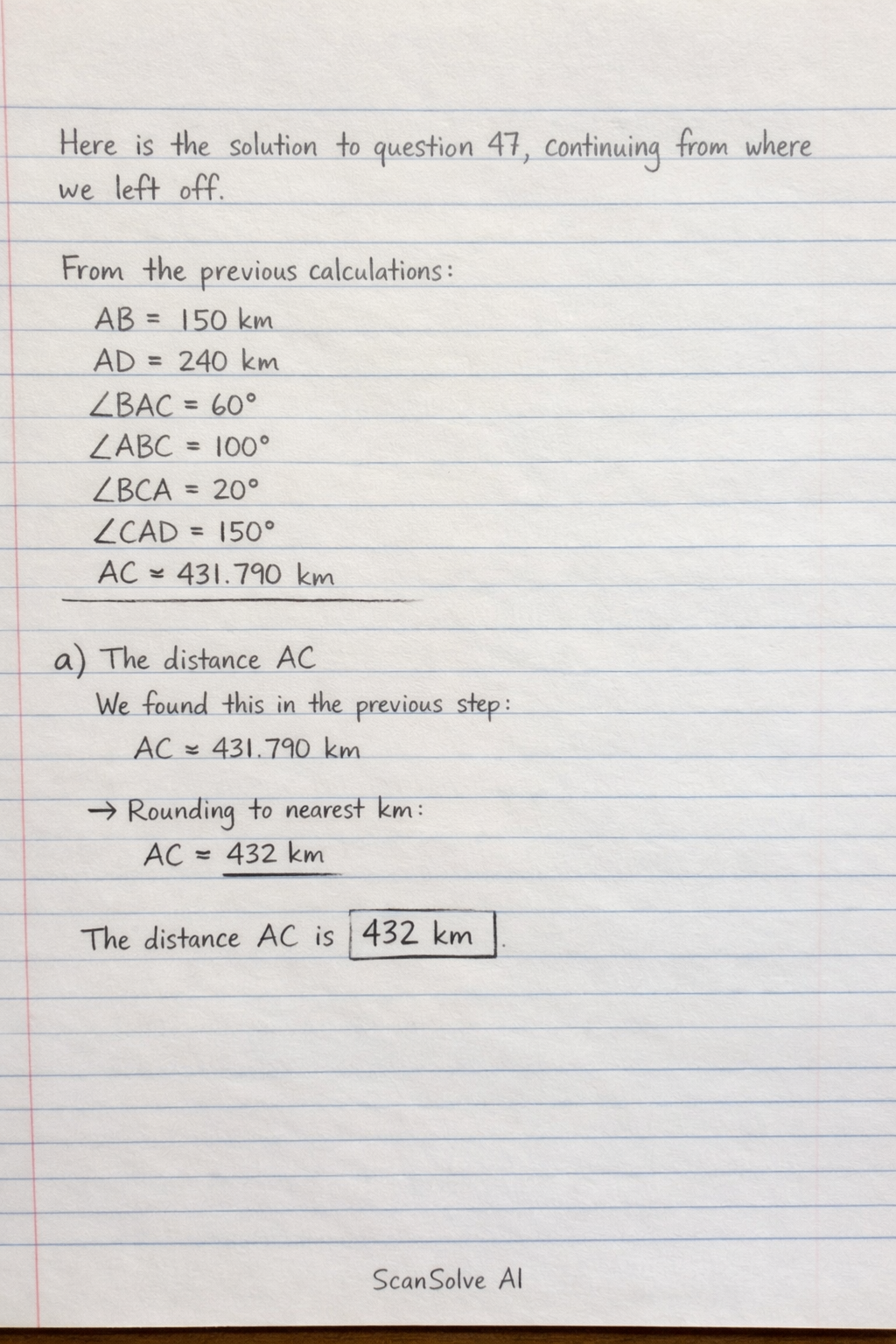
Here is the solution to question 47, continuing from where we left off.

47. Town B is 150 km on a bearing of 050∘050^\circ from town A. Another town C is on a bearing of 110∘110^\circ from town A and on a bearing of 150∘150^\circ from town B. A fourth town D is 240 km on a bearing of 320∘320^\circ from town A. Without using a scale drawing, calculate to the nearest kilometre:

From the previous calculations:

  • AB=150AB = 150 km
  • AD=240AD = 240 km
  • ∠BAC=60∘\angle BAC = 60^\circ
  • ∠ABC=100∘\angle ABC = 100^\circ
  • ∠BCA=20∘\angle BCA = 20^\circ
  • ∠CAD=150∘\angle CAD = 150^\circ
  • AC≈431.790AC \approx 431.790 km

Part a

The distance AC

We found this in the previous step:

AC≈432 kmAC \approx 432 \text{ km}

The distance AC is 432 km\boxed{432 \text{ km}}.

Part b

651 km651 \text{ km}

The distance CD

  1. Use the Cosine Rule in △ACD\triangle ACD.

    We have AD=240AD = 240 km, AC≈431.790AC \approx 431.790 km, and ∠CAD=150∘\angle CAD = 150^\circ.

    CD2=AD2+AC2−2(AD)(AC)cos⁡(∠CAD)CD^2 = AD^2 + AC^2 - 2(AD)(AC) \cos(\angle CAD) CD2=(240)2+(431.790)2−2(240)(431.790)cos⁡(150∘)CD^2 = (240)^2 + (431.790)^2 - 2(240)(431.790) \cos(150^\circ)
  2. Calculate the values.

    CD2=57600+186442.664−207259.2×(−0.8660254)CD^2 = 57600 + 186442.664 - 207259.2 \times (-0.8660254) CD2=244042.664+179505.04CD^2 = 244042.664 + 179505.04 CD2=423547.704CD^2 = 423547.704
  3. Find CD.

    CD=423547.704CD = \sqrt{423547.704} CD≈650.805 kmCD \approx 650.805 \text{ km}

    Rounding to the nearest kilometre:

    CD≈651 kmCD \approx 651 \text{ km}

    The distance CD is 651 km\boxed{651 \text{ km}}.

Part c

380 km380 \text{ km}

The distance BC

  1. Use the Sine Rule in △ABC\triangle ABC.

    We have AB=150AB = 150 km, ∠BAC=60∘\angle BAC = 60^\circ, and ∠BCA=20∘\angle BCA = 20^\circ.

    BCsin⁡(∠BAC)=ABsin⁡(∠BCA)\frac{BC}{\sin(\angle BAC)} = \frac{AB}{\sin(\angle BCA)} BCsin⁡(60∘)=150sin⁡(20∘)\frac{BC}{\sin(60^\circ)} = \frac{150}{\sin(20^\circ)}
  2. Solve for BC.

    BC=150×sin⁡(60∘)sin⁡(20∘)BC = \frac{150 \times \sin(60^\circ)}{\sin(20^\circ)} BC=150×0.8660254040.342020143BC = \frac{150 \times 0.866025404}{0.342020143} BC=129.90381060.342020143BC = \frac{129.9038106}{0.342020143} BC≈379.814 kmBC \approx 379.814 \text{ km}

    Rounding to the nearest kilometre:

    BC≈380 kmBC \approx 380 \text{ km}

    The distance BC is 380 km\boxed{380 \text{ km}}.

Was this helpful?

Try one yourself

A new problem that tests the same skill.

Still stuck on this one?

Ask a follow-up, and the answer starts from this question.

Got a different question?Ask your own question
Handwritten step-by-step solution preview

Handwritten Step-by-Step Solution

Get this as a handwritten image on WhatsApp — like a tutor wrote it for you.

Try on WhatsApp