
We read your photo as:
Solve the trigonometric equation: (2theta - 30^) - ((2theta)/(3)) = 0
ScanSolve AI Answer
Step-by-step solution
3 stepsQuestion 12:
Rewrite the equation.
The given equation is:
Rearrange the equation:
Use the trigonometric identity .
Apply this identity to the right side of the equation:
Substitute this back into the equation:
Solve for using the general solutions for .
The general solutions for are or , where is an integer.
Case 1:
Combine terms with :Multiply by 3:
Divide by 8:
For , .
For , .
For , .Case 2:
Combine terms with :
Multiply by 3:
Divide by 4:
For , .
Assuming the solutions are required in the range , the values for are:
$\boxed{\theta = 45^\circ, 90^\circ, 180^\circ, 315
Still stuck on this one?
Ask a follow-up, and the answer starts from this question.
More Mathematics Questions
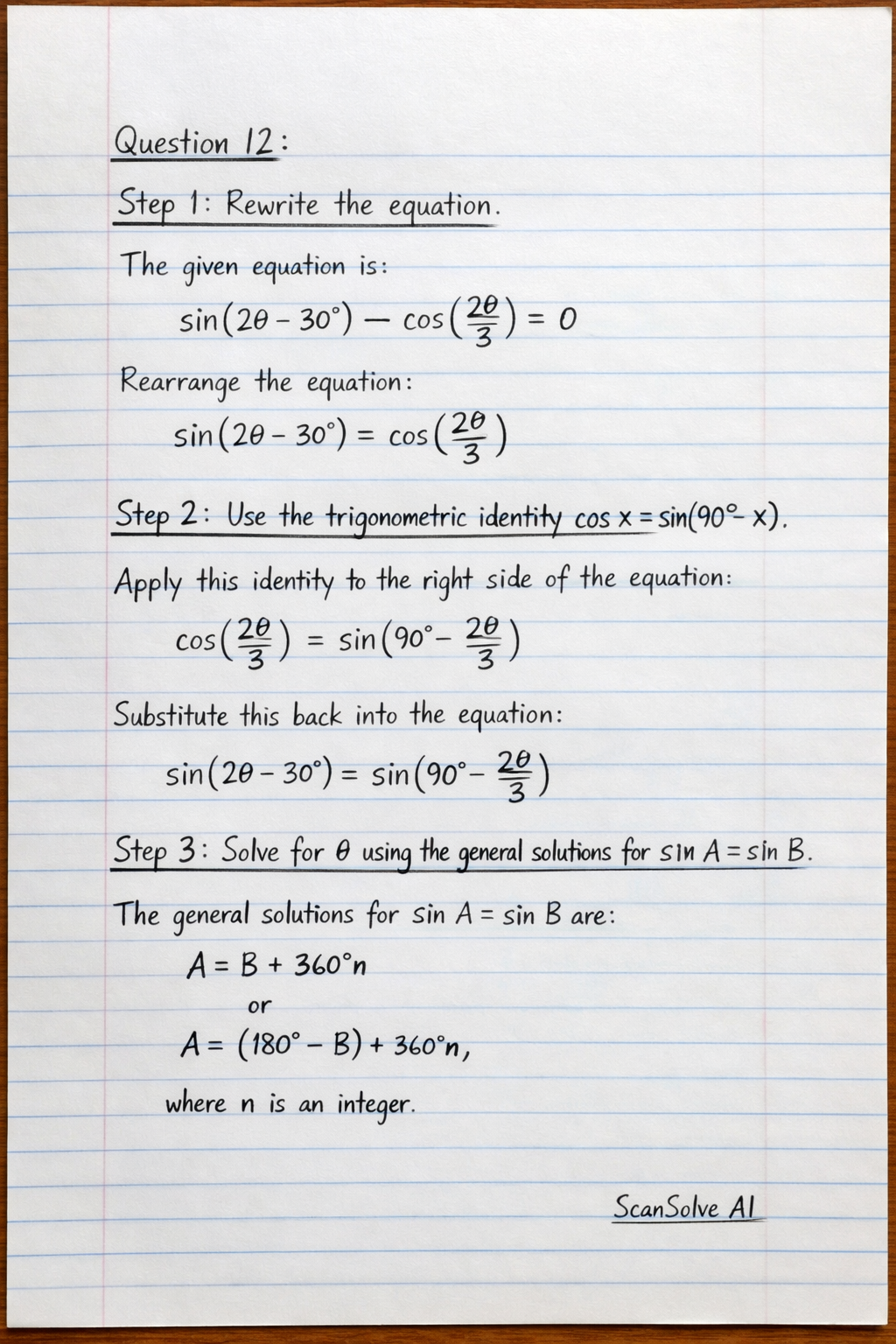
Handwritten Step-by-Step Solution
Get this as a handwritten image on WhatsApp — like a tutor wrote it for you.
Try on WhatsApp