
We read your photo as:
Two buildings are 66 m apart. From the top of the shorter building, the angle of depression to the foot of the taller building is 51 degrees, and the angle of elevation to the top of the taller buildi
ScanSolve AI Answer
Answer
Step-by-step solution
4 stepsDefine variables and set up the trigonometric relationships.
Let be the height of the first building, .
Let be the height of the taller building.
Let be the horizontal distance between the two buildings.
From the top of the first building, the angle of depression to the foot of the taller building is . This forms a right-angled triangle where the opposite side is and the adjacent side is .From the top of the first building, the angle of elevation to the top of the taller building is . This forms another right-angled triangle where the opposite side is and the adjacent side is .
Calculate the horizontal distance using the angle of depression.
Substitute into the first equation:
Solve for :
Calculate the additional height of the taller building using the angle of elevation.
Let . Substitute this into the second equation:
Solve for :
Substitute the value of from Step 2:
Calculate the total height of the taller building.
The total height of the taller building is the sum of the height of the first building and the additional height .
Rounding to one decimal place:
The height of the taller building is .
Try one yourself
A new problem that tests the same skill.
Still stuck on this one?
Ask a follow-up, and the answer starts from this question.
More Mathematics Questions
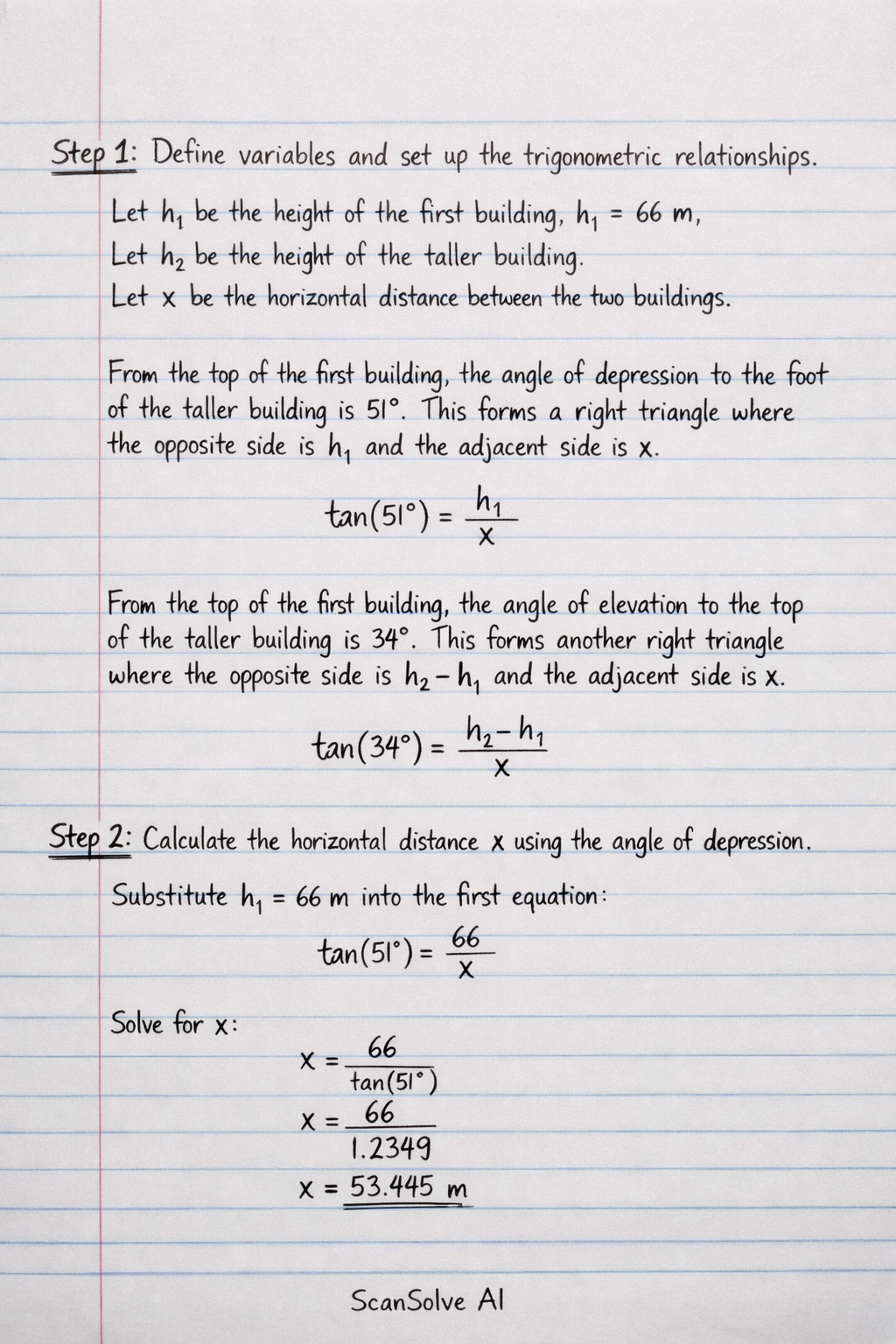
Handwritten Step-by-Step Solution
Get this as a handwritten image on WhatsApp — like a tutor wrote it for you.
Try on WhatsApp