
We read your photo as:
Find two numbers that multiply to the constant term (2) and add up to the coefficient of the middle term (3).
ScanSolve AI Answer
Step-by-step solution
10 stepsHere are the step-by-step solutions for the problems.
1. Factorize
Find two numbers that multiply to the constant term (2) and add up to the coefficient of the middle term (3).
The numbers are 1 and 2, because and .
Write the quadratic expression in factored form using these numbers.
The factored form is .
2. Solve the equation
Assuming the equation is , as is standard for "solve the equation" when given factors.
Set each factor equal to zero.
For a product of factors to be zero, at least one of the factors must be zero.
Solve each linear equation for x.
The solutions are .
3. Solve for x: Where
This question asks to "solve for x" but then provides a specific value for x. We will first solve the inequality for x in terms of y, and then verify if the given values satisfy the inequality.
Solve the inequality for x.
Divide both sides by 5:
Substitute the given values and into the original inequality to verify.
This statement is true.
The solution for x in terms of y is . The given values satisfy the inequality.4. Solve for a by dividing the equation by -5
Write down the inequality.
Divide every term in the inequality by -5.
Remember to reverse the inequality sign when dividing by a negative number.
Isolate the term with 'a' by adding 5 to both sides.
Multiply both sides by -1 to solve for 'a'.
Remember to reverse the inequality sign again.
The solution is .
Still stuck on this one?
Ask a follow-up, and the answer starts from this question.
More Mathematics Questions
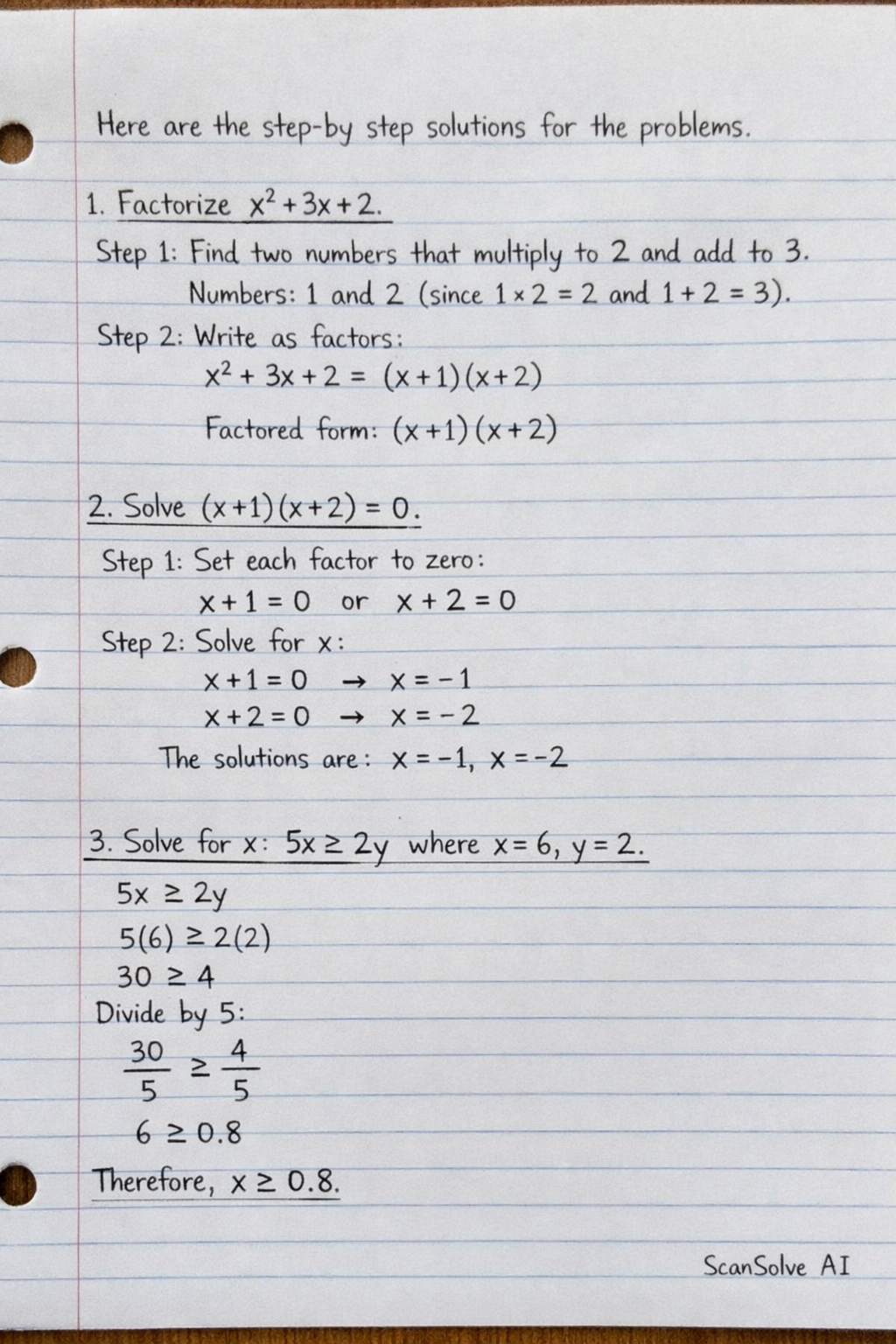
Handwritten Step-by-Step Solution
Get this as a handwritten image on WhatsApp — like a tutor wrote it for you.
Try on WhatsApp