
We read your photo as:
Two trains, 135 km/hr and 32.5 m/s, cross each other in 20 seconds when moving in opposite directions. How long do they take to cross if they move in the same direction?
ScanSolve AI Answer
Answer
Step-by-step solution
5 stepsConvert the speed of the first train from kilometers per hour to meters per second.
The speed of the first train is .
To convert km/hr to m/s, we multiply by .The speed of the second train is .
Comparing the speeds, is the faster train.Calculate the relative speed when the trains travel in opposite directions.
When two trains travel in opposite directions, their relative speed is the sum of their individual speeds.
Calculate the total length of the two trains.
When two trains cross each other, the total distance covered is the sum of their lengths ().
Given that they take 20 seconds to cross each other in opposite directions:Calculate the relative speed when the trains travel in the same direction.
When the faster train crosses the slower train from behind (traveling in the same direction), their relative speed is the difference between their speeds.
Calculate the time taken for the faster train to completely cross the other train in the same direction.
The distance to be covered for one train to completely cross the other is still the sum of their lengths, which is .
The time taken by the faster train to completely cross the other train from behind while traveling in the same direction is .
Try one yourself
A new problem that tests the same skill.
Still stuck on this one?
Ask a follow-up, and the answer starts from this question.
More Mathematics Questions
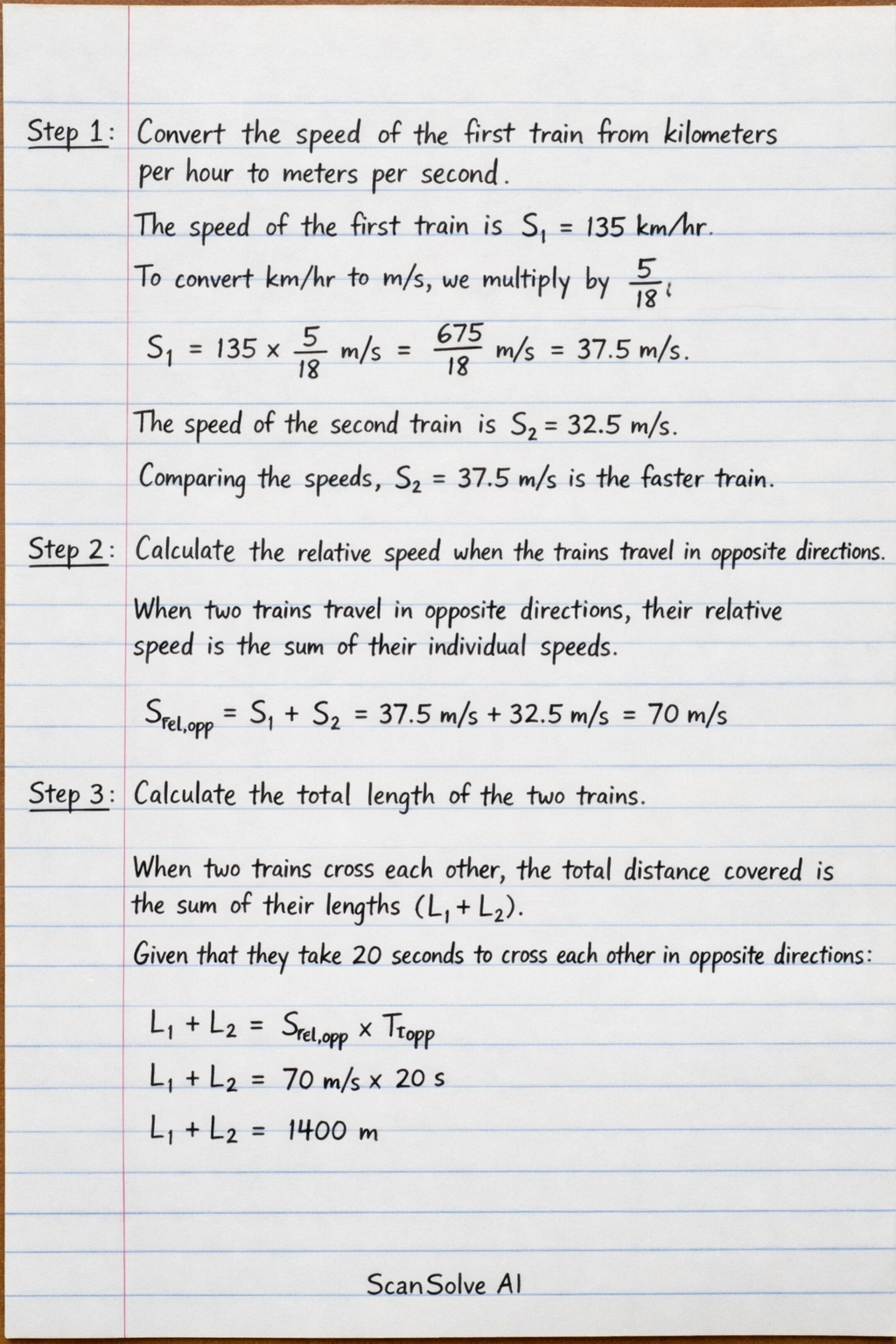
Handwritten Step-by-Step Solution
Get this as a handwritten image on WhatsApp — like a tutor wrote it for you.
Try on WhatsApp