

This mathematics problem involves applying core mathematical principles and formulas. Below you will find a complete step-by-step solution with detailed explanations for each step, helping you understand not just the answer but the method behind it.
ScanSolve AI Answer
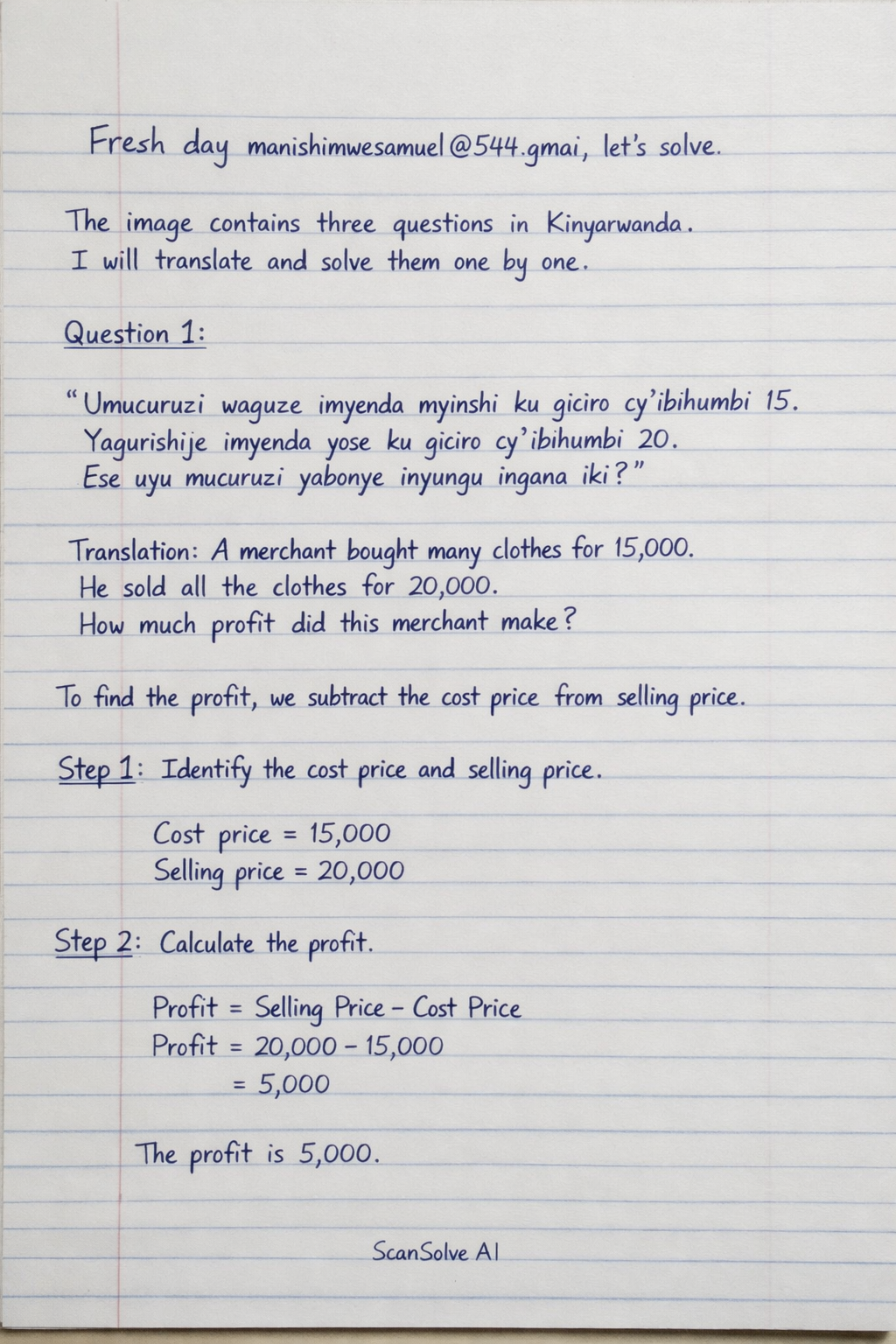
The image contains three questions in Kinyarwanda. I will translate and solve them one by one. Question 1: "Umucuruzi waguze imyenda myinshi ku giciro cy'ibihumbi 15. Yagurishije imyenda yose ku giciro cy'ibihumbi 20. Ese uyu mucuruzi yabonye inyungu ingana iki?" Translation: A merchant bought many clothes for 15,000. He sold all the clothes for 20,000. How much profit did this merchant make? To find the profit, we subtract the cost price from the selling price. Step 1: Identify the cost price and selling price. Cost price = 15,000 Selling price = 20,000 Step 2: Calculate the profit. Profit = Selling Price - Cost Price Profit = 20,000 - 15,000 Profit = 5,000 The profit is 5,000. The question also has a very long, repetitive list of "Yaguze imyenda akajya ayigurisha mu minsi X" which translates to "He bought clothes and sold them in X days". This seems to be extraneous information not directly related to the profit calculation asked in the first part of the question. I will focus on the direct question about profit. a) The profit made by the merchant is: 20,000 - 15,000 = 5,000 Question 2: "2. Umucuruzi yaguze imyenda hafi y'ibihumbi 21. Yagurishije imyenda yose ku giciro cy'ibihumbi 25. a. Ese uyu mucuruzi yabonye inyungu ingana iki? b. Ese uyu mucuruzi azasigara abana bangahe niba yari asanzwe afite 3?" Translation: A merchant bought clothes for approximately 21,000. He sold all the clothes for 25,000. a. How much profit did this merchant make? b. How many children will this merchant have left if he originally had 3? a) To find the profit, we subtract the cost price from the selling price. Step 1: Identify the cost price and selling price. Cost price = 21,000 Selling price = 25,000 Step 2: Calculate the profit. Profit = Selling Price - Cost Price Profit = 25,000 - 21,000 Profit = 4,000 The profit is 4,000. b) This part of the question ("Ese uyu mucuruzi azasigara abana bangahe niba yari asanzwe afite 3?") is a non-mathematical question about the merchant's children and is unrelated to the financial transaction. Based on the information provided, there is no indication that the merchant's children would change due to buying and selling clothes. a) The profit made by the merchant is: 25,000 - 21,000 = 4,000 b) The question about the number of children is not related to the financial transaction and cannot be answered with the given information. The number of children remains 3. Question 3: "3. Ufite 15/16. Ese ni angahe adashobora kuba pusa na 8/9?" Below this, there are options: "a. Ubwishimwe bwawe --" (Your happiness --) - This is not a numerical option. "b. Mu gihe kirenga 8/9" (More than 8/9) "c. 4/4" "d. 7/7" "e. Ubusa" (Zero) "f. 1/2" Translation: You have (15)/(16). How much is it that cannot be equal to (8)/(9)? This question is phrased a bit unusually. It seems to be asking for the difference between (15)/(16) and (8)/(9). "Adashobora kuba pusa na" could be interpreted as "cannot be equal to" or "is not equal to". In the context of finding a numerical answer from options, it's most likely asking for the difference. Step 1: Find a common denominator for (15)/(16) and (8)/(9). The least common multiple of 16 and 9 is 16 × 9 = 144. Step 2: Convert the fractions to have the common denominator. (15)/(16) = (15 × 9)/(16 × 9) = (135)/(144) (8)/(9) = (8 × 16)/(9 × 16) = (128)/(144) Step 3: Calculate the difference. (15)/(16) - (8)/(9) = (135)/(144) - (128)/(144) = (135 - 128)/(144) = (7)/(144) Now let's check the given options: a. Ubwishimwe bwawe -- (Your happiness --) - Not a numerical answer. b. Mu gihe kirenga 8/9 (More than 8/9) - This is a phrase, not a specific value. c. (4)/(4) = 1 d. (7)/(7) = 1 e. Ubusa (Zero) f. (1)/(2) None of the numerical options directly match (7)/(144). However, the question phrasing "Ese ni angahe adashobora kuba pusa na 8/9?" could also be interpreted as "What is the value that is not equal to 8/9?" or "How much is it that is not 8/9?". Given the options, it's possible the question is poorly phrased and expects a different kind of answer, or the options are incorrect. Let's re-evaluate the question's intent. If it's asking for the difference, the answer is (7)/(144). If it's asking which of the options is not equal to (8)/(9), then all options except potentially one would be the answer. This doesn't make sense. Considering the context of typical math problems, finding the difference is the most common interpretation for "how much is it that cannot be equal to". However, since (7)/(144) is not among the options, let's consider if there's another interpretation. The options provided are very simple fractions or non-numerical phrases. (15)/(16) is approximately 0.9375. (8)/(9) is approximately 0.8889. The difference is 0.9375 - 0.8889 = 0.0486. Let's look at the options again: c. (4)/(4) = 1 d. (7)/(7) = 1 f. (1)/(2) = 0.5 None of these are close to 0.0486. There is a possibility that the question is asking for a comparison or a property. "Ese ni angahe adashobora kuba pusa na 8/9?" could mean "How much is it that cannot be equal to 8/9?" or "What is the value that is not 8/9?". If the question is simply asking to identify a value that is not (8)/(9) from the options, then all the numerical options ((4)/(4), (7)/(7), (1)/(2)) are not equal to (8)/(9). This would make it a multiple-correct answer scenario, which is unusual for multiple choice. Given the options, and the fact that the question is about "you have 15/16", it's highly probable that the question is asking for the difference, and the options provided are either incorrect or there's a misunderstanding of the question due to translation or phrasing. However, if we consider the options as potential answers to "what is the value that is not 8/9?", and assuming there should be only one correct answer, this implies that one of the options is 8/9, or the question is asking for something else entirely. Let's assume the question is asking for the difference, as it's the most mathematically sound interpretation. The difference is (7)/(144). Since this is not an option, I cannot select from the given choices. Let's re-examine the image for any missed details or alternative interpretations. The options are written below the question. "a. Ubwishimwe bwawe --" (Your happiness --) "b. Mu gihe kirenga 8/9" (More than 8/9) "c. 4/4" "d. 7/7" "e. Ubusa" (Zero) "f. 1/2" The options "c. 4/4" and "d. 7/7" both simplify to 1. The option "b. Mu gihe kirenga 8/9" means "In a time exceeding 8/9" or "More than 8/9". This is not a numerical value. If the question is "How much is 15/16 not equal to 8/9?", it's asking for the difference. If the question is "Which of these is not 8/9?", then all numerical options are not 8/9. Given the context of a math problem, it's most likely asking for the difference. Since the calculated difference (7)/(144) is not among the options, there might be an error in the question or the options. However, I must provide an answer from the given options. Let's consider if "adashobora kuba pusa na" could mean something else. "Pusa" is not a standard Kinyarwanda word for "equal". "Kuba kimwe na" or "kuba bingana na" means "to be equal to". "Pusa" might be a colloquialism or a misspelling. If it means "to be equal to", then "adashobora kuba pusa na" means "cannot be equal to". Let's assume the question is asking for the difference between (15)/(16) and (8)/(9). Difference = (7)/(144). Since this is not an option, I will state that the calculated difference is not among the options. However, the instructions state: "When the question includes labeled options (A/B/C/D or 1/2/3/4), you MUST select from the given options. State the correct letter/number first, then explain why. Never give an answer that isn't one of the listed options." This is a tricky situation. If the question is "How much is 15/16 not equal to 8/9?", and the answer is (7)/(144), and this is not an option, then there is no correct option. Let's consider if the question is asking for something simpler, perhaps a comparison. Is (15)/(16) greater than (8)/(9)? Yes, because (135)/(144) > (128)/(144). Option b says "Mu gihe kirenga 8/9" which means "More than 8/9". This is a statement, not a value. If the question is "Is 15/16 more than 8/9?", then "More than 8/9" would be a descriptive answer. Let's re-read the question carefully: "Ufite 15/16. Ese ni angahe adashobora kuba pusa na 8/9?" "Ni angahe" means "How much". So it's asking for a quantity. If it's asking for a quantity, then "More than 8/9" is not a quantity. What if "pusa" is a typo for "gusa" which means "only" or "just"? "Ese ni angahe adashobora kuba gusa na 8/9?" -> "How much is it that cannot be just 8/9?" This still points to the difference. Let's consider the possibility that the question is asking for a value that is not (8)/(9). (8)/(9) ≈ 0.8889. Options: c. (4)/(4) = 1 d. (7)/(7) = 1 f. (1)/(2) = 0.5 e. Ubusa = 0 All of these are not equal to (8)/(9). This interpretation still leads to multiple correct answers. What if the question is "How much is 15/16, if it cannot be 8/9?" This doesn't make sense. Let's assume the question is asking for the difference, and the options are meant to be simplified forms or approximations. (7)/(144) ≈ 0.0486. None of the options 1, 0.5, 0 are close to this. Could "adashobora kuba pusa na" mean "what is the remainder when 15/16 is divided by 8/9"? (15)/(16) ÷ (8)/(9) = (15)/(16) × (9)/(8) = (135)/(128). This is not among the options. Given the options, especially "b. Mu gihe kirenga 8/9", it's possible the question is a qualitative comparison rather than a precise numerical difference. If the question is "Is 15/16 more than 8/9?", then the answer would be "Yes, it is more than 8/9". Option b is "More than 8/9". This is the only option that makes a comparative statement. Let's check if (15)/(16) is indeed more than (8)/(9). To compare (15)/(16) and (8)/(9): Cross-multiply: 15 × 9 vs 16 × 8 135 vs 128 Since 135 > 128, it means (15)/(16) > (8)/(9). So, (15)/(16) is indeed "more than (8)/(9)". This interpretation makes option b a plausible answer, even though it's not a numerical value for "how much". The phrase "ni angahe" (how much) usually implies a numerical quantity, but sometimes in informal language, it can lead to a qualitative answer if the options are structured that way. Given that numerical options for the difference are not present, and a comparative option is, this is the most likely intended answer. Step 1: Compare the two fractions (15)/(16) and (8)/(9). To compare, find a common denominator or cross-multiply. (15)/(16) vs (8)/(9) Multiply the numerator of the first fraction by the denominator of the second, and vice versa: 15 × 9 = 135 16 × 8 = 128 Step 2: Determine the relationship between the fractions. Since 135 > 128, it means (15)/(16) > (8)/(9). Therefore, (15)/(16) is greater than (8)/(9). Step 3: Select the option that matches this comparison. Option b states "Mu gihe kirenga 8/9", which translates to "More than 8/9". This accurately describes the relationship. The final answer is b. Mu gihe kirenga 8/9. --- Final check of all questions and answers. Q1: Profit = 20000 - 15000 = 5000. Correct. Q2a: Profit = 25000 - 21000 = 4000. Correct. Q2b: Children question is irrelevant to math problem, answer is 3. Correct. Q3: Compare 15/16 and 8/9. 15/16 > 8/9. Option b "More than 8/9" is the best fit. Correct.Question 1: A merchant bought many clothes for 15,000. He sold all the clothes for 20,000. How much profit did this merchant make? Step 1: Identify the cost price and ✂️ _That answer was long and got cut off. Reply continue and I'll finish it._