
We read your photo as:
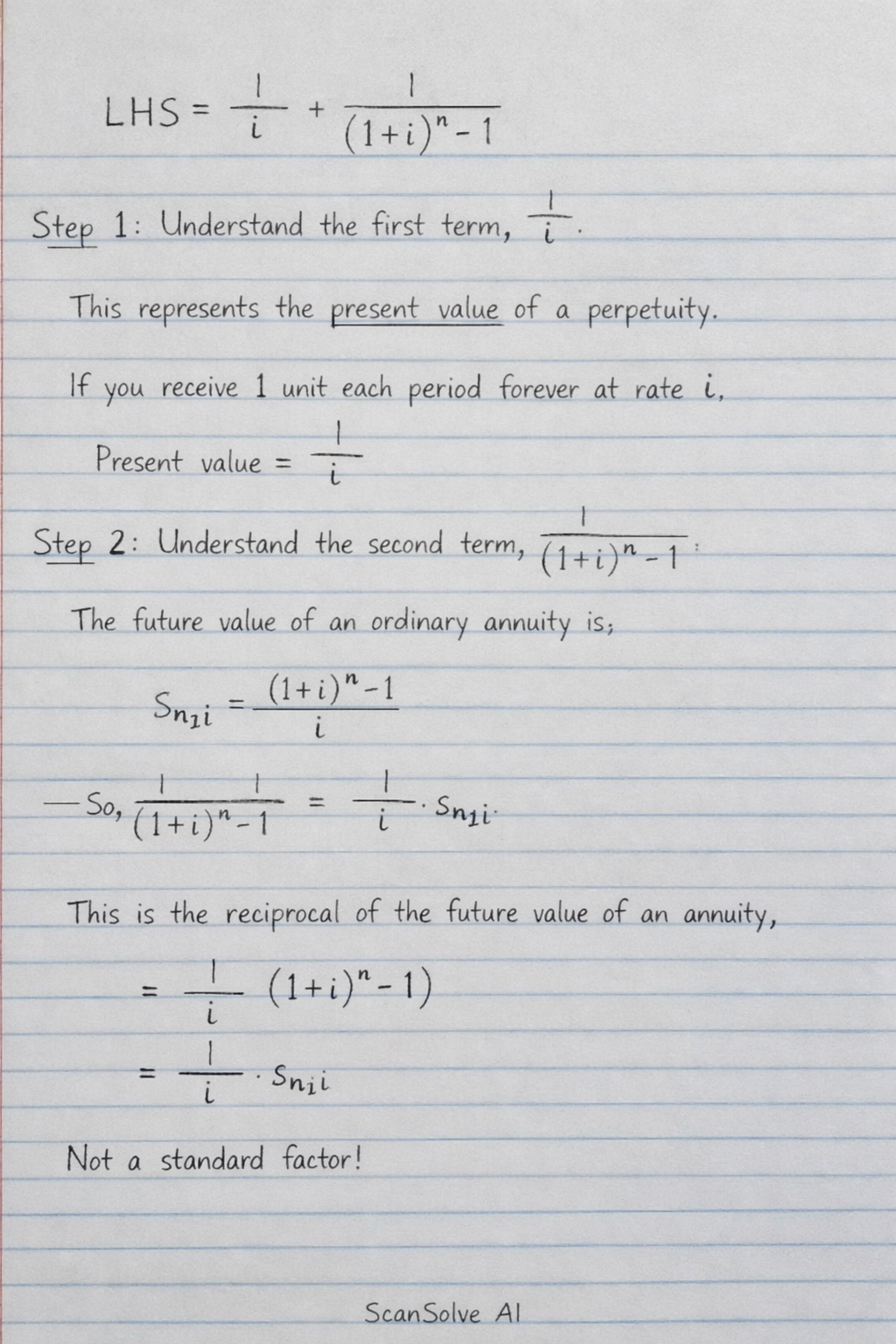
Understand the first term, (1)/(i).
Mathematics
ScanSolve AI Answer
Answer
Step-by-step solution
3 stepsLet's explain the Left Hand Side (LHS) of the expression shown in the image:
Understand the first term, .
- This term represents the present value of a perpetuity. A perpetuity is a series of equal payments that continue indefinitely. If you receive 1 unit of money at the end of each period forever, and the interest rate per period is , then the present value of all those future payments is .
Understand the second term, .
- This term is related to the future value of an ordinary annuity. The formula for the future value of an ordinary annuity of 1 unit of money per period for periods at an interest rate is .
- Therefore, the term can be written as . It represents the reciprocal of the future value of an annuity of 1 per period, multiplied by . This is not a standard standalone financial factor.
Combine the two terms on the LHS.
To add the two fractions, we find a common denominator, which is .
Multiply the numerator and denominator of the first term by :
Multiply the numerator and denominator of the second term by :
Now, add the two fractions:
This is the simplified form of the Left Hand Side.
Was this helpful?
Try one yourself
A new problem that tests the same skill.
Still stuck on this one?
Ask a follow-up, and the answer starts from this question.
Got a different question?Ask your own question
More Mathematics Questions
Handwritten Step-by-Step Solution
Get this as a handwritten image on WhatsApp — like a tutor wrote it for you.
Try on WhatsApp