

This mathematics problem involves applying core mathematical principles and formulas. Below you will find a complete step-by-step solution with detailed explanations for each step, helping you understand not just the answer but the method behind it.
ScanSolve AI Answer
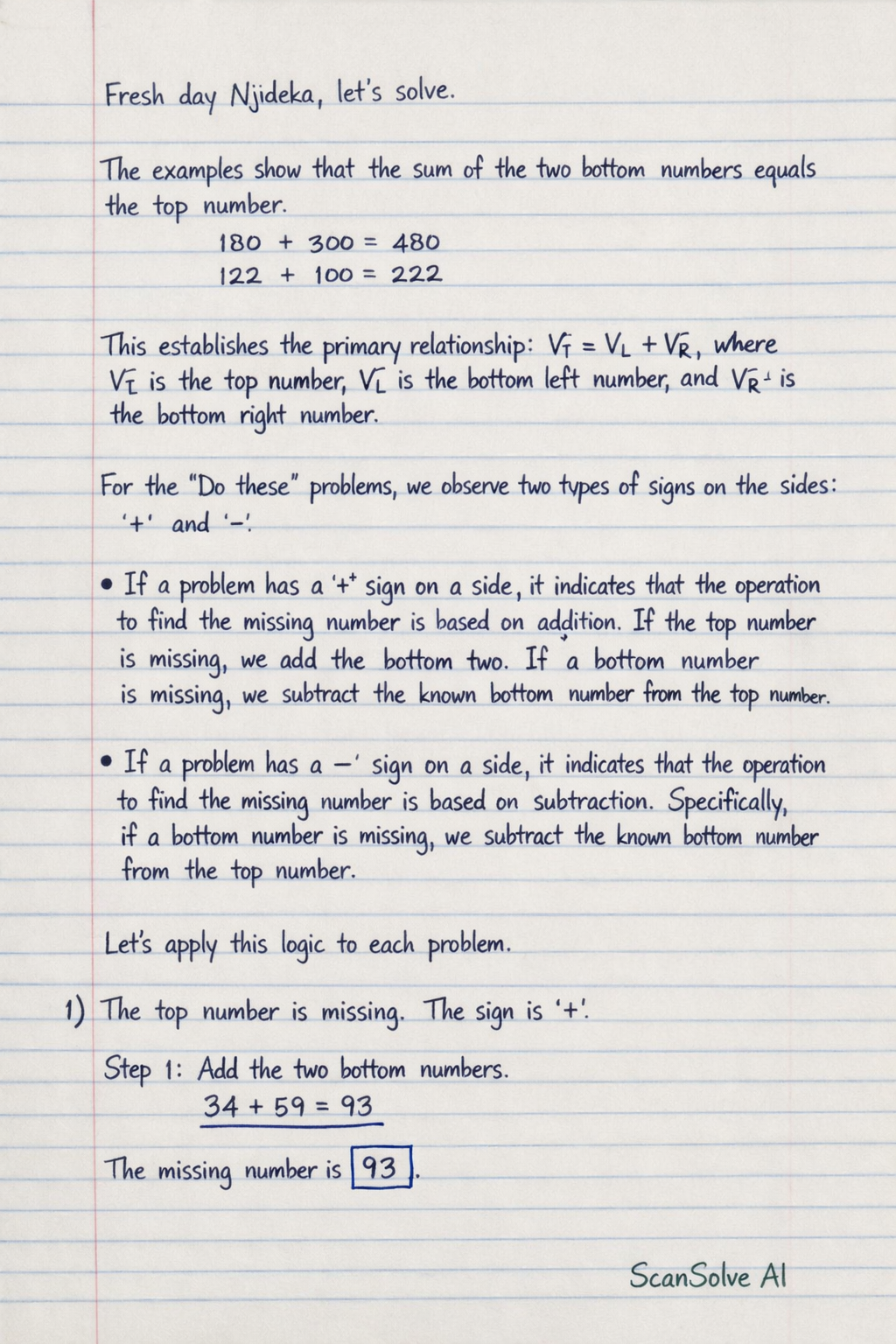
The examples show that the sum of the two bottom numbers equals the top number. 180 + 300 = 480 122 + 100 = 222 This establishes the primary relationship: V_T = V_L + V_R, where V_T is the top number, V_L is the bottom left number, and V_R is the bottom right number. For the "Do these" problems, we observe two types of signs on the sides: '+' and '-'. • If a problem has a '+' sign on a side, it indicates that the operation to find the missing number is based on addition. If the top number is missing, we add the bottom two. If a bottom number is missing, we subtract the known bottom number from the top number. • If a problem has a '-' sign on a side, it indicates that the operation to find the missing number is based on subtraction. Specifically, if a bottom number is missing, we subtract the known bottom number from the top number. Let's apply this logic to each problem. 1) The top number is missing. The sign is '+'. Step 1: Add the two bottom numbers. 34 + 59 = 93 The missing number is 93. 2) The top number is missing. The sign is '+'. Step 1: Add the two bottom numbers. 640 + 460 = 1100 The missing number is 1100. 3) The bottom right number is missing. The sign is '-'. Step 1: Subtract the bottom left number from the top number. 92 - 24 = 68 The missing number is 68. 4) All numbers are given: Top = 91, Bottom left = 91, Bottom right = 2. The sign is '-'. This problem appears to be an example of a subtraction relationship, similar to the addition examples. However, it does not fit the pattern V_T - V_L = V_R (91 - 91 = 0 ≠ 2) or V_T - V_R = V_L (91 - 2 = 89 ≠ 91). Given that all other problems require finding a missing number, and this one has all numbers filled, it's likely an illustrative example that might contain a slight inconsistency or represent a different type of relationship not explicitly defined. Since there is no missing number to solve for, we will proceed to the next problem. 5) The top number is missing. The sign is '+'. Step 1: Add the two bottom numbers. 34 + 59 = 93 The missing number is 93. 6) The bottom right number is missing. The sign is '-'. Step 1: Subtract the bottom left number from the top number. 220 - 50 = 170 The missing number is 170. 7) The top number is missing. The sign is '+'. Step 1: Add the two bottom numbers. 60 + 70 = 130 The missing number is 130. 8) The top number is missing. The sign is '+'. Step 1: Add the two bottom numbers. 83 + 77 = 160 The missing number is 160. 9) The bottom left number is missing. The sign is '-'. Step 1: Subtract the bottom right number from the top number. 200 - 55 = 145 The missing number is 145. 10) The top number is missing. The sign is '+'. Step 1: Add the two bottom numbers. 40 + 75 = 115 The missing number is 115. Send me the next one 📸