
We read your photo as:
Use the conversion factor pi radians180^ to convert degrees to radians.
ScanSolve AI Answer
Answers
3 partsStep-by-step solution
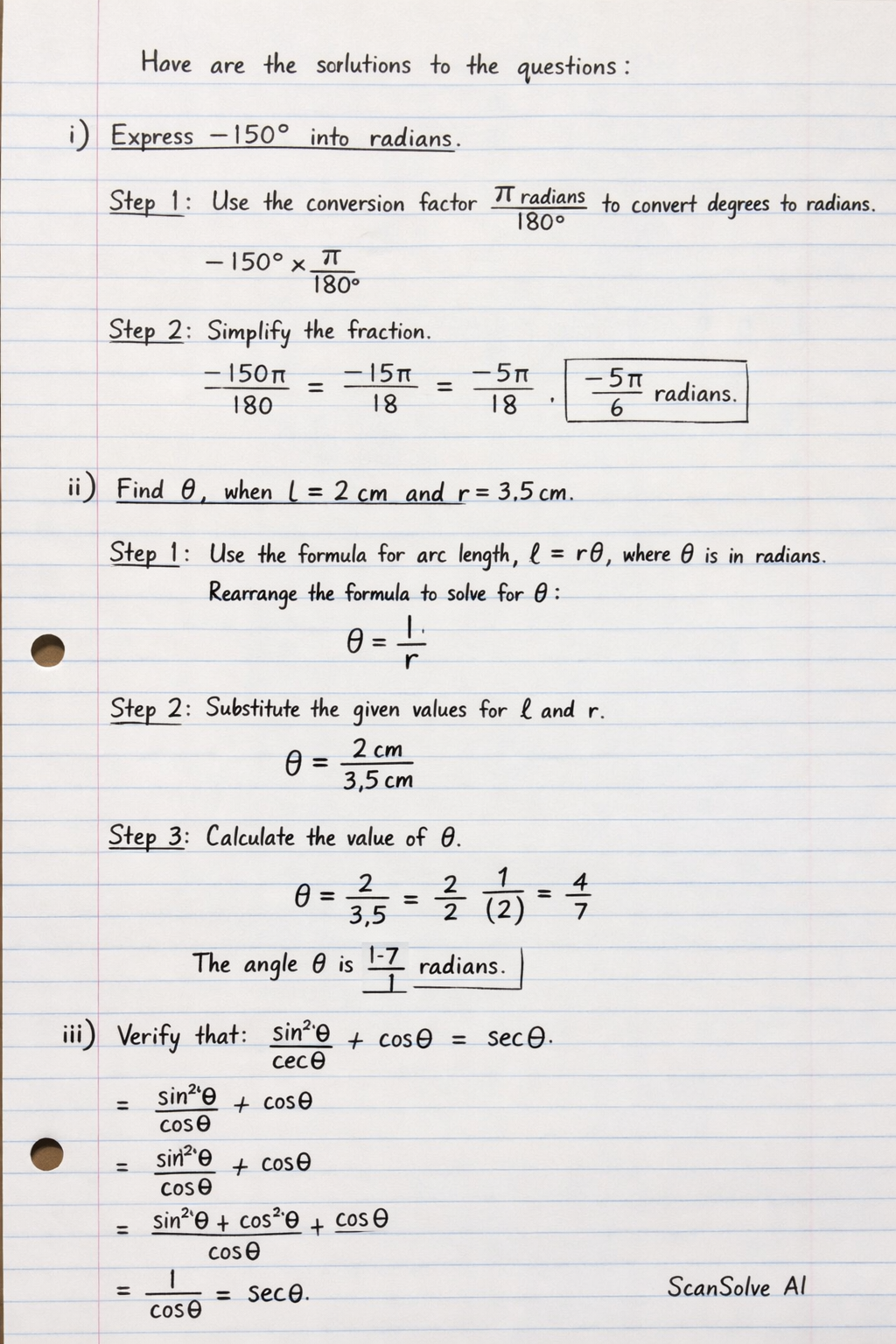
10 stepsHere are the solutions to the questions:
Part i· 2 steps
Express into radians.
Use the conversion factor to convert degrees to radians.
Simplify the fraction.
The angle in radians is .
Part ii
Find , when and .
Use the formula for arc length, , where is in radians.
Rearrange the formula to solve for :
Substitute the given values for and .
Calculate the value of .
The angle is .
Part iii:
:
Verify that: .
Start with the left-hand side (LHS) of the equation.
Find a common denominator for the terms, which is .
Combine the terms over the common denominator.
Apply the Pythagorean identity .
Recognize that is equal to .
This matches the right-hand side (RHS) of the equation.
Therefore, the identity is verified.
Try one yourself
A new problem that tests the same skill.
Still stuck on this one?
Ask a follow-up, and the answer starts from this question.
More Mathematics Questions
Handwritten Step-by-Step Solution
Get this as a handwritten image on WhatsApp — like a tutor wrote it for you.
Try on WhatsApp