
We read your photo as:
Use the distributive property to solve the following multiplication problems: 12 imes 13, 10 imes 21, and 22 imes 14.
ScanSolve AI Answer
Step-by-step solution
5 stepsThe method shown in the example involves breaking down each number into its tens and ones components and then using the distributive property (also known as the FOIL method or partial products).
For :
So, .
This expands to .
Calculating each part: .
Adding these partial products: .
We will apply this method to the given problems.
Solve .
We break down the numbers: and .
The product is .
Solve .
We break down the numbers: and .
The product is .
Solve .
We break down the numbers: and .
The product is .
Solve .
We break down the numbers: and .
The product is .
Solve .
We break down the numbers: and .
The product is .
Still stuck on this one?
Ask a follow-up, and the answer starts from this question.
More Mathematics Questions
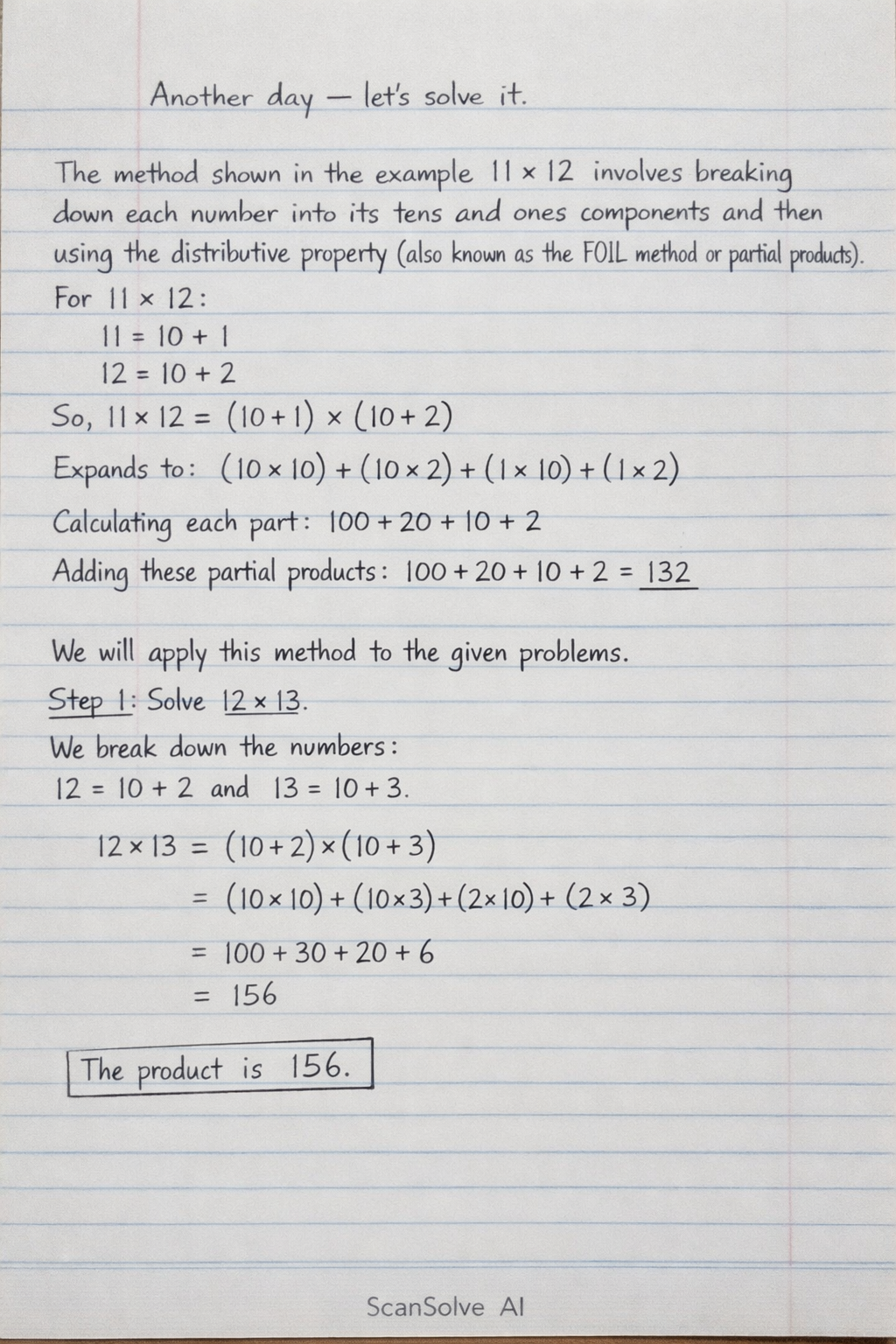
Handwritten Step-by-Step Solution
Get this as a handwritten image on WhatsApp — like a tutor wrote it for you.
Try on WhatsApp