
We read your photo as:
Using the Principle of Inclusion-Exclusion, calculate the number of elements in the union of three sets A, B, and C, given n(A)=25, n(B)=30, n(C)=20, n(A intersect B)=10, n(B intersect C)=8, n(A inter
Mathematics
ScanSolve AI Answer
Step-by-step solution
2 steps- D. 60
Apply the Principle of Inclusion-Exclusion for three sets.
The formula for the union of three sets , , and is:
Substitute the given values into the formula.
Given: , , , $n(A \cap B
Was this helpful?
Still stuck on this one?
Ask a follow-up, and the answer starts from this question.
Got a different question?Ask your own question
More Mathematics Questions
QGiven the sets A = multiples of 3 less than 12, B = integers between 4 and 8, and C = 4, 5, 7, find…QGiven sets A = 3, 4, 5, 6 and B = 3, 5, 7, 9, 11, find the union and intersection of A and B.QTo find the union of sets A and B, and the intersection of sets B and C, using the given sets.QGiven U=x|x is an integer and 0 < x <= 20, A=5,7,9,11,13,17,19, B=2,4,8,10,12,18,20, C=3,9,12,15,18…QIf the number of common elements between A × B and B × A is 25, what is the number of common…
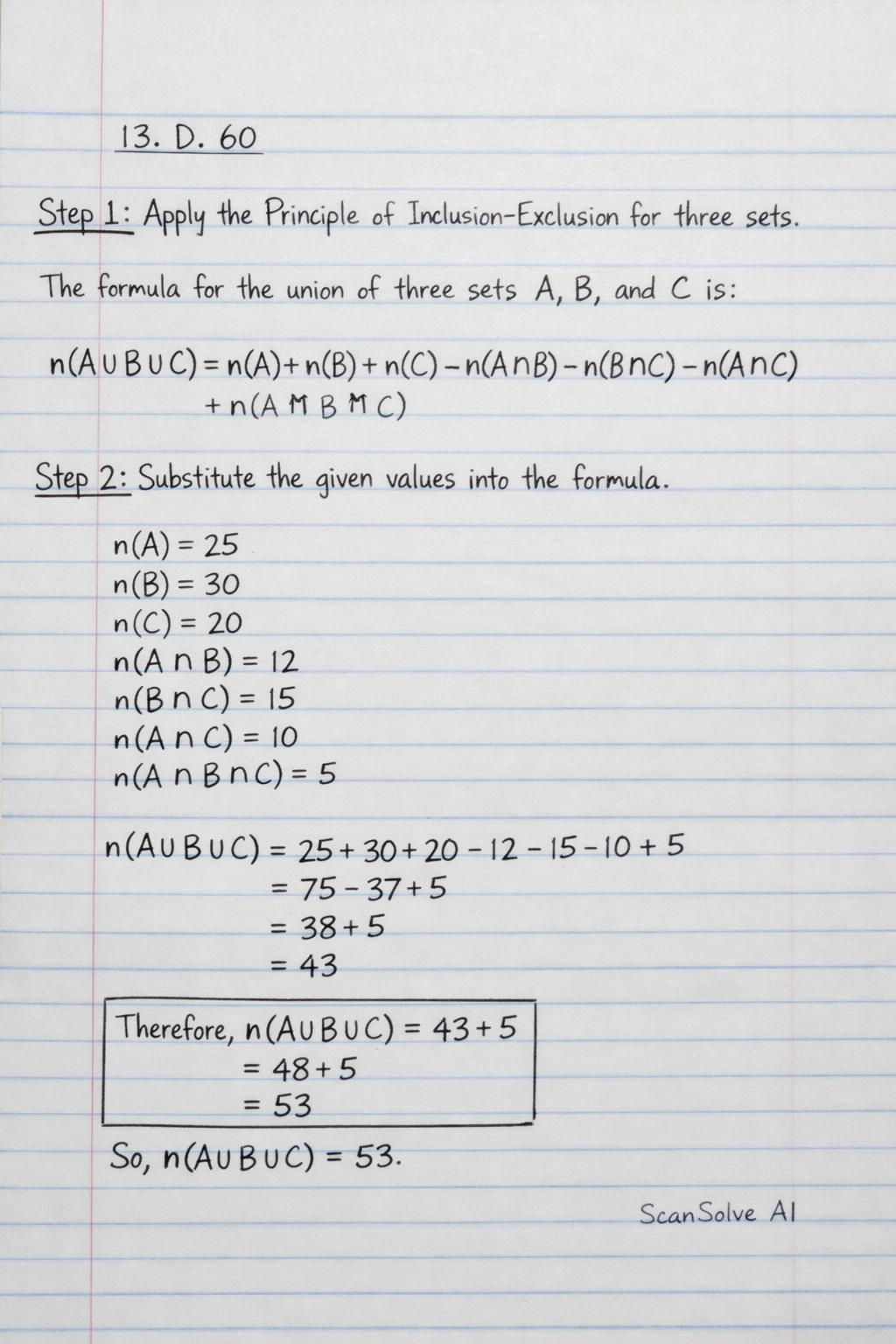
Handwritten Step-by-Step Solution
Get this as a handwritten image on WhatsApp — like a tutor wrote it for you.
Try on WhatsApp