
We read your photo as:
Determine the value of a, b and c in the following flow diagram and complete the table below: P = 5Q + 2
ScanSolve AI Answer
Step-by-step solution
13 stepsQuestion 5.1:
The given pattern is
Find the common difference between consecutive terms.
The common difference is 3.5.1.1) Write down the next term of the pattern.
Add the common difference to the last given term.
Next term .
The next term is .5.1.2) What rule did you use to find the next term of the pattern?
State the rule.
The rule used is to add 3 to the previous term.
5.1.3) Find term 10 of the pattern.
Use the arithmetic sequence formula .
Here, (first term), (common difference), and .
Term 10 is .
Question 5.2:
Study the Geometric pattern below.
Pattern 1: 1 triangle, 3 matches
Pattern 2: 2 triangles, 5 matches
Pattern 3: 3 triangles, 7 matches5.2.1) Draw pattern 4.
Determine the number of matches for Pattern 4.
The number of matches increases by 2 for each new pattern (, ).
So, Pattern 4 will have matches.
Pattern 4 consists of 4 triangles arranged in a row, sharing one side between adjacent triangles, using 9 matches.5.2.2) Describe the rule of the pattern in your own words.
State the rule.
The rule is to add 2 matches to the previous pattern to form the next pattern.
Question 6.1:
Determine the value of a, b and c in the following flow diagram.
Input OutputCalculate 'a'.
For 'a', the input is 12.
The value of a is .
Calculate 'b'.
For 'b', the output is 21.
The value of b is .
Calculate 'c'.
For 'c', the input is -3.
The value of c is .
Question 6.2:
Use the following formula to complete the table below:Calculate P when .
Calculate P when .
Calculate Q when .
Calculate P when .
The completed table is:
Input (Q) | 1 | 2 | 3 | 7 | | 10
Output (P)| 7 | 12 | 17 | 37 | | 52
The values to complete the table are .
Still stuck on this one?
Ask a follow-up, and the answer starts from this question.
More Mathematics Questions
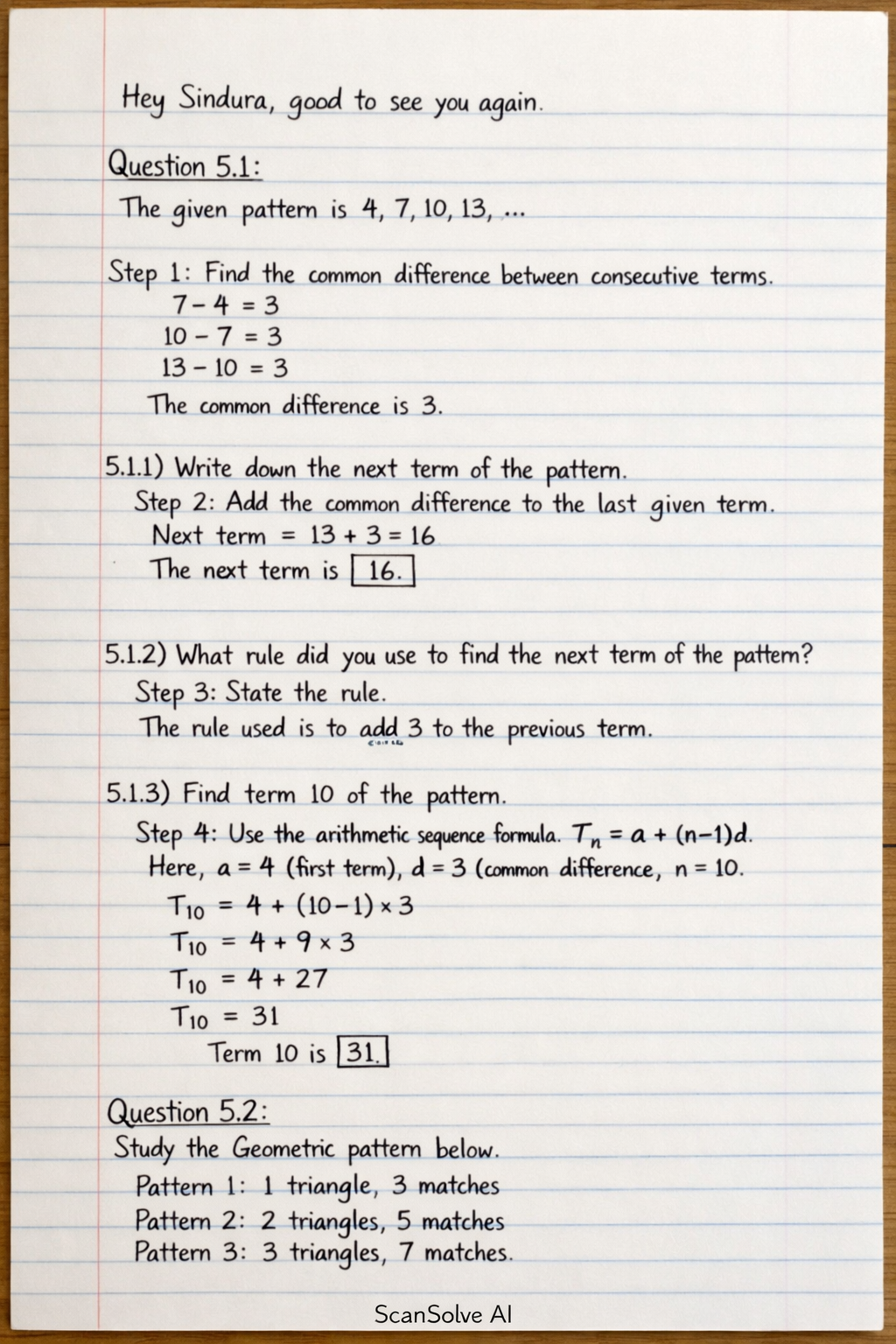
Handwritten Step-by-Step Solution
Get this as a handwritten image on WhatsApp — like a tutor wrote it for you.
Try on WhatsApp