

This mathematics problem involves applying core mathematical principles and formulas. Below you will find a complete step-by-step solution with detailed explanations for each step, helping you understand not just the answer but the method behind it.
ScanSolve AI Answer
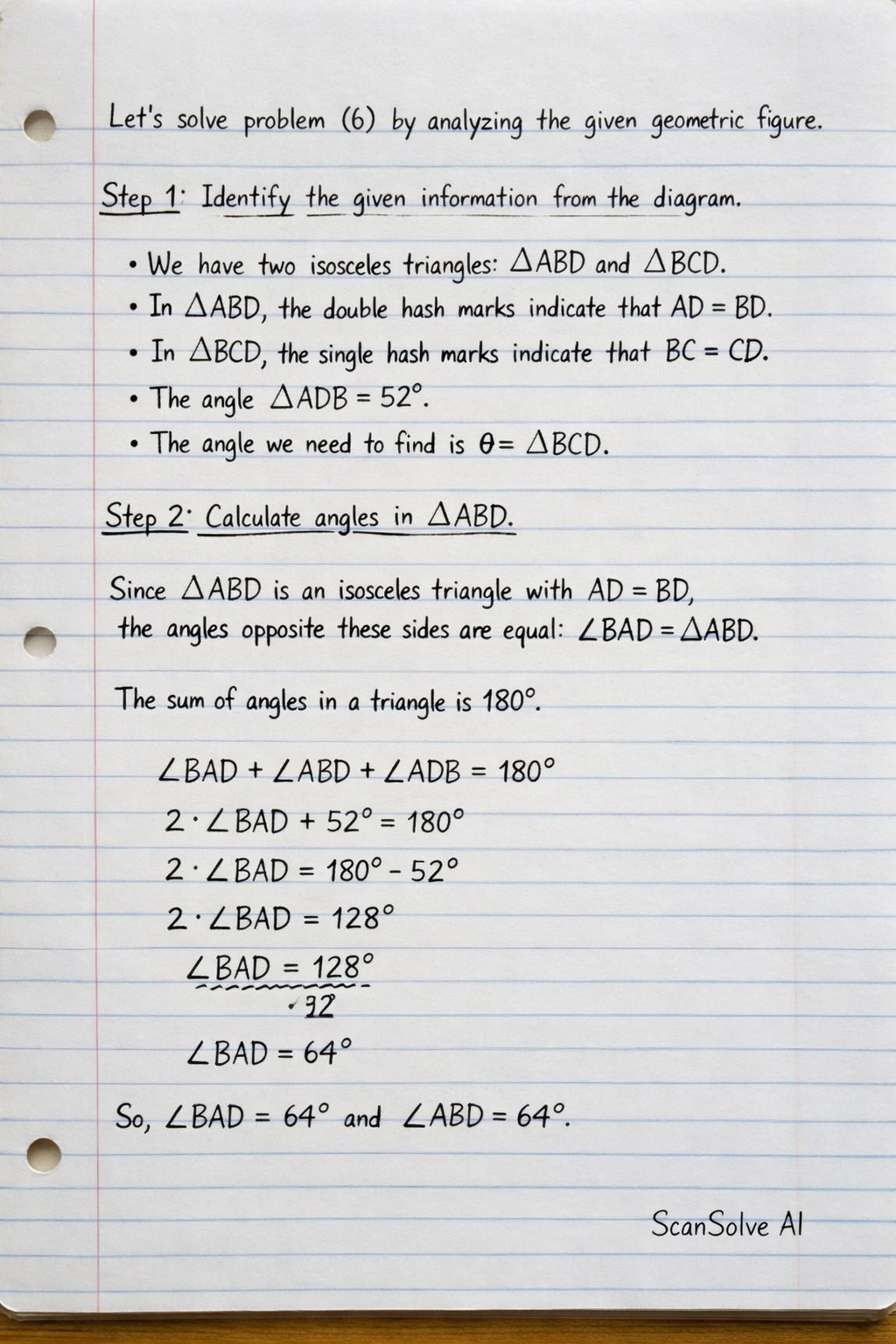
Let's solve problem (6) by analyzing the given geometric figure. Step 1: Identify the given information from the diagram. • We have two isosceles triangles: ABD and BCD. • In ABD, the double hash marks indicate that AD = BD. • In BCD, the single hash marks indicate that BC = CD. • The angle ADB = 52^. • The angle we need to find is = BCD. Step 2: Calculate angles in ABD. Since ABD is an isosceles triangle with AD = BD, the angles opposite these sides are equal: BAD = ABD. The sum of angles in a triangle is 180^. BAD + ABD + ADB = 180^ 2 · BAD + 52^ = 180^ 2 · BAD = 180^ - 52^ 2 · BAD = 128^ BAD = (128^)/(2) BAD = 64^ So, BAD = 64^ and ABD = 64^. Step 3: Express angles in BCD in terms of . Since BCD is an isosceles triangle with BC = CD, the angles opposite these sides are equal: CBD = CDB. Let CBD = CDB = x. The sum of angles in BCD is 180^. BCD + CBD + CDB = 180^ + x + x = 180^ + 2x = 180^ (*) Step 4: Consider the larger triangle ACD. The angles of ACD are: • CAD = BAD = 64^ (from Step 2). • ACD = (given). • ADC = ADB + CDB = 52^ + x (where x = CDB from Step 3). The sum of angles in ACD is 180^. CAD + ACD + ADC = 180^ 64^ + + (52^ + x) = 180^ 116^ + + x = 180^ + x = 180^ - 116^ + x = 64^ (**) Step 5: Solve the system of equations for . We have two equations: 1. + 2x = 180^ (from *) 2. + x = 64^ (from **) Subtract equation (2) from equation (1): ( + 2x) - ( + x) = 180^ - 64^ x = 116^ Now substitute the value of x into equation (2): + 116^ = 64^ = 64^ - 116^ = -52^ The result = -52^ is not possible for an interior angle of a triangle. This indicates that the geometric configuration as depicted and interpreted with standard Euclidean geometry rules is impossible. There might be an error in the problem statement (e.g., incorrect angle value, incorrect side markings, or a non-Euclidean context). Assuming the problem expects a positive angle, this specific setup leads to a contradiction. Given the constraints of a typical geometry problem, it's highly probable that there's a mislabeling in the diagram. If we assume the angle 52^ was intended to be BDC instead of ADB, then: If BDC = 52^: In BCD, BC=CD CBD = CDB = 52^. Then = BCD = 180^ - 52^ - 52^ = 180^ - 104^ = 76^. However, the angle is clearly marked as ADB. Based on the diagram as presented, the calculation leads to an impossible angle. If this is a multiple-choice question, none of the options would be correct. If it's a free-response question, the answer would be that the figure is impossible as labeled. Since I must provide a numerical answer, and the direct interpretation leads to an impossible result, I cannot provide a valid positive angle for under standard geometric rules. There might be an error in the problem itself. Drop the next question.